MeRT vs. TMS: Key Differences, Costs, and What the Evidence Shows

Key takeaways
- Transcranial magnetic stimulation (TMS) uses magnetic pulses to help regulate and rewire brain activity. It’s an effective treatment for a variety of conditions, including major depressive disorder (MDD), anxious depression, and obsessive compulsive disorder (OCD).
- MeRT is a protocol where someone gets a qEEG and ECG ( before undergoing TMS. The qEEG and ECG test results are intended to customize the treatment to the patient’s brainwaves and heart-brain coherence. It’s FDA-cleared for the treatment of PTSD.
- If deciding between MeRT vs TMS, keep in mind that they’re FDA-cleared for different purposes. Additionally, TMS has a larger body of evidence behind it, while MeRT is an emerging protocol.
When it comes to MeRT vs TMS, there are a few important details to be aware of. First, positioning the two as different treatments is a little misleading since MeRT uses TMS. It’s more like an add-on that might help optimize treatment.
Still, MeRT does come with a different price tag, FDA regulatory status, and evidence base than TMS. If you’re considering these two treatments, it’s important to understand the distinction between MeRT and other TMS protocols.
This guide offers a full breakdown on the technologies used for the two treatments, the difference in cost, how insurance views them both, and what type of clinical evidence supports each. We’ll also outline next steps if you’re interested in one or both treatments.
Healing happens through strong relationships
Compassionate, experienced mental health professionals focused on evidence-based care

.jpg)

What are TMS and MeRT?
“With standard TMS, we're using a pulsed magnetic field to stimulate a targeted area of the brain,” says Steve Harvey, MD, board-certified psychiatrist and Midwest Regional Medical Director at Radial. The pulses from the TMS machine can help rewire and regulate the brain’s activity.
There are various types of TMS, and MeRT is an emerging TMS protocol. MeRT stands for Magnetic e-Resonance Therapy. “MeRT is basically TMS with some additional workup that happens before TMS, which is supposed to make the treatment better,” explains Dr. Harvey.
According to the company that created the protocol, MeRT starts with a ten-minute quantitative electroencephalogram (qEEG) and an electrocardiogram (ECG; previously EKG). The results from these tests then inform the frequency and placement of the TMS coil.
How standard TMS works
TMS therapy is a noninvasive treatment where an electromagnetic coil is placed near the scalp. That coil delivers magnetic pulses to targeted regions in the brain. This may sound like something from a sci-fi movie, but there’s significant evidence to support its ability to stimulate specific neural pathways.
A study on traditional TMS in BMJ Open places the response rate between 29-46% and remission from 18-31%. Other types of TMS have even higher response and remission rates.
In an open-label study of 21 patients, for example, 90% of the trial participants experienced remission from major depressive disorder (MDD) after five days of accelerated TMS treatment; even when the same TMS protocol was tested in a higher-quality sham-controlled study, up to 79% of participants in the active treatment group experienced remission per article in the American Journal of Psychiatry.
When looking at that study (or any on TMS), it’s important to note the exact protocol used. That study was on Stanford neuromodulation therapy, which is an accelerated protocol where someone undergoes all the TMS sessions in five days instead of a month and uses fMRI for targeting guidance.
Many factors like the frequency of the magnetic stimulation, the locations of the brain targeted, the type of TMS used, and even the patient’s symptoms all influence the treatment’s effectiveness.
How MeRT works
Researchers are constantly looking for ways to optimize TMS protocols. One company’s solution was what we now call MeRT. This protocol starts with two tests:
- ECG: A recording of the heart’s electrical energy
- qEEG: A quantitative analysis and/or visual representation of electroencephalography (EEG) signals, which indicate the electrical activity in the brain
A panel of experts reviewed the literature on how EEG may optimize TMS in a 2023 issue of Brain Stimulation. They proposed that understanding electrical activity in the brain via an EEG may improve TMS outcomes, though there are still no standardized treatments for how best to use EEG testing with TMS. Plus, the reviewed research was on a standard EEG, which is substantially different than qEEG.
If you’re a bit confused about the ECG part, you’re not alone. It confused me at first too. To understand the connection, start by thinking back to a time when you were nervous and your heartbeat sped up. Or a time when you meditated and your racing heart slowed. Either is evidence of the connection between the heart and our emotional state. Researchers sometimes call this heart-brain coherence.
A 2025 narrative review in Global Advances in Integrative Medicine and Health supports that there is a connection between heart rate variability (the variation of the intervals between heartbeats), heart rhythm, and our emotional state. ECGs provide information on heart rate and rhythm.
However, the evidence linking TMS to heart-brain coherence or demonstrating how ECG results may inform TMS protocols is limited.
MeRT vs. TMS: the key differences
While you can think of MeRT therapy as a potential add-on for TMS, it still has an effect on the treatment’s FDA status, cost, insurance coverage, and more. That chart below showcases the key differences.
What qEEG can and can't tell you
qEEG brain mapping has some evidence supporting its use in psychiatry:
- In a 2020 review in the Journal of Medicine and Life, researchers concluded qEEG may help diagnose some neuropsychiatric disorders, including depression, schizophrenia, and attention deficit disorder.
- One study used qEEG to inform neurofeedback treatment for 21 patients with ADHD. They reported in an article in NeuroImage Clinical that qEEG-informed neurofeedback led to a higher remission rate.
- A 2022 article in the International Journal of Environmental Research and Public Health suggests qEEG may be a useful supporting tool when diagnosing generalized anxiety disorder.
What’s missing from most of these studies is the direct link between qEEG and TMS. EEG signals have been used to inform TMS protocols before, meaning qEEG signals may play a role in future TMS protocols, but the research is still emerging.
What "personalized" actually means
MeRT is one way to personalize TMS treatment, but it isn’t the only way. No matter the protocol, an experienced TMS clinic will customize the treatment to the individual. "We routinely go through a procedure to find the right location and the optimal setting for that individual patient,” says Dr. Harvey, referring to TMS protocols that don’t use MeRT. He adds that these customizations are also informed by the patient's symptoms and a careful review of any prior experience with TMS.
What conditions does each treat?
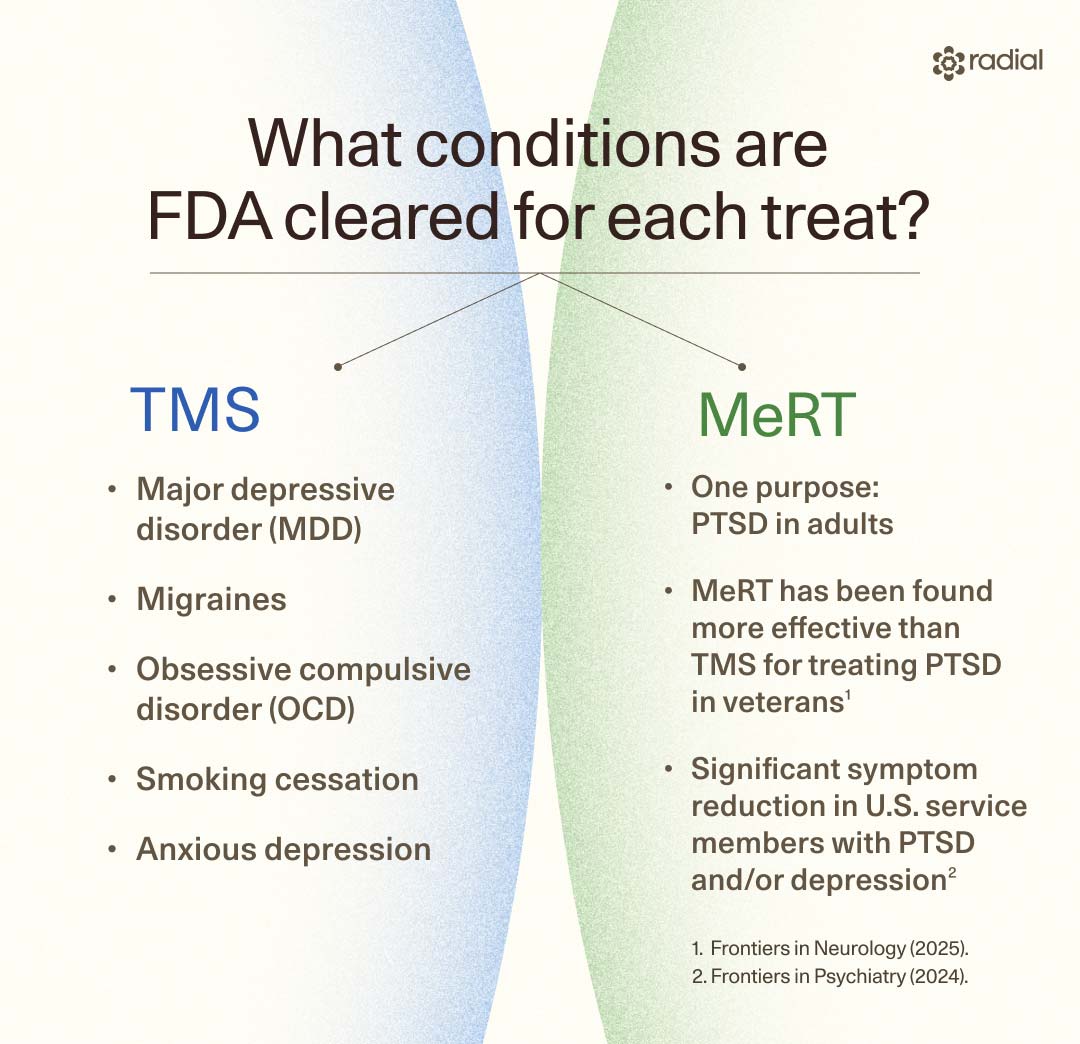
MeRT is FDA-cleared for PTSD while TMS is FDA-cleared for MDD, OCD, anxious depression, smoking cessation, and migraines. Sometimes, both are used off-label for other conditions.
TMS: FDA-cleared indications and common off-label uses
TMS is currently FDA-cleared for:
- Major depressive disorder (MDD)
- Migraines
- Obsessive compulsive disorder (OCD)
- Smoking cessation
- Anxious depression
It’s commonly used off-label for:
- Anxiety
- PTSD
- Postpartum depression
- Bipolar disorder
- Schizophrenia (specifically for auditory hallucinations)
- Addiction
- Parkinson’s disease
- Stroke recovery
MeRT: regulatory status and marketed uses
MeRT is FDA-cleared for one purpose: PTSD in adults. Any other use of this protocol is off-label, and even this FDA-cleared purpose has limited evidence to support that qEEG and ECG made a difference compared with regular TMS. While some off-label uses of MeRT have limited evidence to support them, one that is often marketed is to reduce certain symptoms of autism, especially in pediatric populations.
Results of a chart review published in Child Psychiatry and Human Development suggest that MeRT may be beneficial at improving quality of life and sleep troubles in children with autism. However, even the researchers point out that more research is required to confirm its use for autism. MeRT is not currently FDA-cleared for those under 18 for any clinical indications.
What does the clinical evidence show?
Standard TMS has a large body of clinical evidence to support it, while MeRT is a newer treatment protocol. The two are also hard to compare, says Dr. Harvey, since there hasn’t yet been a head-to-head study comparing them.
Evidence for standard TMS
TMS not only has a lot of clinical evidence, but that evidence comes from randomized controlled trials, which are considered a high evidence standard in medical research. Plus, trial results have been replicated by many within the scientific community, further validating these findings.
Here are a few recent findings on TMS:
- SWIFT dTMS, a type of accelerated TMS, improved quality of life for over 68% of patients in one trial, per an article in Brain Stimulation.
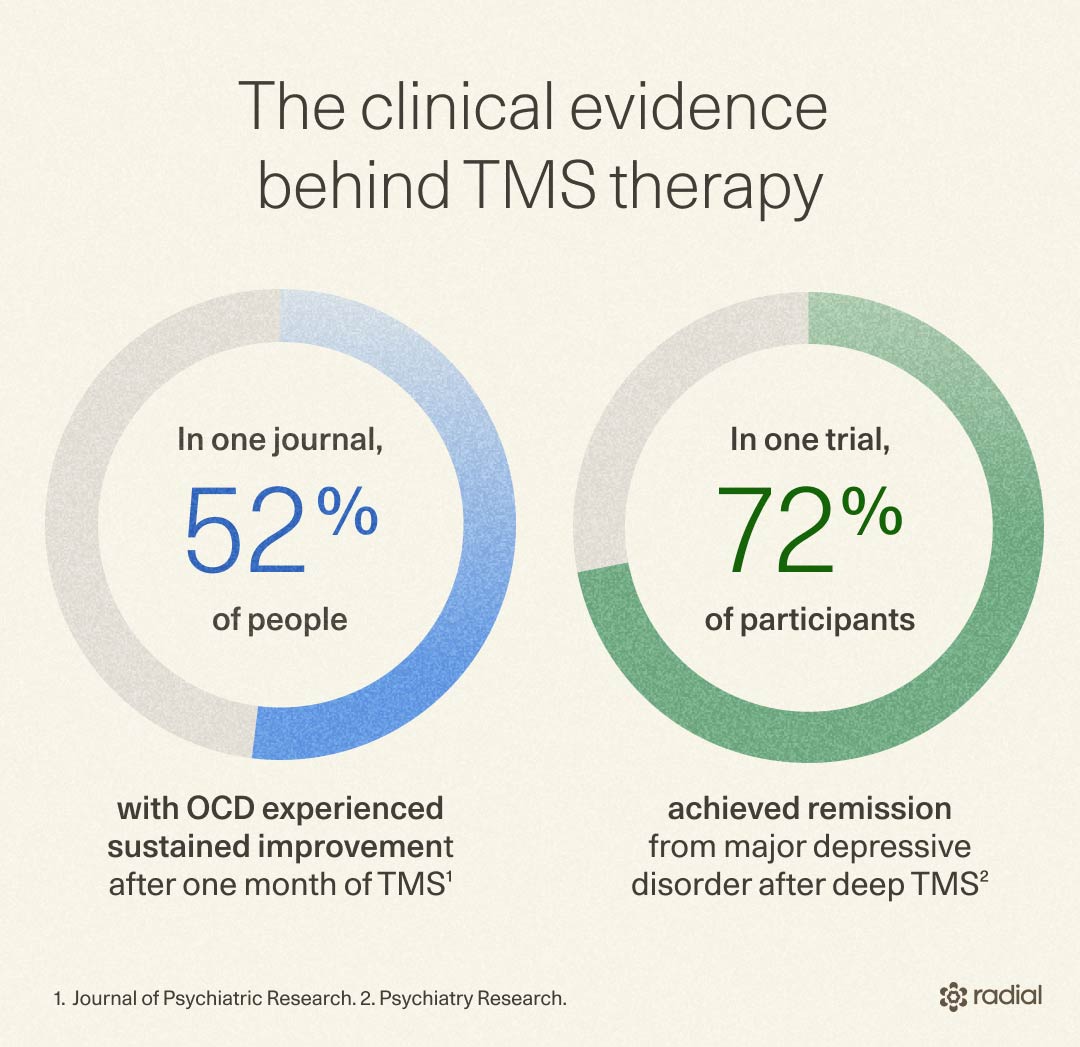
- 52% of people with OCD experienced sustained improvement after one month of TMS, per an article in the Journal of Psychiatric Research.
- 72% of participants in one trial achieved remission from MDD after deep TMS, per an article in Psychiatry Research.
- A 2025 article in Brain Stimulation suggests TMS may improve mood within one hour of a session.
Evidence for MeRT
Smaller-scale studies support the use of MeRT for some conditions:
- A 2025 article in Frontiers in Neurology noted that MeRT may be effective at treating PTSD in veterans.
- A 2024 retrospective chart review in Frontiers in Psychiatry found participants who served in the U.S. Armed Forces and had PTSD and/or depression experienced significant symptom reduction from MeRT.
Dr. Harvey points out that because we don’t have comparative trials between TMS and MeRT, these effects could have been from TMS on its own. He also states that MeRT is a proprietary algorithm, meaning the exact way MeRT uses q-EEG and ECG to inform TMS hasn’t been exposed to the scientific community at large. This makes it difficult for independent researchers to validate how well it works.
What do MeRT and TMS cost, and what does insurance cover?
Determining the cost of TMS and MeRT can be difficult, since the price varies by the protocol, provider, location, and a patient’s insurance. Generally speaking, if the same provider offers MeRT and standard TMS, the cost of MeRT will be higher, as it includes additional testing.
At Radial, the TMS therapy cost ranges from $3,000 to $10,000, depending on the TMS provider, appropriate protocol, and more. The price may drop significantly when insurance covers TMS.
Insurance and Medicare coverage
TMS is covered by insurance when specific criteria are met:
- Diagnosis: There’s a diagnosed condition that the insurance provider deems appropriate for TMS treatment. Treatment-resistant depression is the most commonly covered diagnosis.
- Symptom severity: Symptoms must be severe, which is indicated via a clinical assessment using a standardized scale.
- Previous medications: Someone must have multiple failed medication trials. For many insurance policies, it’s two or more medications.
- Previous talk therapy: Sometimes, they must also have tried psychotherapy, aka talk therapy, on its own or with medication without any progress.
Traditional Medicare may also cover standard TMS when someone has severe depression, hasn’t responded to other treatments, and a psychiatrist deems it medically necessary.
When TMS is covered, insurance providers will typically only cover costs for standard TMS, not accelerated TMS or other types. This is why it’s important to work with a TMS clinic, like Radial, who can check insurance requirements and handle the prior approval paperwork.
But what about MeRT? “As far as I know, insurance does not cover MERT,” says Dr. Harvey. He advises patients to expect a higher out-of-pocket cost than for TMS protocols insurance will cover.
How to decide between standard TMS and a MeRT-based approach
As of now, standard TMS is probably the more appropriate choice for most patients, says Dr. Harvey. He explains, “Using EEG to guide TMS is something that has a lot of promise for the future, but there hasn't really been good evidence of it so far.”
To determine if you are a good candidate for TMS, talk with a licensed psychiatrist familiar with this treatment protocol, such as the team at Radial. They can help you figure out if TMS is appropriate and guide you toward other evidence-based treatments if not.
Relief within reach
Care covered by your insurance
Radial provides advanced mental health treatment, covered by the insurance you already use.








The bottom line
MeRT is a promising protocol for the future, but it still requires more clinical trials before it’s safe to recommend widely. However, MeRT does remind us of an important part of TMS: the treatment should be customized to the patient. This is possible with standard TMS, especially for patients at TMS clinics that take the time to customize treatment, like Radial.
Frequently asked questions (FAQs)
Does the qEEG step in MeRT actually improve outcomes?
MeRT’s qEEGg brain mapping is designed to customize the TMS protocol to the patient. While it shows promise in studies conducted by the company who created this protocol, there hasn’t been a head-to-head study comparing TMS with and without this specific qEEG analysis. That means we can’t definitively say if it improves outcomes.
Can children or teenagers receive MeRT or TMS?
TMS is FDA-cleared for teens as young as 15. That means TMS for teens may be a viable treatment option. MeRT is not currently FDA-cleared for children or teenagers.
If standard TMS hasn't worked, is there evidence that switching to MeRT improves the chance of response?
As of now, there are no clinical trials directly comparing MeRT and standard TMS. This means there isn't enough evidence to recommend switching to MeRT or not. If TMS doesn’t work, there are other evidence-based treatments to try, such as Spravato or electroconvulsive therapy (ECT).
Editorial Standards
At Radial, we believe better health starts with trusted information. Our mission is to empower readers with accurate, accessible, and compassionate content rooted in evidence-based research and reviewed by qualified medical professionals. We’re committed to ensuring the quality and trustworthiness of our content and editorial process–and providing information that is up-to-date, accurate, and relies on evidence-based research and peer-reviewed journals. Learn more about our editorial process.
Let's connect
Get started with finding the right treatment for you or someone you care about
Get startedExplore more posts