What Are the Symptoms of Schizophrenia? How to Recognize Them and Seek Help

Schizophrenia is a serious mental health condition that is often misunderstood. Many schizophrenia symptoms are dismissed since they don’t fit the oversimplified stereotype of this condition. To help fill in the gaps, here is a comprehensive list of symptoms, and guidance on what to do if you recognize them in yourself or someone you love.
While schizophrenia is not the most common mental health condition, it may be the most commonly misrepresented. Impacting about 1% of the population, this condition is often characterized as someone hearing voices and losing touch with reality. Technically, these are possible symptoms, but they don’t capture the full breadth of living with schizophrenia.
Schizophrenia symptoms range from the hallmark signs mentioned above to a lack of pleasure from hobbies, to trouble concentrating, to difficulty making or keeping friends. These symptoms overlap with many other mental health conditions, which is why it’s important to get evaluated by a specialist. This guide will hopefully shed some light on the spectrum of possible symptoms and the signs it’s time to see a mental healthcare provider.
If you’re having suicidal thoughts, experiencing impulses to harm others, or hearing voices that compel you to harm yourself or others, immediate help is available. Call or text 988 or visit the Suicide & Crisis Lifeline website.
Types of schizophrenia symptoms
“Broadly, schizophrenia is a disorder of the brain that involves changes in perception (how people see the world around them), cognition (ability to think logically and deliberately), and behavior,” says Eugene Grudnikoff, MD, a staff psychiatrist at Radial.
Schizophrenia appears alongside structural changes in the brain and neurotransmitter dysfunction. Neurotransmitters are chemicals that communicate with different parts of the nervous system. They play a role in how the body and mind function. More specifically, schizophrenia impacts neurotransmitters involved in the dopamine and glutamate systems.
Dopamine helps regulate reward, motivation, and learning, and it also plays a role in movement and the way the brain assigns importance to experiences, while glutamate is crucial for cognitive functions like making memories, learning new information, and processing the world around us.
I wish I could be more specific about how schizophrenia impacts the brain, but even researchers have questions about what causes schizophrenia and how schizophrenia impacts dopamine and glutamate systems.
What scientists do know is that the structural brain changes and neurotransmitter changes result in three main symptom types:
- Positive symptoms: As it relates to schizophrenia, “positive symptoms” is the term for the symptoms such as delusions, hallucinations, and paranoia. The term can be confusing because the word 'positive' can sound like a good thing. But for schizophrenia, the term just refers to the presence of these troublesome symptoms.
- Negative symptoms:. Similarly, negative symptoms of schizophrenia are the absence of actions, thoughts, or emotions someone is expected to have. For example, people with schizophrenia often have symptoms including a high level of indifference or apathy, flattened emotions, and a lack of talkativeness.
- Cognitive symptoms: People with schizophrenia often have some specific types of difficulty in thinking, such as impaired attention and difficulty processing social cues. We call these the cognitive symptoms of schizophrenia.

Prodromal schizophrenia: early signs of schizophrenia
In medical speak, prodromal refers to the early phase of an illness, when symptoms or functional changes begin to appear before the full syndrome is present. When it comes to schizophrenia, it’s used to describe a clinical high-risk period with subtle or attenuated symptoms, though many people in this phase do not go on to develop schizophrenia
Prodromal symptoms can include:
- Odd beliefs: Someone with prodromal schizophrenia may be suspicious of others or hold odd beliefs about the world around them.
- Social withdrawal: Pulling back from friends or activities, especially when it’s a clear change from the person’s usual functioning.
- Functional decline:New or worsening difficulty keeping up at school or work, reduced motivation, or trouble concentrating. These changes can resemble depression, anxiety, ADHD, trauma-related symptoms, or substance effects, so a professional evaluation matters.
- Sensory disturbances: This is when someone hears or sees something that isn’t there. Someone might describe this sign as their mind playing tricks on them.
Remember, prodromal is an early phase of illness, before the full syndrome is present, not that there’s a 100% chance someone with one or more of these warning signs of schizophrenia will develop the condition. “For many, these symptoms are mild and will resolve without treatment; while some (at least 10%) will develop schizophrenia,” says Dr. Grudnikoff.
Any of these potential early schizophrenia symptoms, however, indicates that it’s time to see a mental healthcare provider. “Because these early symptoms can be subtle and easy to miss,” says Dr. Grudnikoff, “Many people don't come to the attention of clinicians until the symptoms worsen and develop into schizophrenia.” Yet early diagnosis is often associated with better treatment outcomes.
Positive symptoms of schizophrenia
As a quick refresher, positive schizophrenia symptoms are the addition of something abnormal, whether it’s something someone sees, does, or feels. Positive symptoms include what you may first think of when someone mentions schizophrenia.
Hallucinations
Auditory or visual hallucinations are when someone sees, hears, or feels something that isn’t there. It’s probably the most commonly known symptom of schizophrenia, and hallucinations occur in 70-80% of people with this condition.
Delusions
If someone has a fixed, inaccurate, and unshakeable belief, it’s referred to as a delusion. These are another common symptom of schizophrenia, though they’re often misunderstood.
Perhaps it’s because of the common saying “delusions of grandeur” which refers to someone who has an overinflated sense of self. While these are possible in schizophrenia, delusions are more likely to be negative misconceptions of one’s self or the world around them. Schizophrenia delusions also tend to be less believable than those stemming from other mental health conditions.
Paranoia
Part of paranoia is persecutory delusions, a type of delusion in which someone falsely believes others intend to harm or target them. Persecutory delusions are one of the most common delusional themes in schizophrenia, so it’s worth calling out specifically. Paranoia is when someone is suspicious that people around them are trying to harm them or a loved one. This symptom is especially prevalent in people who have both schizophrenia and PTSD.
Disorganized thinking or speech
Schizophrenia leads to a disruption in logical thinking and organization, which is often reflected in how someone speaks or thinks. People might describe this as brain fog or “hazy” thoughts.
It may also lead to difficulty conversing with others. Loved ones might describe a person with schizophrenia’s speech as difficult to follow. Their speech might seem disorganized and rambling. Or, they might seem like they're talking a lot, but saying very little.
Disorganized or catatonic behavior
Disorganization can also extend to someone’s behavior. A messy workspace or home can be part of this, but disorganized behavior is more than messiness alone. It may even look like being disorganized when doing complex tasks, like a work project, or simple tasks, such as brushing teeth or cleaning up after dinner.
In some people, schizophrenia can also involve catatonia, which is a separate syndrome. This state is characterized by a lack of movement and could look like slumped posturing, slower than expected movements, or being in a stupor, a state close to unconsciousness.
Negative symptoms of schizophrenia
Negative schizophrenia symptoms refers to the absence of thought patterns, behavior, and feelings that we might expect of ourselves or others. Most patients with schizophrenia experience some negative symptoms, and these symptoms often occur before onset of the more overt “positive” symptoms.
Despite their prevalence, they often go unnoticed by patients since they aren’t “classic” schizophrenia symptoms. From a clinical perspective, Dr. Grudnikoff points out that there’s less research on why these symptoms appear and more limited treatments for them.
Affective flattening
Affective flattening refers to when someone has a lack of emotional expression. This could look like a blank face when opening a gift or not making eye contact when appropriate. It impacts 40% or more of people with schizophrenia.
Alogia
Alogia is Greek for “without words.” It refers to when someone with schizophrenia has reduced speech output and sometimes reduced content. This is often marked by brief, unelaborated answers, reduced spontaneous conversation, and longer delays before responding.
Avolition
Avolition is a severe, persistent lack of motivation. With avolition the individual has difficulty initiating and sustaining goal-directed activities. For example, someone with schizophrenia may be less motivated to do a good job at work or to workout, even when the person understands the importance of doing them.
Anhedonia
Anhedonia is the loss of interest or inability to enjoy activities that used to be pleasurable. While most commonly associated with depression, it can be a negative symptom of schizophrenia.People may have more difficulty anticipating enjoyment or feeling motivated to seek out rewarding activities, which can contribute to reduced participation in hobbies and social life.
Asociality
Asociality, a lack of interest in engaging with others, is another negative symptom. This could look like difficulty making or keeping friends or avoiding social situations whenever possible. Asociality is part of the reason why many people with schizophrenia feel lonely or isolated.
Cognitive symptoms of schizophrenia
The cognitive symptoms of schizophrenia influence someone’s functioning at work or school, in social situations, or when making decisions related to self-care.
They include:
- Slower processing speed: Someone may take longer to understand information, respond to a question, or complete work.
- Difficulty concentrating: It may be difficult to pay attention at work, to a university lecture, or to a conversation.
- Working memory impairment: One may have trouble forming memories and recalling recent information, such as not remembering instructions that were provided less than five minutes ago.
- Verbal learning issues: Someone may struggle to learn information that’s presented to them verbally.
- Visual learning issues: It may also be a struggle to remember information that’s presented visually, such as in a graph or written guide.
- Trouble with executive function or reasoning: Someone may struggle with planning, making decisions, organizing information or projects, or problem-solving.
- Impaired social cognition: The person might struggle to interpret social cues or understand others’ emotions or intentions.
Anosognosia: Why some people don’t recognize their symptoms
Somewhere between 50-90% of people with schizophrenia experience anosognosia, which is a lack of awareness of a psychiatric condition. This isn’t simply denial; anosognosia is likely related to brain-based changes in insight and self-monitoring, making it hard to recognize symptoms or functional difficulties.
Anasognosia makes it less likely someone sets up that initial appointment with a psychiatrist and to follow a treatment plan. After all, why would you see a psychiatrist if everything seems fine? This symptom is also associated with a higher risk of suicide, yet another reason prompt treatment is essential.
How schizophrenia symptoms change over time
Dementia and schizophrenia both include cognitive problems and anosognosia, but otherwise the two conditions are quite different. Schizophrenia does not necessarily progress or worsen over time. And treatment for schizophrenia often brings dramatic improvement.
Most people with schizophrenia get better with treatment. Treatments mostly address the positive symptoms, but help with other symptoms as well. The goal is always to minimize the burden of schizophrenia, and to help the patient live their best life.
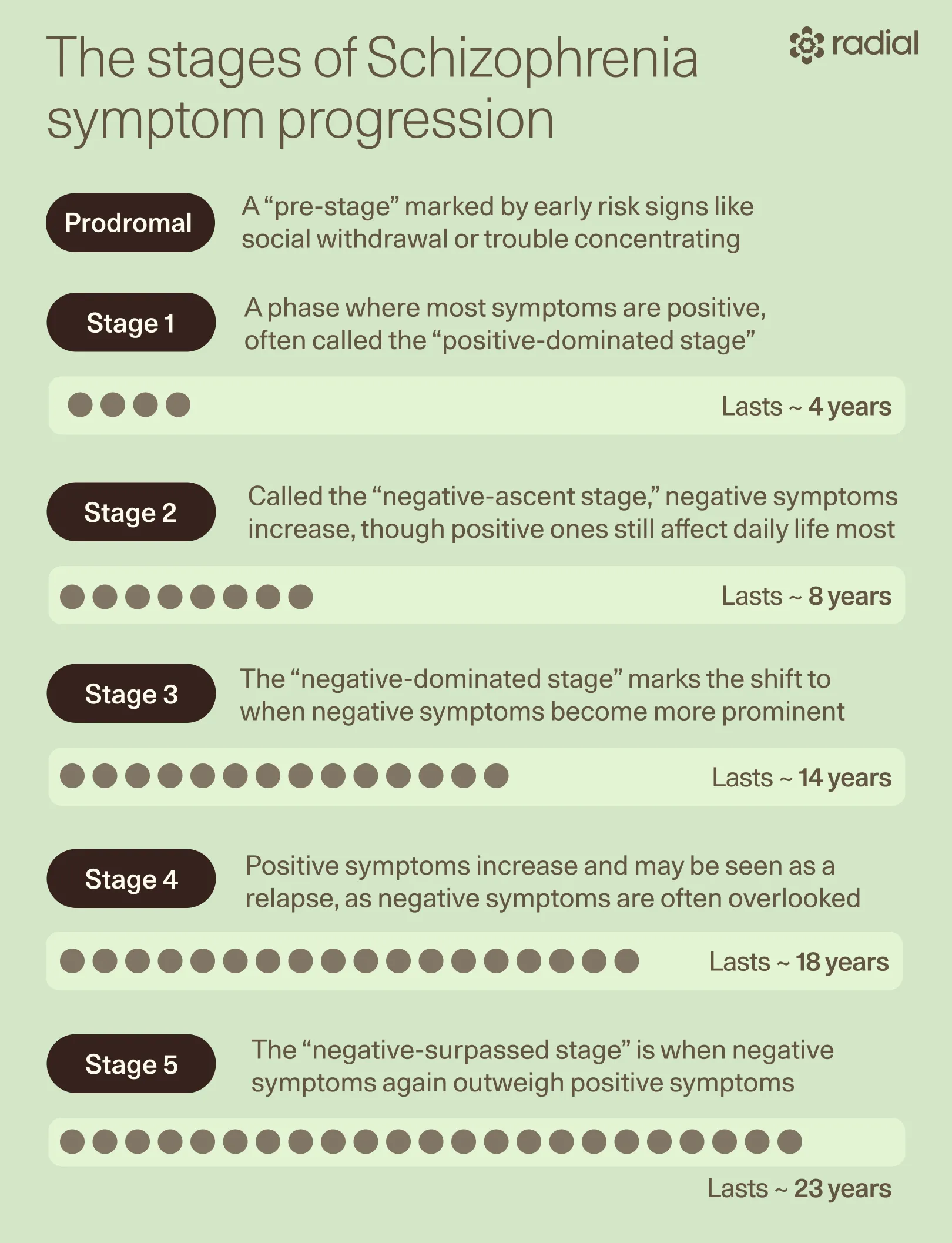
The way that symptoms evolve vary considerably from person to person. Jiang et al developed a description of five typical "stages" —although any individual person will not necessarily progress in a way that matches these stages:
- Prodromal: Ok, if you count the stages on this list there are six, but that’s because this is more of a “before” phase. It’s when someone experiences risk factors for schizophrenia, like social withdrawal or difficulty concentrating at work.
- Stage One: A phase where most symptoms are positive, lasting about four years on average. It’s often referred to as the “positive-dominated stage.”
- Stage Two: Labeled “the negative-ascent stage,” this is when negative symptoms become more prevalent, though positive ones still have the greatest impact on everyday life. It usually lasts about eight years.
- Stage Three: The “negative-dominated stage” lasts about 14 years and marks the transition to when negative symptoms become more pressing than positive ones.
- Stage Four: The “positive-ascendant stage” is where, for about 18 years, someone begins to experience more positive symptoms than in stage three. Sometimes this is thought of as a relapse, since people often miss or don’t associate negative symptoms with schizophrenia.
- Stage Five: Lasting 23 years on average, the “negative-surpassed stage” is when negative symptoms again outweigh positive symptoms.
This staged model is different from the traditional conception of disease progression, where schizophrenia was thought of as acute episodes of positive symptoms, followed by periods of remission with “residual” negative symptoms. The five stages better capture how symptoms fluctuate and the very real impact negative symptoms have on individuals, which are definitely not just “periods of remission.” or “residual symptoms.”
Relief within reach
Care covered by your insurance
Radial provides advanced mental health treatment, covered by the insurance you already use.








Symptom differences by age group
Schizophrenia has an average onset age of 21-25 in men and 25-30 in women. However, 20% of cases occur in people over the age of 40, and it’s an exceedingly rare condition for children under 13.
No matter someone’s age at diagnosis, symptoms often are the same, though they vary in severity. “The full range of symptoms can occur at any age,” says Dr. Grudnikoff, “but the early-onset forms of illness tend to have worse courses and outcomes.”
Schizophrenia in children
While schizophrenia is rare before the age of 13, some children are diagnosed with this condition. The signs of schizophrenia in children are similar to those seen in teenagers and adults (i.e. communication difficulties, difficulty making or keeping friends, delusions, etc.), but they may also stem from other conditions that are diagnosed around this age, such as autism and ADHD. This makes it extremely difficult to diagnose children with schizophrenia.
To make matters more confusing, autism and ADHD both increase the risk of developing schizophrenia.
Teens and young adults
Most schizophrenia cases are diagnosed when someone is in their 20s. However, there is an uptick in cases once people go through puberty. Signs of schizophrenia in teens and adults are basically the same, though the condition is more difficult to diagnose in teenagers.
That’s because many teenagers who experience psychotic-like episodes or the negative symptoms of schizophrenia are actually experiencing other conditions, such as post-traumatic stress disorder (PTSD) or another condition on the psychosis spectrum.
Late-onset schizophrenia
Schizophrenia symptoms in adults encompass the ones we’ve already discussed, though severity of symptoms depends on age of diagnosis. On average, an earlier onset of schizophrenia symptoms is associated with more severe symptoms.
Interestingly, while men are more likely to be diagnosed with schizophrenia in general, there seems to be a relationship between late-onset cases and menopause. Women diagnosed with schizophrenia earlier also seem to have a second peak of positive symptoms around the time they go through this transition.
.webp)
When and how to seek professional help
“People think of positive symptoms, such as paranoia or hearing voices, when they think of schizophrenia. Negative and cognitive symptoms are harder to recognize and easy to overlook,” says Dr. Grudnikoff, “This is partly because these symptoms lack specificity, often mimicking the characteristics of depression or substance use.”
While negative and cognitive symptoms can appear first (in the prodromal phase), and can be from many mental health conditions, they deserve treatment. Mental healthcare can help, whether they’re from schizophrenia, depression, or something else.
That means see a healthcare provider if you’re experiencing any of the following:
- Noticeable decrease in hygiene or self-care
- No longer interested in things you used to care about
- Low to no motivation
- Social withdrawal
- Cognitive slowing or a new-to-you difficulty concentrating
When schizophrenia symptoms are a medical emergency
Schizophrenia is a serious mental health condition that sometimes requires emergency psychiatric help. The chance of committing suicide is 13-20 times higher in people with schizophrenia, and those with this condition are slightly more likely to display violent behavior toward others.
Seek emergency medical attention if experiencing:
- Suicidal thoughts or behaviors
- Hearing voices that tell someone to harm themself or others
- Extreme agitation or aggression
- Experience hallucinations that quickly get worse
- Are suddenly confused
- Feeling like you’re not in control of your thoughts or what you say
Emergency medical attention can be received at a local emergency room, by calling 911, or by calling the 988 crisis lifeline.
The bottom line
Schizophrenia symptoms include the classic ones we think of, such as hallucinations or paranoia, as well as those that may be overlooked, such as social withdrawal or difficulty concentrating. At Radial, our psychiatrists help people understand schizophrenia symptoms and get access to the most innovative, effective treatments.
Key takeaways
- Schizophrenia symptoms can be grouped into three types: positive (the addition of abnormal behavior, thoughts, or sensory experiences), negative (an absence of expected thoughts, feelings, or behaviors), and cognitive (changes in how someone processes memories and information and makes decisions).
- Symptoms can be difficult to spot since they overlap with other conditions, especially in schizophrenia’s earliest stages.
- If experiencing any symptoms above, even if you don’t think it’s from schizophrenia, seek mental healthcare from a clinic like Radial. A mental healthcare provider can help you better understand what’s causing symptoms, reduce their impact on everyday life, and build a management plan.
Frequently asked questions (FAQs)
What are the early warning signs of schizophrenia?
The early warning signs of schizophrenia often present as withdrawing from social situations, difficulty concentrating at school or work, and sensory disturbances, such as briefly seeing or hearing something that isn’t there. These are often overlooked, though the earlier schizophrenia is diagnosed, the higher the chance of effective treatment outcomes.
When does schizophrenia develop in women?
Schizophrenia in women usually develops between the ages of 25 and 30 years old. Developing schizophrenia later in life is rare, and many of the cases of late life schizophrenia are women who develop the condition after menopause.
Can schizophrenia be cured?
There isn’t a “cure” for schizophrenia, but with expert treatment, the disease can be managed successfully, with much better outcomes. Working with an innovative psychiatric clinic, like Radial, can provide access to the most current treatment options, with many successful treatment plans including a mix of talk therapy, social support resources, and medication.
Editorial Standards
At Radial, we believe better health starts with trusted information. Our mission is to empower readers with accurate, accessible, and compassionate content rooted in evidence-based research and reviewed by qualified medical professionals. We’re committed to ensuring the quality and trustworthiness of our content and editorial process–and providing information that is up-to-date, accurate, and relies on evidence-based research and peer-reviewed journals. Learn more about our editorial process.
Let's connect
Get started with finding the right treatment for you or someone you care about
Get startedExplore more posts