Esketamine vs. Ketamine: How They Differ and How to Choose

Key takeaways
- A major difference between esketamine vs. ketamine is their chemical makeup: esketamine contains one of the two mirror-image forms of the molecule found in racemic ketamine.
- Spravato contains esketamine and is an FDA-approved treatment for certain types of depression. Ketamine is FDA-approved as an anesthetic and is also used off-label for depression.
- Spravato is administered as a nasal spray in supervised healthcare settings, while ketamine for depression is given as an IV infusion in a clinic.
- Both treatments affect the brain’s glutamate system. The right choice for you often depends on your access to treatment and insurance coverage, as well as your medical history.
Esketamine and ketamine are both fast-acting treatments for depression, so how do you know which one is right for you? While they sound similar and are closely related, they are not the same treatment and have several important distinctions.
Spravato is not the same as ketamine, although they have a shared underlying chemistry. Ketamine contains two forms of the same molecule, while esketamine contains only one. Esketamine is also the active ingredient found in Spravato, a nasal spray that is FDA-approved to treat depression in adults.
When deciding between them, practical considerations tend to take precedence, such as whether they're FDA-approved for the conditions being treated, how they are administered, cost, accessibility, monitoring requirements, and your medical history.
In this article, we’ll explain what you should know about esketamine vs. ketamine, including how their differences affect treatment, so that you can talk about your options with your provider.
Healing happens through strong relationships
Compassionate, experienced mental health professionals focused on evidence-based care


.webp)

Esketamine vs. ketamine: key differences at a glance
Esketamine and ketamine are closely related but differ in their chemical structure, whether they are FDA-approved for treating depression, and how they are given during treatment. Other factors, like how they are regulated and whether they are covered by insurance, are also important and can affect which option might be right for you.
Esketamine is the S-enantiomer of racemic ketamine and is sold in the U.S. as the FDA-approved intranasal spray Spravato. Ketamine that is used to treat depression usually refers to racemic ketamine, which contains both S-ketamine and R-ketamine and is prescribed off-label for depression, says the Journal of Psychopharmacology.
Difference 1: chemical makeup and effect
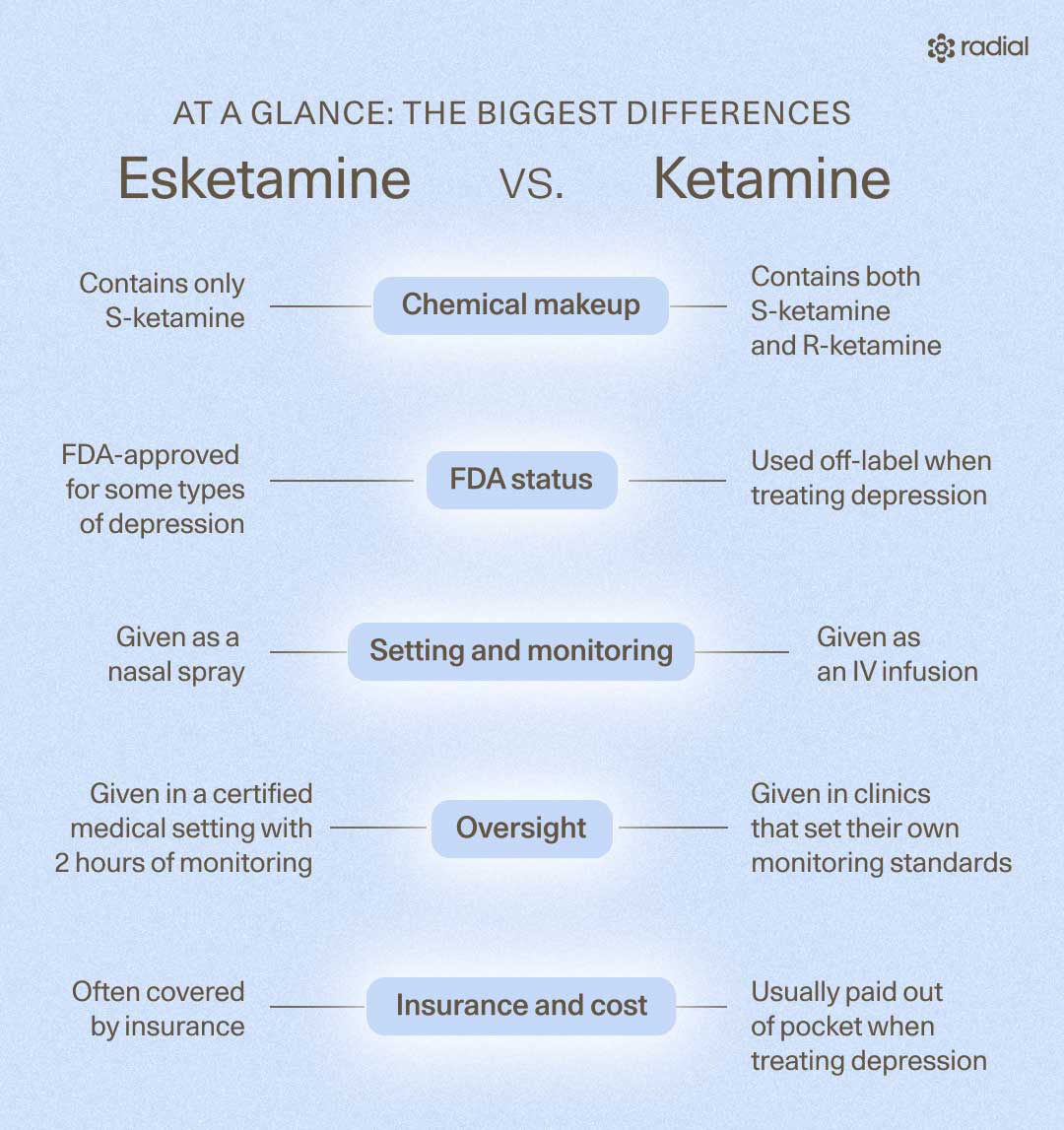
Ketamine contains both S-ketamine and R-ketamine, while esketamine contains the S form only.
As Steven Harvey, MD, the Midwest Regional Medical Director at Radial explains, "Ketamine is a mixture of two mirror-image molecules: the 'right-handed' molecule and the 'left-handed' molecule." One is the S-enantiomer, or S-ketamine (esketamine). The other is the R-enantiomer, known as arketamine or R-ketamine, says Molecular Psychiatry.
"With esketamine, all of the drug is the esketamine instead of the two mixed together," he says. "The result is a drug that is similar to ketamine, but not the same."
All the similar-sounding names can be confusing, but it can be helpful to remember that “S-ketamine” sounds like esketamine.
The two drugs also act in the body through a shared mechanism. Ketamine and esketamine interact with the brain’s glutamate system to block a type of glutamate receptor called the NMDA receptor, explains Discover Mental Health. Glutamate is one of the brain’s main chemical messengers that plays a part in communication between cells.
Why ketamine and esketamine have such fast-acting antidepressant effects is still being studied. One idea is that their effects on glutamate might lead to changes that help brain cells communicate more effectively.
"We know that Spravato and ketamine both work," Dr. Harvey says. "We don't think that one is better than the other, although there hasn't been a good head-to-head comparison yet."
Difference 2: FDA status
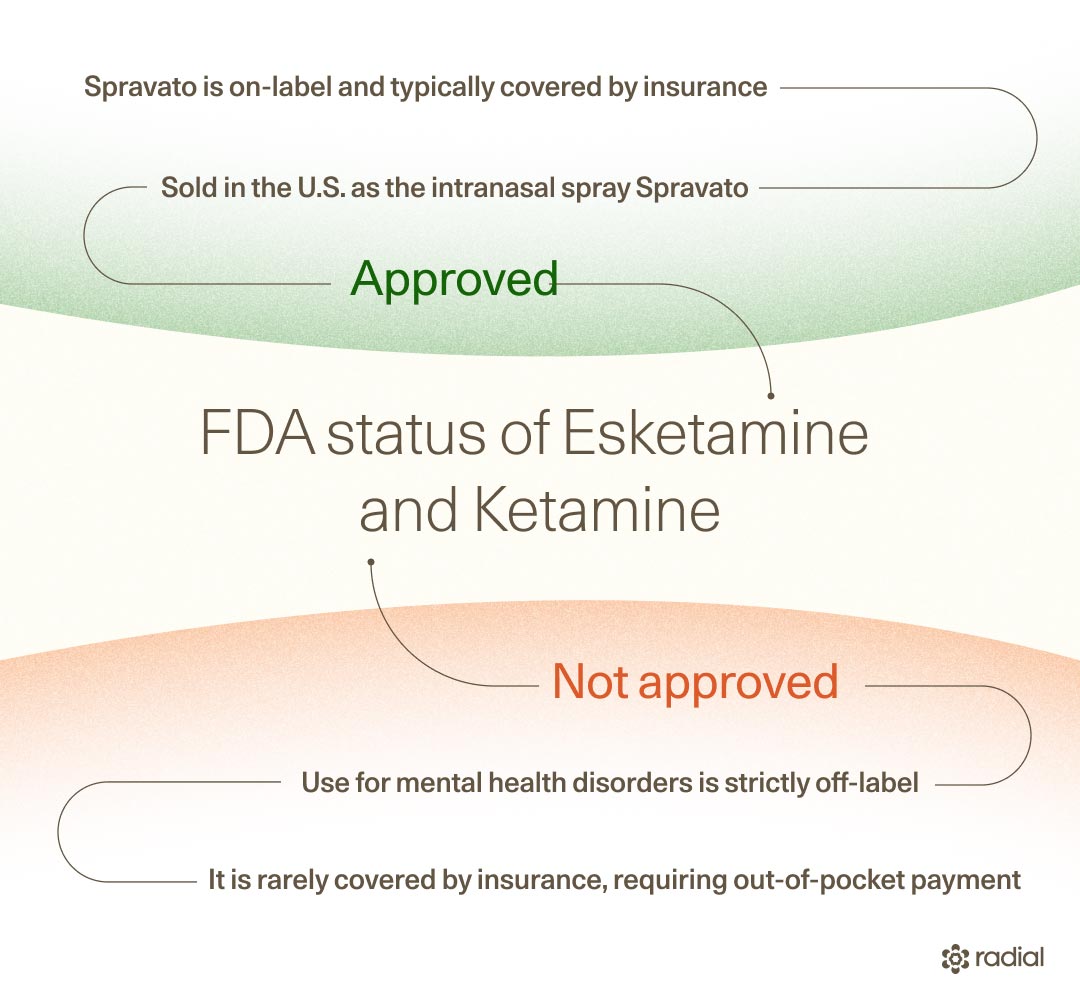
Spravato is FDA-approved for certain types of depression, while ketamine is approved only as an anesthetic and not for any type of psychiatric condition. So that means that ketamine for depression is used off-label.
"Since it doesn't have the FDA stamp of approval for depression, ketamine treatment is not currently covered by insurance, even though we know it works," Dr. Harvey says.
According to the FDA prescribing information for Spravato, its current approved indications include:
- Treatment-resistant depression in adults, either as a stand-alone treatment or in combination with an oral antidepressant
- Depressive symptoms in adults with major depressive disorder with acute suicidal ideation or behavior, when used with an oral antidepressant
These differences in FDA approval also have practical considerations. "Spravato being FDA approved means that its use is 'on-label,'" Dr. Harvey says. "And since it's on-label, it is also usually covered by insurance."
Difference 3: How and where you get treated
Spravato is administered as an intranasal spray under the supervision of a healthcare professional in an approved medical facility. Ketamine for depression is usually administered in a clinic as an IV infusion.
With esketamine nasal spray, you administer the medication yourself under the observation of a healthcare provider. Treatment must take place in a REMS-certified healthcare setting, and you must be monitored for at least two hours afterward. Our guide to how Spravato is administered can walk you through how to prepare and what to expect during treatment.
With IV ketamine, or a ketamine infusion, the medication is given intravenously, although the exact dosing and treatment schedule can vary. Recommendations published in the Journal of Affective Disorders suggest that IV infusions should be administered in a healthcare setting equipped to monitor heart rate, blood pressure, and oxygen saturation. Our article on ketamine therapy can help you learn more about what treatment involves.
Difference 4: Oversight and monitoring
Spravato is available only through a federally required REMS program, while off-label ketamine follows protocols and procedures that are set by the individual clinics providing treatment.
REMS stands for Risk Evaluation and Mitigation Strategy, explains the U.S. Food and Drug Administration. These requirements affect who can prescribe Spravato as well as where it can be administered. Health settings must be certified and patients must be monitored during treatment, and for an additional two hours afterward.
Difference 5: Insurance coverage and cost
Another key difference between IV ketamine vs. Spravato is that Spravato is more likely to be covered by insurance because it is FDA-approved, while IV ketamine for depression is usually paid for out of pocket. However, coverage varies from one insurer to the next because each insurer has its own rules about who is eligible for Spravato, and prior authorization is often required.
For example, Spravato is often covered when it’s deemed medically necessary. This may require documentation of treatment-resistant depression and previous attempts to treat with antidepressants.
Because of this, cost is often a deciding factor between the two treatments, since insurance coverage for ketamine therapy can be tricky. "Frankly, one factor is going to be the cost to the patient," Dr. Harvey says. "Sometimes ketamine treatment is unaffordable to some because it's not covered by insurance. This often tips the balance toward Spravato. But it depends."
Esketamine vs. ketamine: which is right for you?
Deciding which treatment is right for your needs depends on your situation, and there isn’t one choice that’s right for everyone. Whether esketamine or ketamine makes the most sense depends on your diagnosis, what you’ve tried before, your preference for how it's administered, and how much it will cost.
Your provider will also consider whether your diagnosis matches one of the FDA-approved indications for Spravato. Practical considerations are also important. These include whether your insurance covers Spravato treatment, how much each treatment costs, and whether you are more comfortable with an IV or a self-administered nasal spray.
Availability also plays a part in the decision. As Dr. Harvey points out, "Another factor is simply which one is available locally. Some localities might only have one or the other available."
Whether you’re weighing esketamine vs. ketamine, or another option like TMS vs. Spravato, it’s more useful to think about which treatment best fits your needs and your life. Radial can help you navigate insurance coverage, understand your treatment options, and see how the differences between esketamine and ketamine affect which might be best for you.
Relief within reach
Care covered by your insurance
Radial provides advanced mental health treatment, covered by the insurance you already use.







The bottom line
Esketamine and ketamine both come from the same molecule, but there are important differences in how they are administered and which is approved by the FDA to treat depression. For most people, the decision often comes down to which option is most accessible, affordable, and recommended by their provider.
Both can offer fast-acting relief for depression symptoms, but when it comes to a comparison of Spravato and ketamine, there isn’t any single “best” option. That’s why talking to a qualified provider can help you figure out which choice might be right for you.
Frequently asked questions (FAQs)
Is esketamine weaker or stronger than ketamine?
Both IV ketamine and esketamine nasal spray are effective for rapidly reducing depressive symptoms. There is no research suggesting that one medication is stronger than the other. According to Pharmacotherapy, esketamine’s affinity for NMDA receptors is greater than that of arketamine. However, Therapeutic Advances in Psychopharmacology suggests that there are no significant differences in response or remission rates between the two medications, although IV infusion may act faster.
Can you switch between ketamine and Spravato?
It may be possible to switch from ketamine to Spravato, but the two treatments are not substitutes for one another. They don't have the same formulation or dosing, so your provider will determine the best way to transition from one treatment to another, if advisable, based on your symptoms and treatment response.
Is at-home ketamine the same as Spravato?
No, at-home ketamine and Spravato are not the same. At-home ketamine is used off-label, while Spravato is a nasal spray that must be administered under supervision in a certified facility.
(Disclosure: Steven Harvey is a paid speaker for Spravato manufacturer Johnson & Johnson.)
Editorial Standards
At Radial, we believe better health starts with trusted information. Our mission is to empower readers with accurate, accessible, and compassionate content rooted in evidence-based research and reviewed by qualified medical professionals. We’re committed to ensuring the quality and trustworthiness of our content and editorial process–and providing information that is up-to-date, accurate, and relies on evidence-based research and peer-reviewed journals. Learn more about our editorial process.
Let's connect
Get started with finding the right treatment for you or someone you care about
Get startedExplore more posts