Types of TMS Therapy: What Makes Each Protocol Different

TMS provides a path forward for many people managing conditions that are notoriously hard to treat, like treatment-resistant depression and OCD. But there are many variations in the types of TMS offered. From rTMS (repetitive TMS) and deep TMS to theta burst and accelerated TMS, the differences in both machine type and treatment protocol can affect everything from how long you sit in the chair, how often you go to the clinic, and which conditions will be approved for treatment.
Researching the different types of TMS can be surprisingly confusing. One clinic lists three, another lists six, and suddenly you're trying to decode terms like deep TMS, SAINT, and theta burst TMS while wondering what's the difference between them, and what it means for your treatment.
The truth is, TMS isn't one treatment but a category of treatments, which we'll break down in the paragraphs that follow. TMS types differ by coil design, pulse pattern, treatment schedule, and sometimes the device itself.
Let's take a look at the different types of TMS, explain why FDA clearances apply to specific devices, and show how clinicians decide which approach may be the best fit for you, so you can compare clinics with confidence.
Connect with our Clinicians

%20(1).webp)
.png)
What makes one type of TMS different from another
The key differences between TMS types boil down to three variables: coil design, pulse pattern and frequency, and treatment schedule, says Seth Resnick MD, DFAPA, FASAM, Radial’s New York Regional Medical Director. All TMS protocols use magnetic pulses delivered through a coil placed on the scalp to stimulate regions of the brain involved in mood.
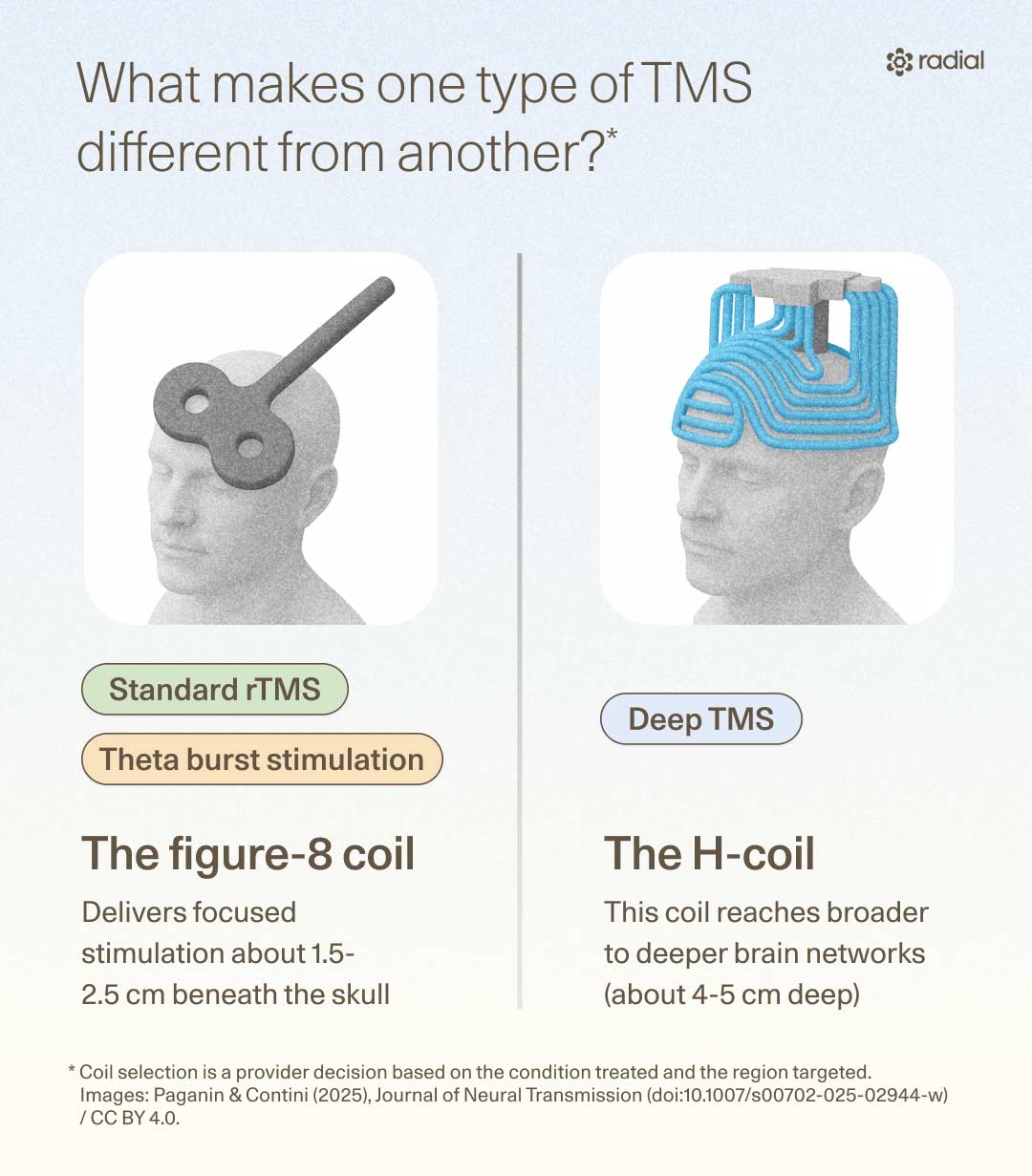
- Coil shape: The coil “determines how focused or broad the magnetic field is and how deep it penetrates,” says Dr. Resnick. Figure-8 coils create a focused field for precise cortical targets, while H-coils spread stimulation more broadly and deeply, he explains.
- Pulse pattern and frequency: Protocols differ in how often pulses are delivered and the pattern they follow. For example, standard rTMS commonly uses 10Hz pulses, totaling about 3,000 pulses over 19-37 minutes, while theta burst stimulation delivers pulses in short triplet bursts that mimic natural theta rhythms (about 600 pulses in roughly 3 minutes), says Dr. Resnick.
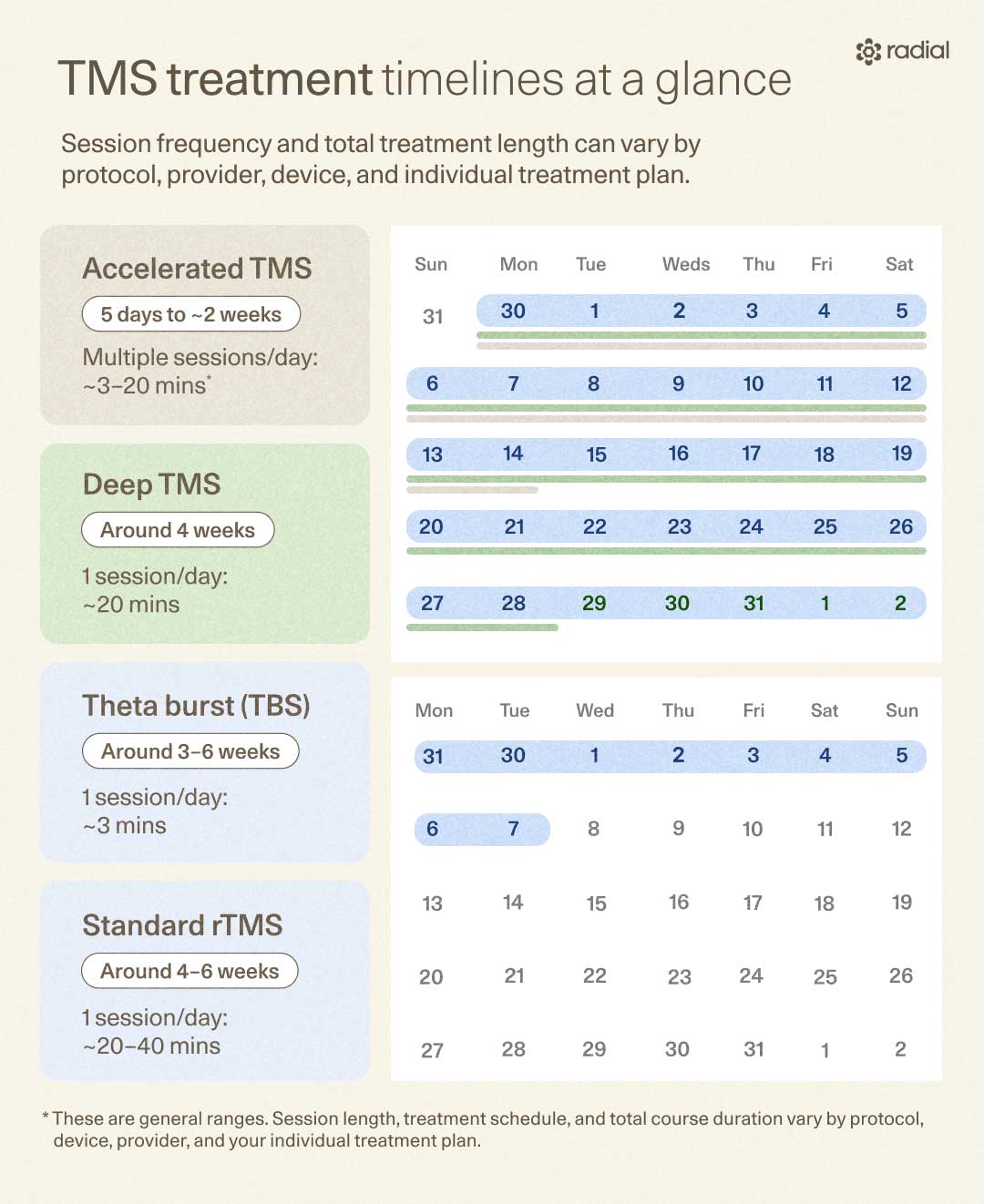
- Treatment schedule: This is where protocols can look dramatically different. Conventional TMS therapy is typically delivered once daily over four to six weeks, while accelerated protocols compress multiple sessions into each day over a much shorter treatment window, says Dr. Resnick.
The main types of TMS therapy
From coil design, pulse pattern and frequency, and treatment schedule, each type of TMS has its own unique approach, according to Clinical Neurophysiology. Here’s what to know about standard rTMS, deep TMS, theta burst stimulation, and accelerated TMS.
Standard rTMS (repetitive TMS)
Standard repetitive TMS (rTMS) is the most researched TMS protocol and the first cleared by the FDA for major depressive disorder in 2008. Standard rTMS typically uses a figure-8 coil to stimulate the left dorsolateral prefrontal cortex (L-DLPFC) using high-frequency (10 Hz) magnetic pulses according to research in the Journal of Neural Transmission.
Traditionally, rTMS treatment involves 20- to 40-minute sessions 3-5 days a week for about six weeks (typically 36 sessions), followed by a brief taper period. At Radial, treatment is often scheduled as two sessions per day, allowing many patients to finish in about three to four weeks.
A note on rTMS vs TMS: Because standard rTMS is common, it’s often simply called “TMS.” But to be clear, TMS is the broad term for using magnetic fields to influence brain activity while rTMS is a specific type of TMS that delivers repeated magnetic pulses.
Deep TMS (dTMS)
Deep TMS (dTMS) uses a specialized H-coil to stimulate broader and deeper brain networks involved in depression, OCD, addiction, and other mental health conditions.
For depression, treatment typically involves 20-minute sessions, five days a week for four weeks, followed by a taper period. An accelerated option, SWIFT™ Deep TMS, dramatically shortens the timeline for the acute treatment phase, delivering 10-minute sessions over just six days.
Theta burst stimulation (TBS)
Theta burst stimulation (TBS) isn't a different machine — it's a different way of delivering TMS pulses. It mimics the brain's natural neuronal firing patterns in the hippocampus.
The most common version, intermittent theta burst stimulation (iTBS), delivers 600 pulses in about three minutes, making treatment much faster than standard TMS, per research in Clinical Neurophysiology. That's a major advantage if you're balancing work, childcare, or have chronic pain that makes longer sessions uncomfortable.
Research in the same journal shows iTBS is just as effective as standard high-frequency rTMS for treating major depressive disorder when both target the left dorsolateral prefrontal cortex (DLPFC).
Accelerated TMS
Accelerated TMS packs multiple treatment sessions into a single day instead of spreading them over four to six weeks. The goal? Faster symptom relief and fewer trips to the clinic.
There isn't just one accelerated approach — researchers are studying protocols that deliver anywhere from two to 20 sessions per day, using different brain targets, stimulation patterns, and pulse doses, per research in Clinical Neurophysiology. One of the best-known is Stanford Accelerated Intelligent Neuromodulation Therapy (SAINT®), which uses fMRI brain scans to personalize the treatment target and is completed in just five days.
Other terms you'll encounter
As you research TMS clinics, you'll probably come across a lot of unfamiliar jargon. Here's a quick cheat sheet.
Targeting methods
Most TMS treatments target the dorsolateral prefrontal cortex (DLPFC), but providers use different methods to find the ideal spot, including these, per Frontiers in Neuroimaging:
- 5.5 cm rule: Finds the motor area controlling your thumb, then measures 5.5 cm forward to locate the DLPFC.
- Beam F3: Uses your head measurements for a more personalized target.
- MRI-guided targeting: Uses brain imaging for added precision (neuronavigation).
- Structural MRI: Maps brain anatomy when the brain is at rest
- Functional MRI (fMRI): Maps brain activity while the brain is active, using blood flow patterns to personalize the target.
Branded protocols
These are proprietary treatment approaches developed by device manufacturers. Common examples include:
- SAINT® TMS: fMRI-guided targeting with multiple daily sessions over five days.
- BrainsWay SWIFT™ Deep TMS: Accelerated deep TMS completed over six days.
- MeRT (Magnetic eResonance Therapy): Uses EEG recordings to help tailor treatment over time, per research in Transcranial Magnetic Stimulation.
- Ampa One: a new FDA-cleared portable TMS device for treating major depressive disorder.
Device manufacturers
Several companies make FDA-cleared TMS devices, including BrainsWay, NeuroStar (Neuronetics), MagVenture, Nexstim, and Soterix.
What each type is FDA-cleared to treat
The FDA clears specific TMS devices — not "types of TMS" — for specific conditions. For example, two clinics may both offer deep TMS, but on different FDA-cleared systems with different indications.
Common FDA-cleared uses include:
- Major depressive disorder: rTMS, deep TMS, accelerated TMS, iTBS
- Major depressive disorder with anxious features: rTMS, deep TMS
- Migraine headaches with aura:
- Smoking cessation: Deep TMS
- OCD: deep TMS
Comparing clinics? “Ask a prospective TMS provider directly which devices and protocols they offer,” says Dr. Resnick. Not every clinic has multiple modalities, and TMS devices and protocols aren’t interchangeable.
A quick note: Even if a specific condition isn't FDA-cleared for TMS treatment, some providers use TMS off-label for conditions with growing evidence. These may include PTSD, anxiety, postpartum depression, bipolar depression, schizophrenia, addiction, migraines, Parkinson's disease, performance optimization for elite athletes, and stroke recovery. These uses are considered investigational, so insurance typically doesn't cover them.
Relief within reach
Care covered by your insurance
Radial provides advanced mental health treatment, covered by the insurance you already use.







How providers decide which type of TMS is right for you
“Diagnosis and device clearance come first,” says Dr. Resnick. While depression has several FDA-cleared TMS options, other conditions have fewer. For OCD, for example, only specific configurations of TMS — like BrainsWay’s Deep TMS using the H7 coil — have standalone FDA clearance, so patients need access to that specific device and coil, he explains.
“From there, it’s a layered decision,” Dr. Resnick says. Providers may consider:
- Treatment history: Someone who didn’t respond to standard rTMS may benefit from a different protocol or coil, while a partial responder may be a candidate for an adjusted approach, says Dr. Resnick.
- Schedule and lifestyle: Someone who can’t commit to daily sessions for six weeks but can take a week off from work may be better suited to an accelerated protocol, says Dr. Resnick.
- Clinic equipment: Providers can only offer devices available at their clinic and that their staff are trained to use, explains Dr. Resnick. Radial offers multiple TMS modalities — including SAINT, BrainsWay dTMS, and AMPA-One — under one roof, giving clinicians more flexibility to match the protocol to each patient, he adds.
- Side-effect tolerance: TMS has a consistent overall safety profile, but side effects and how it feels can vary somewhat by protocol. For instance, if scalp discomfort makes standard rTMS difficult to tolerate, a different coil or pulse pattern may be worth considering, says Dr. Resnick.
- Cost and coverage: TMS for depression is typically covered by insurance, but TMS therapy cost can vary by protocol. Make sure to ask about insurance coverage and get a personalized estimate that includes all fees.
Your provider should walk you through these factors so you can make the decision together. At Radial, a care navigator can explain the process, discuss insurance and costs, and connect you with a clinician to determine whether TMS may be appropriate for you.
The bottom line
TMS isn’t one-size-fits-all, and understanding the differences between protocols can make comparing your options a lot less confusing.
Radial is at the cutting edge of the field, offering multiple types of TMS under one roof. If you’re considering TMS, Radial makes it easy to connect virtually or in person with a licensed clinician who can help you explore whether TMS is right for you.
Key takeaways
- TMS is a category, not a single treatment. The main approaches include standard rTMS, Deep TMS, theta burst stimulation, and accelerated TMS.
- TMS protocols differ by coil design, pulse pattern, treatment schedule, and how deeply the stimulation reaches.
- FDA clearance applies to specific devices and indications, not broad “types” of TMS. Two clinics offering the same type may use different devices with different clearances.
- The right protocol depends on your unique situation. Diagnosis, previous treatment response, side effects, schedule, equipment availability, and cost can all influence which approach makes sense.
Frequently asked questions (FAQs)
What is the difference between rTMS and Deep TMS?
When comparing deep TMS vs rTMS, the main difference is the coil. Standard rTMS uses a figure-8 coil to target the left dorsolateral prefrontal cortex (L-DLPFC). Deep TMS uses a specialized H-coil to stimulate broader and deeper brain networks.
Is theta burst stimulation as effective as standard rTMS?
Yes. According to research in Clinical Neurophysiology, intermittent theta burst stimulation (iTBS) is just as effective as standard high-frequency rTMS for depression, while cutting treatment sessions from 20-40 minutes to about three minutes.
Is accelerated TMS better than standard TMS?
Both are effective protocols for depression, but accelerated TMS condenses treatment into days instead of weeks. Early research in Transcranial Magnetic Stimulation suggests it may relieve symptoms more quickly; SWIFT deep TMS has also shown response and remission rates comparable to standard deep TMS (Radial participated in the study as a clinical trial site).
Still, researchers are refining which accelerated protocols work best and for whom.
Editorial Standards
At Radial, we believe better health starts with trusted information. Our mission is to empower readers with accurate, accessible, and compassionate content rooted in evidence-based research and reviewed by qualified medical professionals. We’re committed to ensuring the quality and trustworthiness of our content and editorial process–and providing information that is up-to-date, accurate, and relies on evidence-based research and peer-reviewed journals. Learn more about our editorial process.
Let's connect
Get started with finding the right treatment for you or someone you care about
Get startedExplore more posts