Why Do I Feel Empty? Understanding the Causes and What You Can Do

Wondering “why do I feel empty?” You’re not alone—and that hollow, checked-out feeling can result from more causes than you might think, from burnout and big life changes to trauma, depression, or plain old sleep deprivation.
If you’ve ever typed “why do I feel empty” into Google at 1 a.m., you’re in good company. The last few years have handed me a perfect storm—a traumatic birth, identity whiplash as a new mom, relationships shifting or falling away, chronic health curveballs, career pivots. At one point it felt like there was nothing left in the tank, just a giant hollow ache in my chest. Emotional numbness, burnout, overwhelm—whatever you want to call it—I knew I was feeling empty inside, but I couldn’t quite name why.
It’s more common than we realize. So many people hit pockets of emptiness at different points in life. And honestly? “Empty” isn’t even one thing. It’s a vague, catch-all word we use for a whole mix of hard-to-pin-down states: numbness, loneliness, depletion, disconnection, grief, stress, dissociation, or the sense that you’re going through the motions without actually being present.
This article is here to help you make sense of that fog. We’ll unpack what this emptiness actually is, why it shows up, and—most importantly—what you can do to support yourself right now, wherever you are in it. You don’t need a diagnosis to deserve clarity or care. You just need a starting point. Let’s find it.
What does “feeling empty” actually mean?
“Emptiness” is one of those feelings most of us are familiar with, but no one can neatly define—not even the experts. It’s a slippery, subjective, and often deeply distressing experience that shows up across many mental health conditions, yet still has no universally agreed-upon definition.
Clinicians sometimes describe it as an “existential feeling” or a kind of “internal deadness,” but researchers have tried to pin it down more concretely. One study identified nine components that commonly cluster together. The result? A picture of someone moving through life on autopilot—mechanical, numb, purposeless—while feeling an internal void (both psychologically and physically), disconnected from people, and detached from a world that keeps spinning without them.
Another study found 10 similar themes people often associate with emptiness: purposelessness, disconnection, numbness, self-deprecation, identity confusion, lack of motivation, hopelessness, lack of pleasure, physical sensations, and dissociation. The standout theme was purposelessness—people repeatedly said things like “Everything feels meaningless” or “I feel like I’m wasting my life.”
Why is it so hard to define emptiness? Because emptiness doesn’t show up the same way in everyone—and that’s kind of the whole point. It’s a subjective emotional state with different interpretations depending on the person. Some people feel emptiness as a literal physical sensation (“I feel hollow inside”), while others describe it as an existential ache (“I don’t know who I am or what I’m doing with my life”).
It also overlaps with other emotional states—like dysphoria, boredom, loneliness, or numbness—and can appear in several mental health conditions, including depression and borderline personality disorder, among others. That overlap can make it even harder to tease apart.
Here’s the part people need to hear: Feeling empty is not a sign of laziness, failure, or moral weakness. It doesn’t mean you’re doing life “wrong.” More often, emptiness is a signal—your mind’s way of pointing to something deeper going on emotionally, psychologically, or relationally.
In other words, it’s not a character flaw. It’s a clue. And paying attention to it is the first step toward understanding what your mind and body might be trying to tell you.
Connect with our Clinicians



Reasons you might feel empty
Emptiness can hit anyone—it’s a totally normal thing to feel once in a while. But when it becomes a daily visitor, it’s usually a sign there’s more going on beneath the surface. “Most people can feel empty from time to time, but recurrent, daily periods of emptiness often reflect unresolved issues of attachment, identity, and emotional regulation and reward,” says Stephanie Hartselle, MD, board-certified pediatric and adult psychiatrist and diplomate of the American Board of Psychiatry and Neurology.
Here are some of the reasons it might be showing up for you.
Burnout and exhaustion
Think of burnout as your brain waving a giant “I’m running on fumes” flag. It’s a psychological syndrome that develops after long-term, chronic stress—often in caregiving or high-pressure jobs—where your emotional reserves slowly drain out until you’re left exhausted, detached, and doubting your own effectiveness.
While we usually think of burnout impacting doctors, therapists, teachers, or other helping professionals, it doesn’t stop there. It can also show up in caregiving for a loved one or in emotionally draining personal relationships. Over time, this sustained stress can leave you feeling wrung out and empty, like there’s nothing left in the tank.
Loneliness
Humans are wired for connection, so when we feel isolated or unseen, it’s natural to sense that something’s missing. According to Dr. Hartselle, loneliness can feed into feelings of emptiness.
While some researchers view emptiness as part of social disconnection, others argue it’s its own separate experience. Still, a qualitative study on emptiness found that social factors showed up again and again in people’s descriptions.
In that study, over a fifth of participants linked their emptiness to a lack of meaningful connection. They shared sentiments like, “I feel lonely despite people being around,” and, “I don’t have any significant personal relationships.” These accounts highlight how emotional disconnection—not just physical isolation—can leave people feeling empty.
Grief and loss
Grief has a way of hollowing you out from the inside. When someone you love dies, the world can suddenly feel empty, muted, or fundamentally changed. Many people describe bereavement as living with a hole in their chest, a kind of emotional amputation where a part of you feels missing.
This sense of emptiness is one of the most consistently reported causes of suffering after losing someone deeply important. You might feel disconnected from yourself, from others, or from the world in general. That “something is missing” sensation is a powerful driver of the emotional emptiness many people experience during grief.
Major life transitions
Big life changes can shake your sense of self like a snow globe. Graduation, job shifts, breakups—or anything that rewrites our daily script—can “scramble our internal map,” says Dr. Hartselle. Major life transitions can make us “question who we are, and for some, feel like they truly don’t know themselves or have a real identity,” she says. That identity wobble can easily morph into a feeling of emptiness.
Science backs this up: stressful turning points across the lifespan are linked to changes in brain microstructure, dips in cognitive abilities, and an uptick in mental health struggles. Dr. Hartselle explains why these moments feel so destabilizing: “When roles change, our [brain] networks that narrate and anchor identity temporarily lose coherence.”
In other words, your brain’s sense-of-self system gets a little jumbled. As those networks destabilize, people often feel “less emotional richness and more internal quiet,” like the volume of their inner world suddenly drops, she says. It takes time for your brain to rewire to new routines and roles, and that in-between phase can feel disorienting and empty.
Health or lifestyle factors
Sometimes emptiness isn’t existential at all—it’s your body waving a giant “Hey, I need something!” sign. When basic needs aren’t met or underlying health issues are in play, emotional flatness can be the fallout. One major culprit: sleep deprivation.
“When you’re in sleep debt, the areas of the brain that regulate emotion, recognize reward, and process memory conserve energy,” says Dr. Hartselle. Your brain shifts into survival mode, creating that washed-out, disconnected feeling—essentially “running on fumes”—as it struggles to “produce a functional baseline,” she says.
Other physical or lifestyle factors can also “blunt emotional range” and contribute to emptiness, including, per Dr. Hartselle:
• Poor nutrition
• Substance use
• Medical issues like anemia or thyroid disorders
• Certain medications
These stressors can “dull the neural circuits that generate emotional depth,” says Dr. Hartselle. Translation: when your body is off balance, your inner world can feel dimmer, quieter, and emptier.
Dissociation or disconnection from self
Ever catch yourself zoning out so hard you feel like you’re on autopilot? That’s dissociation—those everyday moments when your mind unplugs a bit, whether you’re deep in a daydream, driving on “highway hypnosis,” or laser-focused on a task while everything else fades to static. These mild dissociative blips are common, usually harmless, and mostly under your control.
But dissociation exists on a much wider spectrum. On the opposite end, it can act as the mind’s built-in escape hatch. “Dissociation is like an emergency brake for the mind,” says Dr. Hartselle. “It’s a way of disconnecting from thoughts and intense emotions when things feel overwhelming.”
In these moments, people may feel numb, detached, or as if they’re watching their life unfold like a movie. “That distance protects us in the moment but creates a psychological vacuum where emotions quiet, bodily sensations fade, and we don’t feel grounded,” she says. “The result is a distinctive kind of emptiness—not sadness, not boredom, but a sense of existing physically in the world without actually inhabiting it.”
While dissociation is designed to shield you during distress, it can become problematic when it sticks around. Over time, chronic dissociation can disrupt the normal integration of memory, identity, perception, and emotion, making that hollow, ungrounded emptiness more pronounced and potentially contributing to more serious mental health or dissociative disorders.
Trauma
Trauma is one of the most powerful engines behind emptiness, largely because it’s so strongly linked to dissociation—the very mechanism that can leave you feeling hollow or “not fully here.” After a traumatic event, dissociation can act as a built-in buffer, protecting you from emotions that may feel too overwhelming or unsafe to process in the moment, says Dr. Hartselle.
In situations where there’s no physical way out, dissociation can become a psychological exit. For instance, many survivors of sexual assault report feeling as though they were outside their body (a form of depersonalization) during the traumatic event. That mental distancing can help someone endure the unendurable, but it often leaves behind a lingering sense of emptiness.
You can see these effects in the brain. “In trauma research… dissociation shows up as reduced activity between the brain regions that keep our emotional experience cohesive,” says Dr. Hartselle. When those systems disconnect, your emotional world can go quiet, fragmented, or muted.
Trauma early in life can shape these patterns even more deeply. Disruptions in attachment or caregiving can interfere with the development of identity, emotional regulation, and connection, leading to dissociation in some people.
It’s no surprise, then, that “severe emptiness can also be [felt as a result of] early family trauma and identity formation,” says Dr. Hartselle. When care is inconsistent or unsafe, the developing brain may retreat into emotional deadness as a survival strategy, leaving a lasting imprint that can feel like an internal void.
Depression
Feeling empty doesn’t automatically mean you’re depressed, but emptiness is closely linked with major depressive disorder. Depression can trigger anhedonia, the inability to feel interest, pleasure, or an emotional “spark” from things that once mattered.
Anhedonia can show up as low motivation, trouble starting activities, feeling meh about future plans, struggling to access positive emotions in the moment, or losing interest in social outings and hobbies. Basically, life starts to feel muted. This can be the case even if you're otherwise functioning with depression.
In those with depression, anhedonia is associated with more severe depressive episodes, a tougher prognosis, and higher suicide risk. People who’ve attempted suicide often report stronger feelings of emptiness, and emptiness itself can predict future attempts.
Scientists are still piecing together the “why,” but brain imaging offers clues. In people with depression-related anhedonia, certain brain regions—both cortical and subcortical, as well as parts of the limbic system—look and behave differently. One hypothesis is that the ventral striatum—home to the brain’s reward circuitry and a major hub for dopamine, the feel-good neurotransmitter—is less active.
When depression hits, “the brain’s reward circuits become less active,” explains Dr. Hartselle. With that system dialed down, even things you know you like may not register as rewarding, which can deepen that feeling of emotional emptiness.
Borderline personality disorder
Borderline personality disorder (BPD) is a mental health condition marked by long-standing patterns of intense, rapidly shifting emotions, impulsive behaviors, unstable self-image, and turbulent relationships. And among all psychiatric diagnoses, the DSM-5-TR highlights BPD as the one where chronic emptiness is a core, defining feature—even though the feeling has also been linked to narcissistic and antisocial personality disorders, which are also considered cluster b personality disorders like BPD.
In one study, people with BPD described chronic emptiness as a profound disconnection from themselves and others—a draining mix of numbness, nothingness, and reduced capacity to function. Many also linked it to purposelessness or feeling fundamentally unfulfilled. Most found it deeply distressing.
Importantly, participants differentiated chronic emptiness from related states like loneliness, hopelessness, dissociation, and depression—it has its own distinct “flavor.”
This symptom also tends to linger. In fact, emptiness is the slowest BPD symptom to improve and the most strongly associated with suicidal thoughts and behaviors, underscoring why compassionate, evidence-based care is so important.
Eating disorders
Research suggests that emotional emptiness may set the stage for binge episodes in certain eating disorders. That hollow, “something’s missing” sensation doesn’t just sit there; for many, it builds tension that a binge can temporarily relieve.
In one study of people with borderline personality traits, momentary feelings of emptiness right before an episode significantly increased the chances of a binge. And the cycle doesn’t stop there—feelings of emptiness and other negative emotions often surge again after the binge, reinforcing the emotional loop.
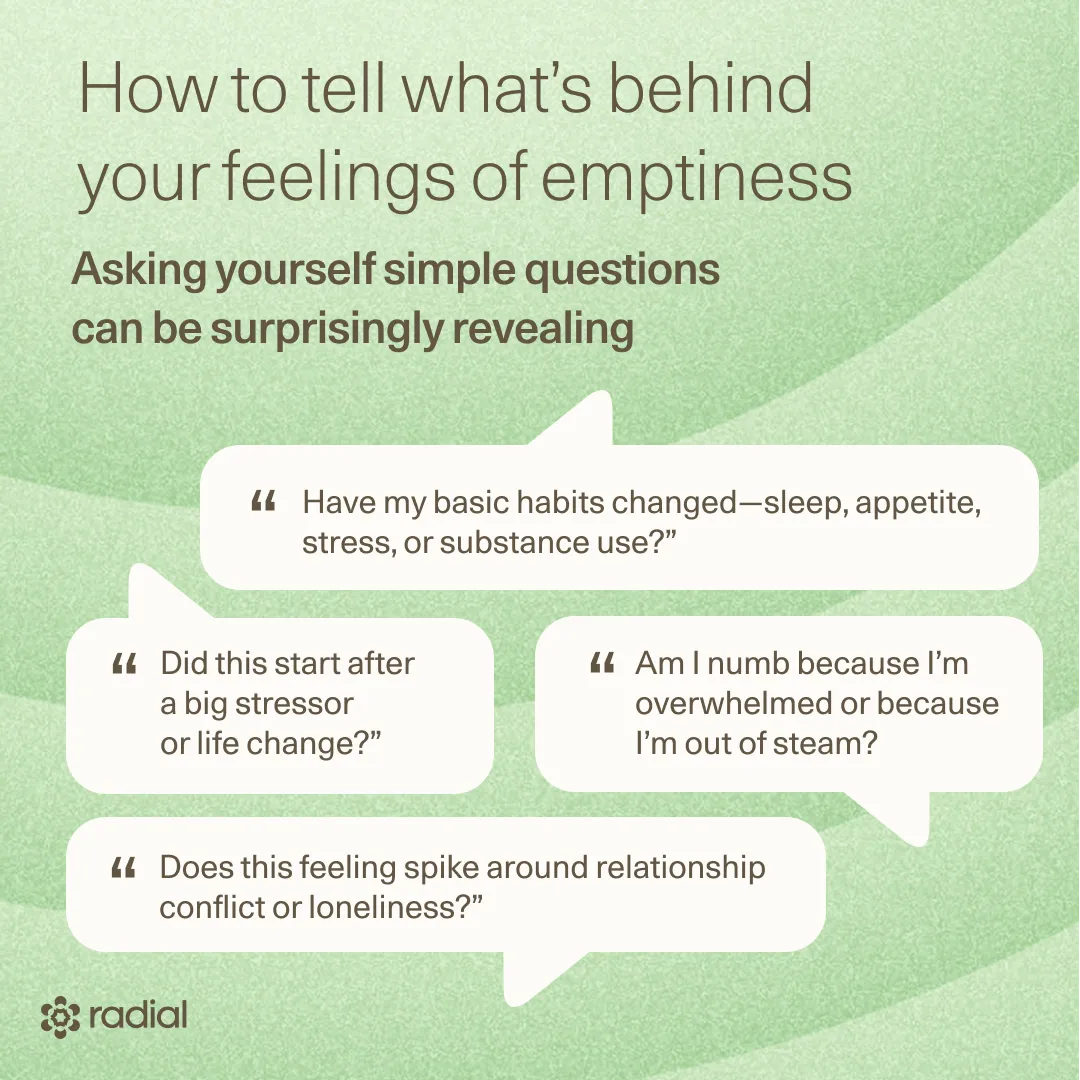
How to tell what’s behind your feelings of emptiness
When you feel hollow inside, the real question is: why now? Because emptiness can come from so many places, figuring out the source can feel like detective work. Dr. Hartselle recommends asking yourself a few simple—but surprisingly revealing—questions to help narrow things down.
Did this start after a big stressor or life change?
“If yes, it often points to identity disruption or emotional overload,” says Dr. Hartselle. Major transitions (breakups, job changes, new parenthood, illness) can temporarily shake your sense of who you are.
Am I numb because I’m overwhelmed or because I’m out of steam?
If you’re overloaded, dissociation may be taking the wheel, says Dr. Hartselle. If your energy and motivation have tanked, depression or burnout might be involved, she adds. And yes—you can be both overwhelmed and exhausted (a fun combo!).
Have my basic habits changed—sleep, appetite, stress, or substance use?
Shifts in these rhythms point to possible biological, medical, or lifestyle factors, which can flatten your brain’s reward system, making everything feel muted, says Dr. Hartselle.
Does this feeling spike around relationship conflict or loneliness?
If emptiness shows up when connection is shaky, the root may be unmet attachment needs or deeper questions about self-worth and identity in relationships, says Dr. Hartselle.
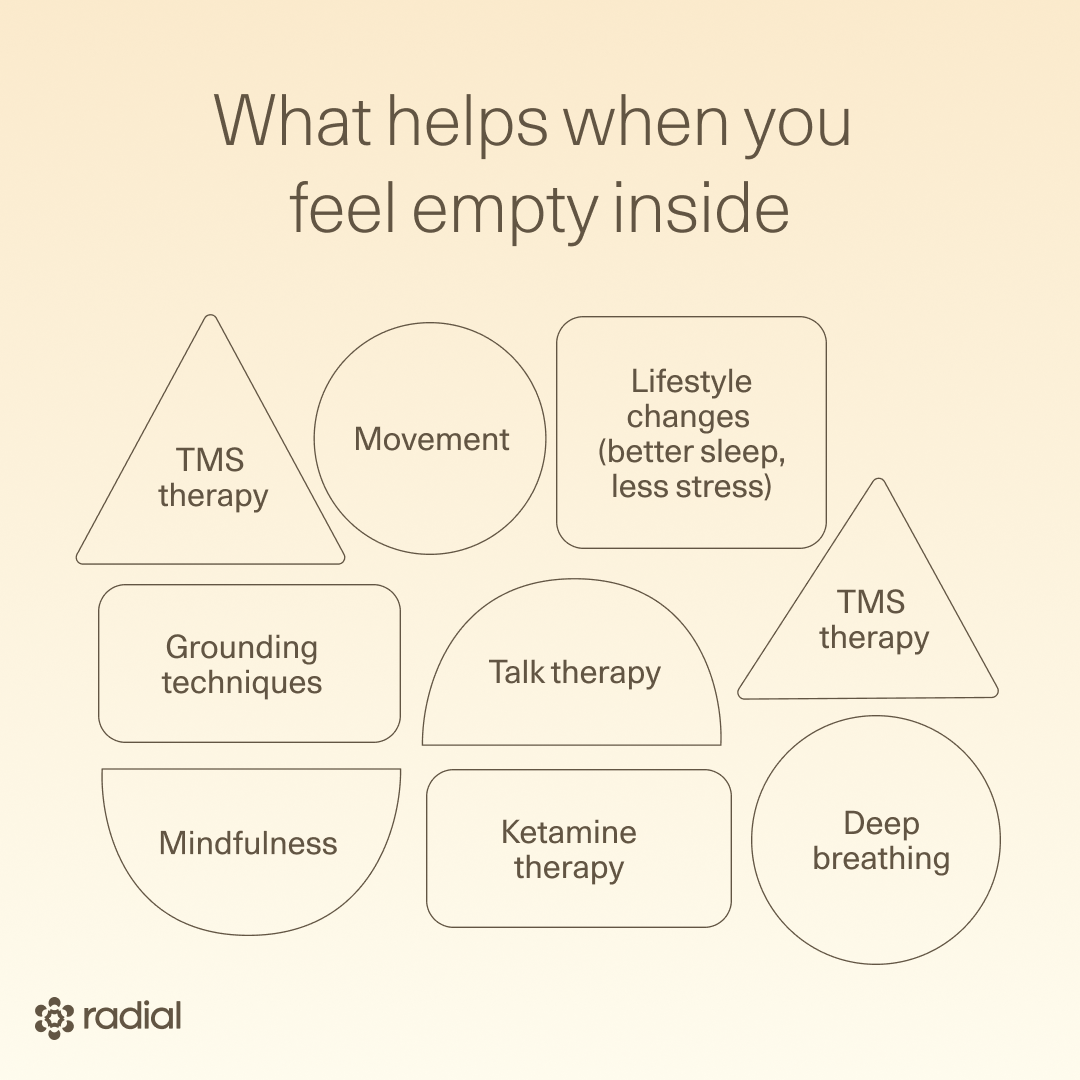
What helps when you feel empty inside
“Things That Help”
- Talk therapy
- Movement
- Mindfulness
- Deep breathing
- Grounding techniques
- TMS therapy
- Ketamine therapy
- Lifestyle changes (better sleep, less stress)
Emptiness doesn’t have to be permanent, and there are ways to climb out of the hollow. “Emptiness eases by rebuilding connections to your body, your emotions, your relationships, and your sense of meaning,” says Dr. Hartselle. Here’s where to start.
Talk therapy
When your inner world feels blank, talking it out can bring the color back. Therapy gives you a safe space to sort through your thoughts, emotions, and behaviors with someone trained to actually help. A good therapist knows that “emptiness” isn’t a checkbox; it’s a clue.
Here are the modalities Dr. Hartselle recommends for emptiness:
- Cognitive behavioral therapy (CBT): Helps you identify unhelpful thought/behavior patterns and swap them for healthier, more balanced ones.
- Mentalization-based therapy (MBT): “Strengthens your ability to understand your own thoughts, feelings, and intentions (and other people’s),” especially when emptiness is tied to attachment wounds or a shaky sense of identity, says Dr. Hartselle. MBT is a research-supported treatment for borderline personality disorder.
- Dialectical behavior therapy (DBT): Teaches emotion regulation, distress tolerance, and interpersonal effectiveness. Originally developed for BPD, it’s also used for depression, ADHD, bipolar disorder, substance use, and eating disorders.
Connect with your body
When your head feels far away, your body can bring you back online. Grounding and breath-based practices can “quickly pull you out of dissociation and back into the present,” says Dr. Hartselle. Try:
- Movement: A walk, yoga (including trauma-sensitive options), or even a 30-second kitchen dance break can help. Any movement counts—truly.
- Mindfulness: Mindfulness can increase awareness of body sensations, expand your tolerance for uncomfortable emotions, and help you reconnect with yourself and others.
- Breathwork: Deliberately changing how you breathe—especially slow, nasal, diaphragmatic breaths— can boost vagal tone (crucial for your body's "rest and digest" system), heart rate variability, parasympathetic activity, and emotional regulation, while lowering cortisol, anxiety, and PTSD symptoms.
- Grounding techniques: Grounding brings you back to “the now” when emotions or memories overwhelm you. Examples include:
- Name five red objects in the room
- Count backward from 100
- Use somatic cues like toe-wiggling or touching the arm of your chair
Standout Box: A note of nuance: For some people with PTSD or dissociation, traditional mindfulness practices can trigger depersonalization (feeling detached from yourself) or derealization (feeling like the world isn’t real). Trauma-informed approaches can help avoid this, so it’s worth working with a trained clinician if you’ve had adverse reactions.
TMS therapy
If depression is driving your emptiness, non-invasive, brain-based treatments like transcranial magnetic stimulation (TMS) may offer relief without the use of medication, says Dr. Hartselle. Already FDA-cleared for major depression, TMS therapy uses magnetic pulses to stimulate specific mood-related brain regions, especially the dorsolateral prefrontal cortex (DLPFC), which can be underactive in depression.
If your emptiness stems from trauma and you have PTSD, early research also suggests both high- and low-frequency TMS may help reduce symptoms (without requiring you to revisit traumatic memories).
Ketamine therapy
When depression blunts your emotions, ketamine may help you feel again—literally.
“Ketamine-based treatments can restore emotional access and motivation,” says Dr. Hartselle. Ketamine acts much more quickly than traditional antidepressants. Exactly how ketamine works is not certain, but it probably acts by strengthening connections between brain cells.
Ketamine can be given intravenously, intramuscularly, or orally. And then there is also esketamine (Spravato) which is an FDA-approved medication that is closely related to ketamine. Esktamine is given as a nasal spray for treatment-resistant depression.
Small lifestyle tweaks
Tiny shifts can slowly refill the inner tank. “Smaller steps—better sleep, reduced stress, gentle social contact, and creative expression—also nudge the brain out of the low-reward fog that makes life feel empty,” says Dr. Hartselle. None of these are magic cures, but they help rebuild the reward pathways that emptiness tends to dim.
Relief within reach
Care covered by your insurance
Radial provides advanced mental health treatment, covered by the insurance you already use.








What doesn’t help
If you’re feeling dead inside, you may be desperate to bring yourself “back to life,” fast. But the quick fixes that promise “feeling something” usually backfire. Trauma and dissociation can make you feel disconnected or “not fully here,” which is why some people turn to substances or self-harm for a temporary spark to help them feel anything, says Dr. Hartselle. But while these behaviors may feel briefly helpful, they “can flatten the brain’s reward system baseline and worsen the cycle,” she explains.
When it’s time to reach out for support
A little emptiness now and then is human. Persistent emptiness that hijacks your life? That’s your cue to call in reinforcements. If the hollow feeling is sticking around, messing with your mood, or spilling into your relationships, talking to a professional can make a real difference. Bring those insights from your self-check—when the emptiness peaks, what triggers it, what’s changed. This helps a clinician connect the dots faster and get you the right support.
According to Dr. Hartselle, it may be time to reach out for professional backup when:
- Emptiness is no longer occasional—it’s showing up regularly.
- You feel overwhelmed by it or can’t climb out of it on your own.
- It lasts for weeks or tags along with depression, anxiety, dissociation, or big shifts in sleep, appetite, or motivation.
- It’s getting in the way of daily functioning, straining relationships, or sparking hopelessness.
“If the emptiness feels tied to trauma, identity confusion, or chaotic relationship patterns, that’s exactly where therapy can prevent these cycles from becoming more entrenched,” says Dr. Hartselle.
That said, some symptoms aren’t “wait and see”—they’re stop-everything signs. “Thoughts of self-harm, death, or suicide can accompany chronic emptiness and depressed mood are urgent signals that you need to talk to someone [right away],” says Dr. Hartselle.
You don’t have to white-knuckle your way through emptiness. Real treatments exist, and with the right support, things can get better.
Standout box: If you’re in crisis, please don’t wait to get support. Help is just a call, text, or click away. Call 911 for immediate medical or safety emergencies. Call or text 988 (or chat online) to connect with a trained mental health crisis counselor at the Suicide and Crisis Lifeline. Veterans: Call 988 and press “1,” text 838255, or chat online with the Veterans Crisis Line.
The bottom line
Feeling empty can be confusing, unsettling, and downright exhausting, but it’s also incredibly human. Whether it’s sparked by stress, trauma, depression, identity shifts, or just running on zero sleep, emptiness is your mind’s way of saying, “Hey, something needs attention.” The good news? With the right support, that hollow feeling can soften, and your sense of connection—to yourself, your emotions, your relationships—can come back online.
If emptiness is lingering or getting in the way of your life, you don’t have to grin and bear it alone. Radial can help you get unstuck with fast-acting, evidence-based treatments that actually meet you where you are. Connect with a licensed clinician—virtually or in person—who will take your concerns seriously and build a treatment plan tailored to you. You deserve to feel whole again, and support is just a conversation away.
Key takeaways
- Emptiness isn’t one thing. It can be tied to stress, burnout, grief, trauma, loneliness, lifestyle factors, or mental health conditions like depression or BPD.
- Your brain plays a big role. Changes in reward circuits, dissociation, and identity disruptions can all flatten emotional depth and fuel that “hollow” feeling.
- Context matters. When emptiness hits—after a big stressor, during a low-energy slump, or around relationship conflict—offers clues about the root cause.
- There are solutions. Talk therapy, grounding techniques, mind-body work, lifestyle tweaks, TMS, and ketamine therapy can help rebuild connection and emotional access.
- Get help if it’s lingering. If emptiness sticks around, disrupts your life, or comes with depression, dissociation, or thoughts of self-harm, it’s time to reach out.
Frequently asked questions (FAQs)
What is emptiness a symptom of?
Feeling empty isn’t one-size-fits-all—it’s more like a “check engine” light that can blink for lots of reasons. According to Dr. Hartselle, emptiness:
- Can show up during major life transitions (like a breakup or job loss), chronic stress or burnout, grief, trauma, or after long periods of loneliness or disconnection
- Can stem from biological or lifestyle factors—think sleep deprivation, medical issues (like thyroid dysfunction or anemia), substance use, or even certain medications.
- Can be tied to mental health conditions such as depression, dissociation, eating disorders, or certain personality disorders.
In short: emptiness is a pattern, not a diagnosis, and the cause depends on what’s going on in your life, body, and relationships.
Is feeling empty a sign of depression?
It can be. Depression often flattens your emotional world, leading to anhedonia—the loss of interest or pleasure in things you usually enjoy—which many people describe as feeling empty or “like the feelings are just… gone.” But emptiness alone doesn’t automatically mean you’re depressed. If that emptiness comes with other symptoms like low energy, loss of motivation, changes in sleep or appetite, or a sense of hopelessness, depression could be part of the picture.
What mental disorder makes you feel empty?
Several conditions can involve emptiness, but one stands out: borderline personality disorder (BPD). In fact, chronic emptiness is a core diagnostic feature of BPD and often one of the most persistent and distressing symptoms. People with BPD may describe it as feeling disconnected from themselves or others, numb, or like there’s an internal void they can’t fill.
That said, emptiness can also show up in other conditions, including depression, trauma-related disorders, dissociative disorders, eating disorders, and even narcissistic or antisocial personality disorders. So if emptiness is part of your daily life, it’s worth exploring the full context with a mental health professional—not jumping to conclusions.
Deep dive recommendations
Kreisman, J and Strauss, H. 2010. I Hate You—Don’t Leave Me: Understanding the Borderline Personality.
Editorial Standards
At Radial, we believe better health starts with trusted information. Our mission is to empower readers with accurate, accessible, and compassionate content rooted in evidence-based research and reviewed by qualified medical professionals. We’re committed to ensuring the quality and trustworthiness of our content and editorial process–and providing information that is up-to-date, accurate, and relies on evidence-based research and peer-reviewed journals. Learn more about our editorial process.
Let's connect
Get started with finding the right treatment for you or someone you care about
Get startedExplore more posts