TMS vs. Spravato: Which Treatment Is Right for You?

Both TMS and Spravato can be helpful for treatment-resistant depression, but they work in different ways. So which is right for you? Choosing TMS vs Spravato depends on your past treatments, medical history, insurance, and your preferred treatment approach.
If you've been living with depression for a while, you've probably tried a few different treatments like antidepressants, therapy, or both. Unfortunately, antidepressants don't provide adequate relief for at least 30% of people who try them, according to World Psychiatry. When that happens, deciding what to try next can feel confusing and discouraging.
You may have heard of transcranial magnetic stimulation (TMS) and Spravato (esketamine), two options that can help with depression. While both can help people who haven't responded well to standard first- or second-line treatments, they work in different ways and have different side effects.
The goal of this article is to help you learn more about TMS vs. Spravato so you can make an informed decision with your healthcare provider. We'll cover how each treatment works, what the research says about effectiveness, side effects and safety, insurance considerations, and how your clinician might determine the best treatment option for you.
Connect with our Clinicians



TMS vs. Spravato: What are the main differences?
The main difference between TMS and Spravato is how they work: TMS uses magnetic pulses to stimulate brain regions implicated in depression, while Spravato is a medication that modulates glutamate signaling in the brain.
Keep in mind, this is just a general overview of Spravato vs. TMS. You'll need to see a healthcare provider to find out if either option is right for your particular situation.
What is TMS?
Transcranial magnetic stimulation, or TMS, is a non-invasive treatment in which a strong magnetic coil stimulates targeted areas of your brain to help regulate mood. Unlike medication, TMS is not a systemic treatment, so it doesn't circulate through the body, and you don't need anesthesia, surgery, or sedation.
- How TMS works: During treatment, a magnetic coil is placed against your scalp to send pulses that stimulate brain circuits linked to depression. This repeated stimulation can help improve how different parts of the mood-related networks in the brain communicate with one another, which may help reduce depression symptoms.
- What TMS treatment usually looks like: TMS for depression usually involves a few treatment sessions each week, often lasting for several weeks. Patients stay awake during the sessions and can usually go back to their normal activities right afterward. Some clinics also offer accelerated TMS therapy protocols, which means that multiple sessions are delivered each day, so that the course can be completed in a shorter amount of time.
What is Spravato (esketamine)?
Spravato is a prescription nasal spray that contains esketamine, a medication approved for treatment-resistant depression and some other depressive disorders in adults.
Spravato for depression differs from IV ketamine therapy and at-home ketamine programs. Spravato treatment must be administered in a certified medical setting under the supervision of a provider.
- How Spravato works: Traditional antidepressants often work by affecting serotonin, norepinephrine, or dopamine. According to the product label, Spravato blocks NMDA receptors, which can change how the brain responds to glutamate, a neurotransmitter involved in learning and memory. This increased glutamate signaling may support changes in brain circuits that regulate mood and emotional processing.
- What Spravato treatment usually looks like: People administer the esketamine nasal spray themselves under the guidance of a healthcare professional. Since there are temporary side effects like sedation, dissociation, and increased blood pressure, people are monitored for at least two hours afterward. At first, treatment sessions happen quite often, but become less frequent once people reach maintenance. However, they can stay on Spravato as long as needed.
According to MaryEllen Eller, MD, the Southeast Regional Medical Director at Radial, Spravato is typically administered twice weekly during the first four weeks of treatment. "You cannot drive the rest of the day after receiving Spravato, so you'll need someone to take you home," she explains.
.webp)
How effective are TMS and Spravato?
TMS and Spravato can lead to meaningful benefits for people with depression who haven't had enough results from standard treatment approaches. But how well they work can really depend on the person, the treatment plan, and what success looks like for you — as you might have noticed in online reviews.
To understand what outcomes mean, it helps to know more about two key terms that often come up in the research:
- Response refers to a meaningful reduction in symptoms of depression, typically defined as at least a 50% improvement on a standardized depression scale, according to Psychiatry Research.
- Remission refers to an improvement of symptoms that makes depression minimal or no longer clinically significant.
Response and remission can both be useful metrics when comparing treatments, but it's important to remember that neither is a guarantee. Research in Expert Review of Neurotherapeutics suggests that some people see big improvements, others see some progress, but a few see little change.
While response and remission rates help researchers and clinicians measure effectiveness, people are often more interested in the real-world signs that Spravato is working or whether TMS is helping them feel better. Such signs may include improved mood and energy levels, or better functioning in daily life.
"Consistent treatment completion is important for TMS to be effective," says Eller. TMS symptom improvement often happens gradually over the course of treatment, whereas Spravato starts working within days or weeks for some people. For both, maintenance treatments may be needed to help ensure those benefits stick over the long term.
Side effects and safety: How do TMS and Spravato compare?
Just like other depression treatments, there are pros and cons to esketamine vs. TMS. The trick is to know about the possible side effects and risks so you can make a more informed choice about whether they might be right for you. Engaging in a collaborative discussion with a healthcare provider is a helpful and necessary step.
TMS side effects and risks
TMS side effects are usually pretty mild or moderate, and usually happen during or right after the session.
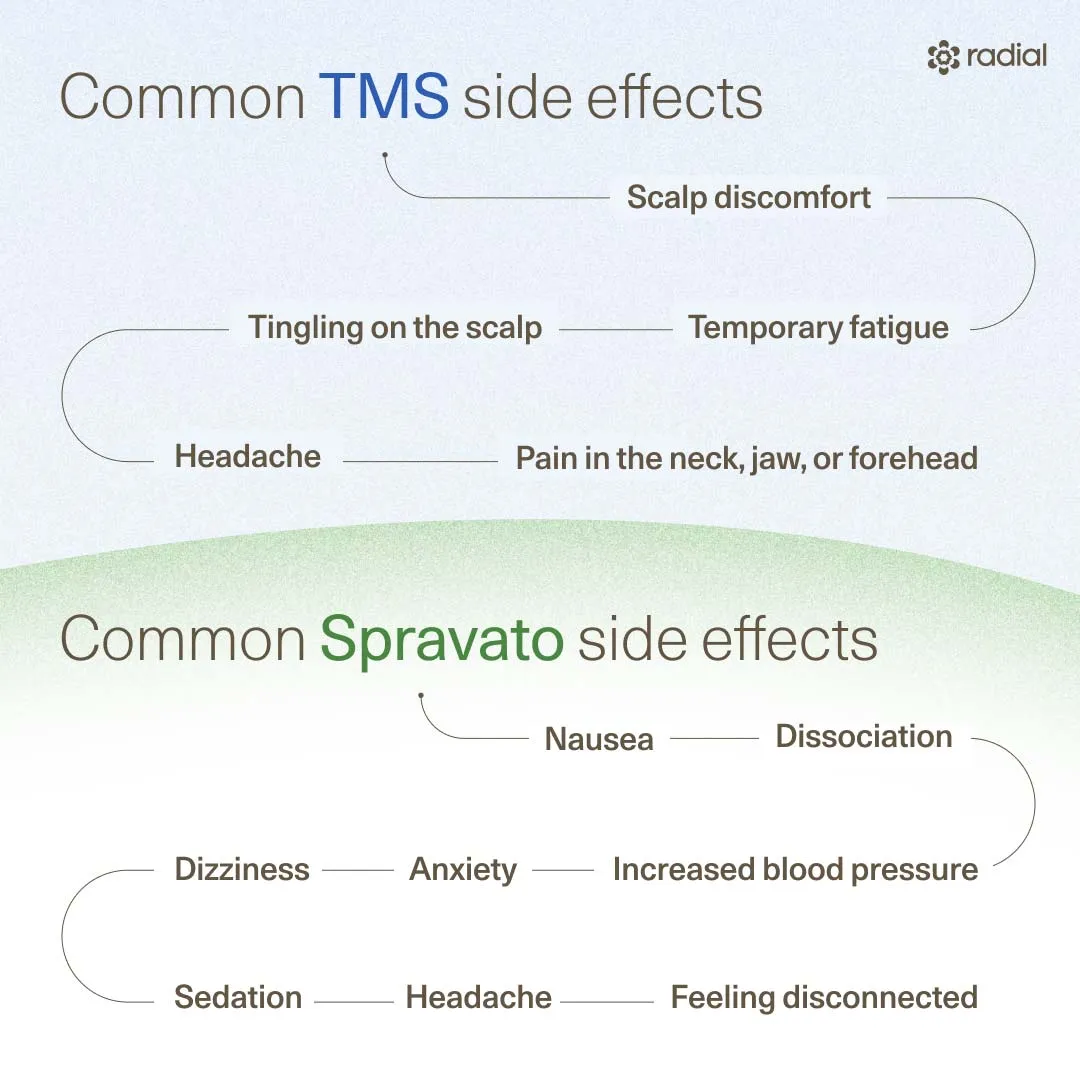
Common side effects include:
- Scalp discomfort
- Headache
- Tingling sensations on the scalp
- Temporary fatigue
- Pain in the neck, jaw, or forehead
Serious adverse events don't happen very often. The main risk is seizure, although it is quite rare (experienced by less than 1 in 1,000 patients according to Brain Stimulation), as long as proper screening and safety protocols are followed.
Eller notes that while TMS is generally considered very safe, it may not be appropriate for everyone. "If you have metal implants in or near your brain or if you have a seizure disorder, we would encourage a different treatment option," she says.
One advantage of TMS is that it usually doesn't require any downtime. Most people can get back to school, work, or their usual daily activities right after treatment.
Spravato side effects and risks
Spravato can cause some short-term side effects of Spravato that you’ll want to keep an eye on after each session.
The medication guide published by the drug's manufacturer suggests that common side effects include:
- Dizziness
- Dissociation
- Nausea
- Sedation
- Increased blood pressure
- Headache
- Anxiety
- Feeling disconnected from surroundings
Because of these effects, Spravato is strictly regulated and only available through a Risk Evaluation and Mitigation Strategy (REMS) program, which the manufacturer describes on the Spravato REMS website. This means that it must be administered in certified healthcare settings where patients can be monitored after treatment.
This observation period is a way for providers to keep an eye out for temporary side effects, such as dizziness and dissociation. It ensures everyone is medically and psychiatrically stable before heading home. Spravato's side effects also mean that people must have transportation home after each session.
Eller notes that the dissociative effects can be unsettling for some people. "During your two-hour treatment, you may experience dissociation, or an out-of-body experience. This can be very distressing for some people," she explains. "We often encourage clients with co-occurring PTSD to have a planning session with a trained therapist so they can feel well-prepared."
Who may be a better candidate for TMS vs. Spravato?
Deciding between TMS and Spravato isn't usually based on just one factor. Doctors look at a mix of personal, medical, and practical factors before recommending the best option. A thorough evaluation is key because figuring out if you're eligible for a treatment depends on more than just your diagnosis.
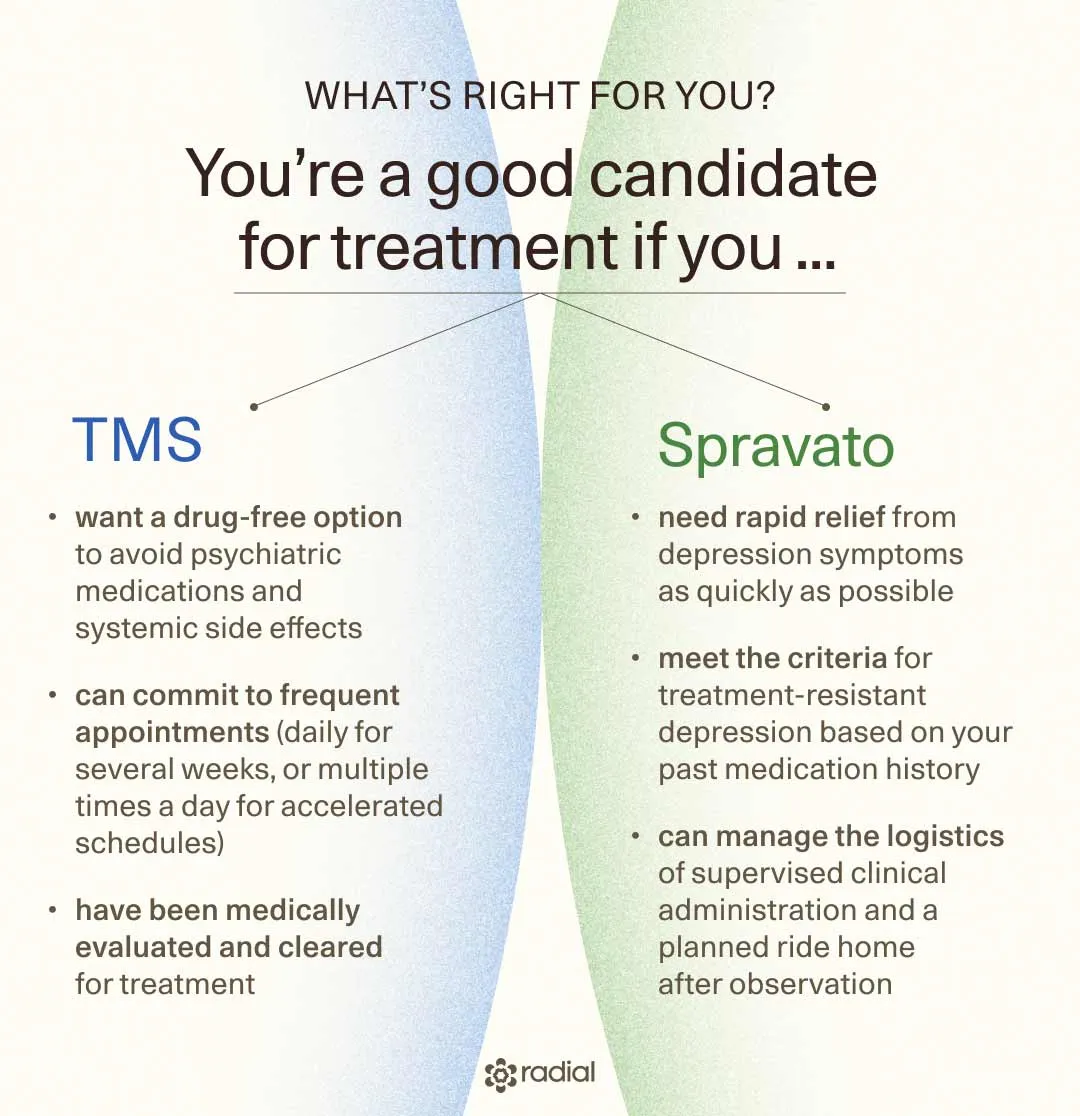
TMS may be a better fit for people who...
- Prefer a non-pharmacological approach and want to avoid taking another psychiatric medication.
- Are concerned about side effects that can occur when a medication circulates through the body.
- Can commit to frequent appointments, since TMS treatment takes several weeks on a standard schedule or several times per day for accelerated TMS.
- Have been evaluated and found clinically appropriate for TMS treatment.
- Have tried at least 2 antidepressant medications (for insurance coverage) or can pay out of pocket for treatment
Spravato may be a better fit for people who...
- Need relief from depression symptoms as quickly as possible.
- Qualify for treatment-resistant depression treatment based on their treatment history.
- Are comfortable with having the medication treatment supervised in a clinical setting.
- Can arrange observation time and transportation after each appointment.
"Spravato is a great treatment option if you have treatment-resistant depression or if you're depressed and experiencing thoughts of dying by suicide," Eller says.
Who may not be a good candidate?
Sometimes, medical reasons mean one treatment might not be the best choice over another.
A person may not be a good candidate for TMS if they have:
- Metal implants or metallic objects in or near the head
- Certain implanted medical devices
- Seizure history and seizure risk factors
- A history of retinal detachment
For Spravato, providers may consider contraindications listed on the medication's product label, including:
- High blood pressure or poor cardiovascular health
- Certain vascular conditions
- History of psychosis
- Substance use concerns
- Pregnancy
Eller notes that Spravato can temporarily increase blood pressure after treatment, which may make it less suitable for some people with uncontrolled hypertension. She also cautions that because esketamine is derived from ketamine, providers may pay particular attention to a person's history of substance use when determining whether the treatment is appropriate.
What do TMS and Spravato cost, and does insurance cover them?
Both TMS and Spravato may be covered by insurance for eligible patients. Research in Clinical Therapeutics suggests that coverage depends on factors like diagnosis, treatment history, plan requirements, prior authorization rules, and provider participation.
TMS cost and insurance coverage
The cost of TMS varies by provider and treatment protocol, but without insurance, a full course can cost several thousand dollars.
Insurance coverage for TMS is available through many plans, although prior authorization is often required. Insurers want to see evidence that standard depression treatments haven't provided adequate relief before they'll give the green light for TMS. Usually, they consider a few factors, including the average cost of the full treatment, prior authorization, and documentation of past therapy trials.
Spravato cost, insurance coverage, and REMS access
Spravato can also be expensive without insurance because patients must pay for both the medication and the required in-clinic monitoring. Insurance coverage for Spravato is available through many plans. Prior authorization and documentation of previous treatments are often required.
The manufacturer also offers patient assistance programs for some patients. Because Spravato is only available at REMS-certified locations, you'll also need to factor in transportation and time spent at appointments when planning treatment.
Can TMS and Spravato be used together?
While researchers are exploring whether combining TMS and Spravato may provide additional benefits, these treatments are generally considered standalone interventions. "Insurance generally limits coverage to one intervention at a time," Eller explains. However, clinicians may recommend switching from one treatment to the other if symptoms persist. "If TMS isn't fully effective, we may recommend Spravato to address lingering symptoms — or vice versa," she says.
How clinicians decide between TMS and Spravato
The choice between TMS and Spravato involves considering multiple factors, rather than picking on a single consideration or "best" treatment. An evaluation with a clinician can determine whether TMS, Spravato, or a different treatment would be the best fit.
- Diagnosis and symptom pattern: Different conditions have different symptoms, which can influence treatment choices.
- Severity and urgency of symptoms: Spravato might be recommended if fast results are the priority due to acute distress and suicidal thinking.
- Medication and treatment history: How people responded to past treatments offers important context that guides next steps.
- Medical history and contraindications: Certain conditions or medical factors, such as high blood pressure or a history of seizures, may make one option more appropriate than another.
- Substance use history: A history of substance use might influence whether Spravato is recommended.
- Side effect tolerance: People who are concerned about side effects like dissociation, increased blood pressure, or sedation may prefer TMS.
- Practical considerations: Treatment schedules, time commitments, and transportation needs influence which option is most doable.
- Insurance coverage: Both may be covered, but prior authorization requirements and out-of-pocket costs can vary.
- Patient goals and preferences: Some people put a bigger emphasis on fast relief, while others prefer a medication-free approach.
- Alternative treatment strategies: Sometimes neither treatment is the right choice, and TMS or Spravato alternatives such as electroconvulsive therapy (ECT) make more sense.
- Patient preference: If there's not a strong reason to prescribe one treatment over the other, often a provider will consider the patient's preference.
"While both TMS and Spravato can be effective ways of obtaining relief from treatment-resistant depression, your medical history, current medications, and differing time commitments are important factors to consider while choosing which treatment is right for you," says Eller.
It's also worth noting: if someone tries TMS and doesn't have much of a response, they can usually try Spravato next, or vice versa.
Relief within reach
Care covered by your insurance
Radial provides advanced mental health treatment, covered by the insurance you already use.








The bottom line
For many people choosing between TMS vs. Spravato, the decision often comes down to fit rather than effectiveness. Both can work well for people who haven't responded enough to other depression treatments, but their unique advantages and tradeoffs might make one appeal to you more than the other.
TMS might appeal to you if you'd prefer minimal recovery time and want to avoid medication. Spravato can be a better fit if fast relief is a key factor, and you're comfortable with the additional monitoring requirements.
But depression symptoms alone aren't the deciding factor. Your medical history, past treatment experiences, lifestyle, insurance, coverage, and personal preferences matter too. Talking to a Radial clinician can help you weigh those considerations and decide which approach is most appropriate for you.
Key takeaways
- TMS uses magnetic stimulation, while Spravato is an esketamine nasal spray medication.
- Both treatments are effective for treatment-resistant depression, but results vary from one person to the next.
- Spravato can often produce quick results, while TMS usually has more gradual effects over the course of treatment.
- TMS tends to have mild side effects, while Spravato requires monitoring after each treatment session.
Frequently asked questions
Do I need to stop my current antidepressants to use TMS or Spravato?
No, you generally do not need to stop taking antidepressants to use TMS or Spravato. Many people continue taking antidepressants while receiving either treatment. Your provider can explain whether any medication adjustments are needed.
Can you switch from Spravato to TMS, or from TMS to Spravato?
Yes. It is not uncommon for patients to transition from one treatment to another if their initial treatment does not provide adequate benefit or if circumstances change.
Can you work during a course of TMS or Spravato?
Many people continue working during treatment. TMS appointments are typically fairly short, and most people can return to normal activities right away. Spravato appointments are longer and require in-office monitoring and transportation home, which may require more flexibility when it comes to scheduling.
Is TMS or Spravato better if you're sensitive to medication side effects?
Some people find TMS appealing for this reason, since it doesn't involve taking a medication that might cause systemic side effects. Whether that makes it the better option depends on your overall situation and preferences, which are worth discussing with your provider.
Are TMS and Spravato used only for depression?
No. Both treatments may have additional approved or emerging uses depending on the condition, treatment setting, and regulatory status. Different TMS devices and protocols are cleared for major depressive disorder, obsessive-compulsive disorder, smoking cessation, and migraine. The Spravato website states that the medication is FDA-approved for treatment-resistant depression and major depressive disorder with acute suicidal ideation or behavior. Your provider can explain whether either treatment is relevant to your diagnosis.
Disclaimer: One medical reviewer listed on this article, Steve Harvey, MD, is a paid speaker for Spravato.
Editorial Standards
At Radial, we believe better health starts with trusted information. Our mission is to empower readers with accurate, accessible, and compassionate content rooted in evidence-based research and reviewed by qualified medical professionals. We’re committed to ensuring the quality and trustworthiness of our content and editorial process–and providing information that is up-to-date, accurate, and relies on evidence-based research and peer-reviewed journals. Learn more about our editorial process.
Let's connect
Get started with finding the right treatment for you or someone you care about
Get startedExplore more posts