TMS Therapy Reviews: What Patients Say About Results and Side Effects

Curious what real people actually say about TMS? We analyzed public TMS therapy reviews to uncover the patterns — life-changing successes, frustrating setbacks, side effects, timelines, and what the experience is really like.
Reading TMS therapy reviews can feel like emotional whiplash: one person says treatment gave them their life back, another says it didn't help at all. It's enough to leave anyone wondering what to believe: is this treatment really worth the hype?
Transcranial magnetic stimulation (TMS) is a noninvasive treatment that uses magnetic pulses to stimulate brain regions involved in mood regulation, relieving depression, anxiety, and OCD. Most online TMS therapy experiences focus on depression, so they don't always apply to other conditions, which is one reason searching for TMS reviews on Reddit and other forums can feel so confusing.
To cut through the noise, we analyzed patterns across public TMS patient reviews, compared them with clinical research, and asked TMS experts to explain what these firsthand accounts can — and can't — tell you. We'll cover what people consistently report, why experiences vary so much, how reviews compare with the evidence, and how to read TMS treatment reviews with a more informed perspective.
Healing happens through strong relationships
Compassionate, experienced mental health professionals focused on evidence-based care




What public online TMS therapy reviews consistently report
To get a sense of what TMS is actually like, I dug through Reddit threads, YouTube videos, and other public patient testimonials. While everyone's experience is different, a few themes come up again and again.
Because most online reviews are from people treated for depression, that's the primary focus here unless otherwise noted.
Common positive themes and signs of improvement
Although everyone's experience was unique, these were the wins people mentioned most often.
Life-changing results
Some people describe TMS as nothing short of life-changing. One Reddit user with OCD and depression wrote, “4 months post TMS and I have my life back.” Before treatment, her fear of death and car accidents made it difficult to live independently. By the end, she was driving herself to appointments and no longer relying on her husband.
Joy returns
Many people say they started enjoying life again. YouTuber and musician Destiny Ann shared, “Everything that… used to be fun in my life is now fun again.” After TMS, she rediscovered her love of playing violin and looked forward to concerts again.
Results happen on varying timelines
Some people notice improvements within days, while others need more time. As one Reddit user put it, “I was a late responder,” adding that 10 extra sessions beyond the initial 36 “did the trick.”
Different protocols work for different people
No single approach works for everyone. One Reddit user found the “5 day, 10 times a day intensive Theta Burst treatment” more effective than the standard protocol, saying, “I felt better by the 3rd day of treatment.”
Meaningful improvement, not necessarily perfection
Many reviewers emphasize that TMS isn't a cure-all, but it can significantly improve quality of life. As one Reddit user wrote, “I am not 100% recovered…but I can now consider myself a functioning adult…I feel like the world is lighter and things are easier to manage.”
Many viewed TMS as one tool — alongside therapy, sleep, exercise, and nutrition — for supporting long-term mental health.
Common mixed or negative themes and logistical challenges
Not every review is glowing. Some people experienced side effects, found TMS didn't help, or felt the benefits faded over time. Here are the most common concerns mentioned in TMS negative reviews.
Benefits faded over time
Some reviewers said their depression gradually returned. One Reddit user wrote, “It genuinely saved my life... But these effects have slowly started to wear off.” Still, they added, “It’s nowhere nearly as bad as it was before.”
Emotional changes
A small number of people described feeling emotionally flat or disconnected. One Reddit user said, “I felt dull, like someone turned the volume down on my emotions.” Another called their experience “exceedingly rare,” describing it as though part of their brain had “shut off.”
Feeling wired or anxious
Some reported feeling unusually energized, irritable, or anxious. One Reddit user wrote, “I felt so wired from BrainsWay, and as someone who deals with panic attacks, that's the last feeling I need.”
Fatigue and headaches
Fatigue was another common complaint. YouTuber Olivia Kathryn said TMS left her “super tired afterwards,” though her doctor explained it was like “exercising your brain.” Headaches were also frequently mentioned — usually mild, but occasionally severe.
A temporary mood dip
Some people described a brief worsening of depression before improving. Destiny Ann called it the “TMS dip,” saying it “was not a fun place,” but her mood improved as treatment continued.
The time commitment
Even satisfied patients admitted that TMS can be demanding. Standard treatment typically requires weekday appointments for six weeks or more. As one Reddit user put it, “It’s time consuming — not the treatment itself, but going every weekday,” adding it can be tricky balancing with a job. Many also mentioned the mental energy it took to stick with the full course.
Why do TMS therapy reviews vary so much?
If you've read enough TMS reviews, you've probably noticed one thing: they're all over the map. That's because TMS is "not a one-size-fits-all treatment," says Seth Resnick, MD, DFAPA, FASAM, a board-certified psychiatrist at Radial. Response depends on many factors, per a paper in Psychiatriki.
Here are some of the biggest reasons two people can have very different experiences:
- The condition being treated: "TMS has the strongest evidence for major depressive disorder, but it is also used for conditions such as OCD and, in some cases, other psychiatric disorders," says Dr. Resnick. Different conditions — and even different symptoms within the same diagnosis — can respond differently, he adds.
- The protocol and device: "Not all TMS treatments are the same," says Dr. Resnick. The brain target, stimulation pattern, intensity, schedule, and device can all influence results, he explains. There's no single "best" protocol for everyone, he adds.
- Your provider: An experienced clinical team can make a difference by selecting the right protocol, monitoring progress, and adjusting treatment when needed, says Dr. Resnick. But provider expertise is only one piece of the puzzle.
- Whether you complete treatment: TMS often takes time to work. "Stopping treatment prematurely may prevent patients from receiving the full therapeutic benefit," says Dr. Resnick. If you're struggling with discomfort, tell your provider. "Your treatment can be adjusted so that you are comfortable."
- Your overall health: "Depression rarely exists in isolation," says Dr. Resnick. Anxiety, trauma, chronic pain, sleep disorders, medical conditions, medication changes, therapy, stress, and lifestyle habits can all influence how well TMS works.
One more thing: expectations matter. It's understandable to hope TMS will be the treatment that finally works, but expecting an overnight miracle can set you up for frustration and disappointment, according to research in Current Opinion in Psychology.
As one Reddit user, a TMS technician certified in NeuroStar, BrainsWay (Deep TMS), and EEG-guided MeRT, put it: "Go in with absolutely no expectations … having expectations … will only limit the growth you are able to make." Many people experience meaningful improvement, but for most, it's a gradual process rather than an instant transformation.
How online TMS reviews compare with clinical research
Online reviews can tell you what TMS feels like in real life. Clinical studies tell you how it performs across large groups of people. Both are useful, but neither can predict how you will respond.
Here's where online experiences and the research line up:
Some people respond, some don't
"TMS is an evidence-based treatment with response rates that are significantly better than placebo," says Dr. Resnick. In one large retrospective study published in Clinical Neurophysiology., rTMS for major depressive disorder had response rates of 58-83% and remission rates of 28-62%.
But, as Dr. Resnick notes, "like nearly every treatment in medicine, it is effective for some patients, partially effective for others, and unfortunately not effective for everyone."
Different protocols work for different people
If one protocol doesn't help, another might. "In some cases, a patient who doesn't respond to one protocol may respond to another," says Dr. Resnick, because different protocols stimulate brain networks in different ways.
Timelines vary
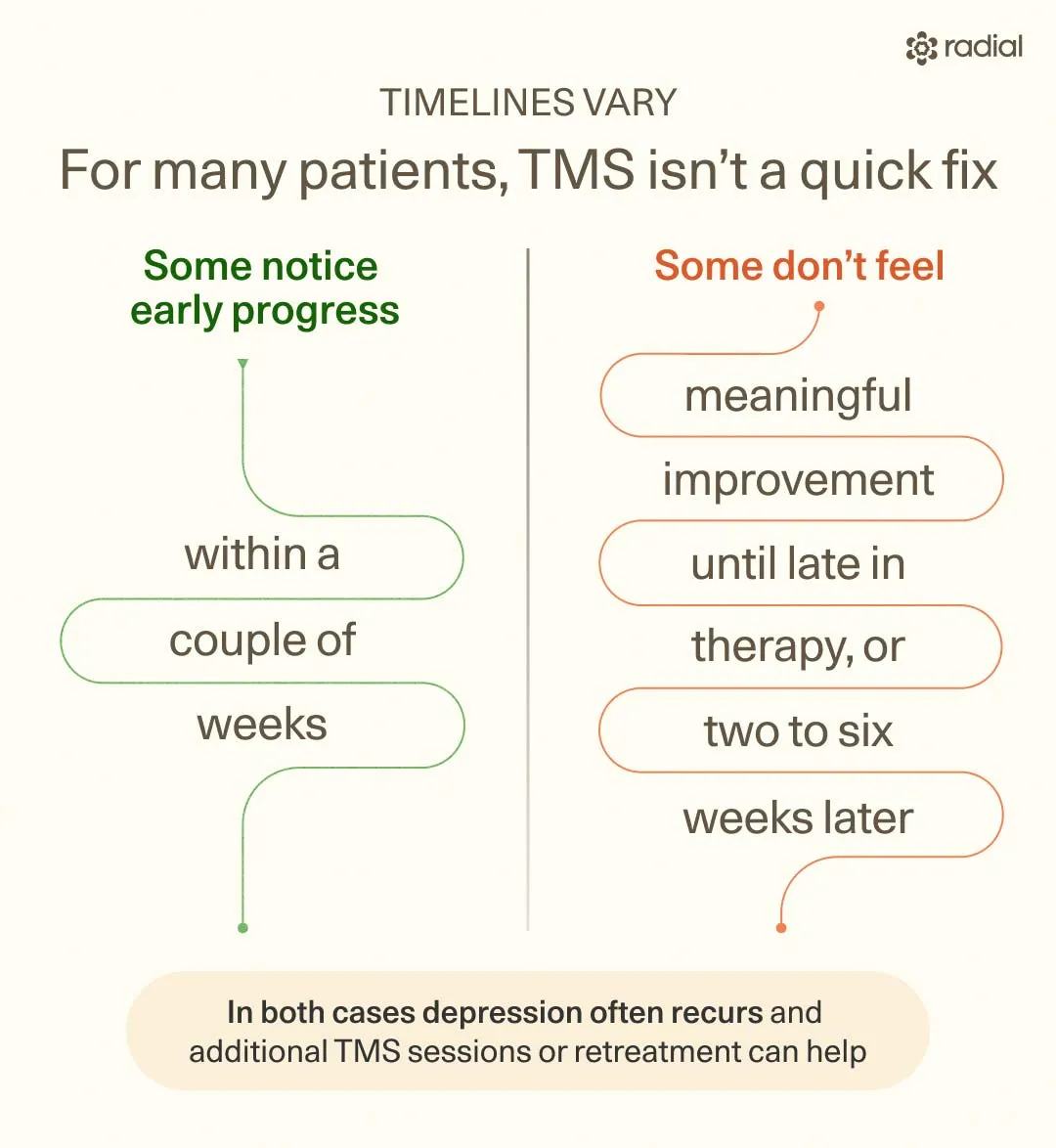
For many patients, TMS isn’t a quick fix. Some people feel better within the first couple of weeks, while others don't notice meaningful improvement until late in treatment, or even 2 to 6 weeks after their final session, says Dr. Resnick. Some patients also benefit from an extended course, he adds.
Results may not last forever
TMS can provide lasting relief, but depression itself has a high relapse rate, per research in the International Journal of Physiology, Pathophysiology, and Pharmacology. If symptoms return months later, additional TMS sessions or retreatment may help.
Side effects are usually mild and temporary
The most commonly reported side effects in studies include headaches, scalp discomfort, fatigue, nausea, and dizziness, according to research in Current Opinion in Psychology. Another frequent complaint, fatigue, often improves after the first week or two, says Dr. Resnick.
More serious psychiatric effects — such as increased anxiety, irritability, or hypomania — are rare but can occur, per a paper in Psychiatriki. “Emotional blunting” is also occasionally reported, though Dr. Resnick notes it may stem from depression itself or antidepressant medications rather than TMS. If anything feels off, let your treatment team know so your plan can be reassessed.
Some people feel worse before they improve.
"Some patients experience a temporary worsening of symptoms before they begin to feel better," says Dr. Resnick. This so-called "TMS dip" can feel discouraging, but it may simply reflect the brain “adapting to changes in neural activity” before benefits emerge, he explains.
Mood changes during treatment can also be influenced by factors like stress, medication changes, poor sleep, or the natural course of depression, says Dr. Resnick. If symptoms worsen or new ones develop, contact your provider promptly so your treatment plan can be adjusted if needed.
How to read TMS therapy reviews more clearly
Online reviews are a great place to learn what TMS can be like, but take them with a healthy dose of perspective — think of them as helpful anecdotes, not as evidence of what your own experience will be. "Online reviews can provide insight into individual experiences, but they shouldn't be viewed as a predictor of how someone else will respond," says Dr. Resnick.
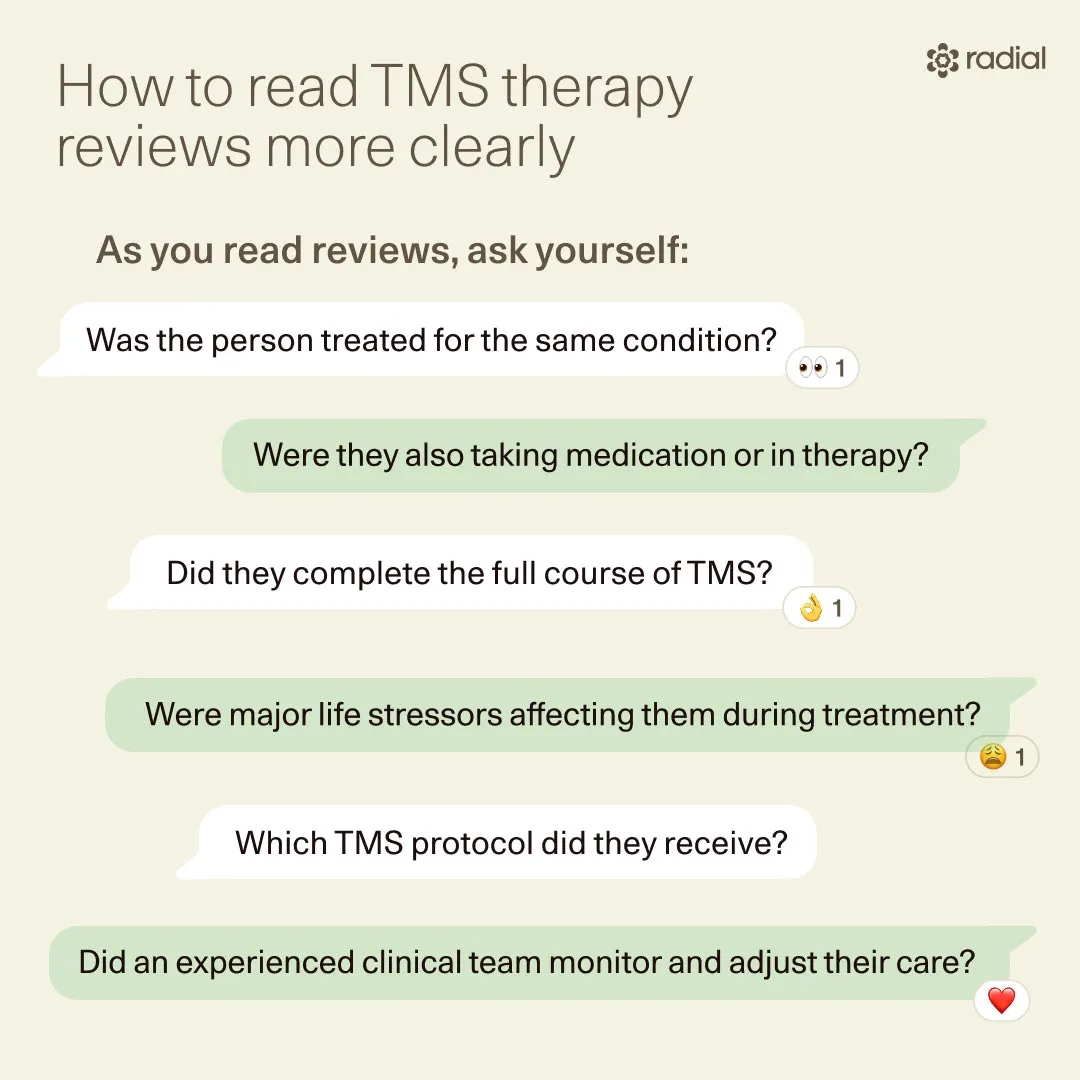
As you read reviews, ask yourself:
- Was the person treated for the same condition?
- Did they complete the full course of TMS?
- Were they also taking medication or in therapy?
- Were major life stressors affecting them during treatment?
- Which TMS protocol did they receive?
- Was their care monitored and adjusted by an experienced clinical team?
Also remember that online reviews are naturally skewed. "People are generally more likely to post online after having either an exceptionally positive or exceptionally negative experience … [but] the majority of patients fall somewhere in between those extremes," says Dr. Resnick.
His advice? Use reviews as one piece of the puzzle, not the whole picture. "The most useful information comes from discussing your own clinical situation with a psychiatrist experienced in TMS, who can explain how the available evidence applies to your specific diagnosis and treatment history."
Relief within reach
Care covered by your insurance
Radial provides advanced mental health treatment, covered by the insurance you already use.








The bottom line
Reading TMS reviews can be reassuring and eye-opening. They include everything from life-changing recoveries to gradual improvements, temporary setbacks, logistical frustrations, and cases where treatment simply didn't help. Together, they paint a realistic picture of what TMS can look like, but they can't predict how you will respond.
As Dr. Resnick says, "it's important to have realistic expectations. TMS is not a miracle treatment, and it doesn't work for everyone. The best outcomes typically occur when TMS is delivered as part of a comprehensive treatment plan that includes thoughtful psychiatric evaluation, appropriate medication management when indicated, psychotherapy, healthy lifestyle habits, and ongoing follow-up."
If you're considering TMS, the next step is simple: bring your questions — and even the reviews you've read — to a qualified provider who can evaluate your diagnosis, treatment history, and goals. Radial makes it easy to connect virtually or in person with a licensed clinician who can help you explore whether TMS is right for you.
Key takeaways
- TMS experiences vary widely. Some people report dramatic improvement, while others experience gradual, partial, or no benefit.
- Results often take time. Many patients don't notice meaningful changes until later in treatment or even weeks after finishing.
- Side effects are usually mild and temporary. Headaches, scalp discomfort, fatigue, and a temporary mood dip are the most commonly reported.
- Online reviews tell stories, not probabilities. They can help you understand the range of experiences but can't predict your own outcome.
Frequently asked questions (FAQs)
Are TMS therapy reviews generally positive or negative?
They range widely from life-changing TMS success stories to “TMS ruined my life.” But those are the extremes. Most people fall somewhere in between, says Dr. Resnick. Reviews can help you understand the range of experiences, but they can't predict your own.
Does TMS therapy actually work?
Yes. Since receiving FDA clearance in 2008, TMS has become an established treatment for depression, with newer protocols continuing to expand its potential. Even people who haven't improved with medication often respond.
Standard TMS for major depressive disorder has response rates of 58-83% and remission rates of 28-62%. SAINT TMS has shown even higher remission rates for MDD — 79% in one study after five days of treatment, per research in The American Journal of Psychiatry. Still, results vary based on the individual, protocol, and condition being treated.
Can TMS reviews for depression predict results for OCD or anxiety?
No. TMS for depression and OCD target different brain networks using different protocols, explains Dr. Resnick. In other words, you can’t compare the treatments (or the results) side by side. Even reviews from people with the same condition can't predict your outcome.
Editorial Standards
At Radial, we believe better health starts with trusted information. Our mission is to empower readers with accurate, accessible, and compassionate content rooted in evidence-based research and reviewed by qualified medical professionals. We’re committed to ensuring the quality and trustworthiness of our content and editorial process–and providing information that is up-to-date, accurate, and relies on evidence-based research and peer-reviewed journals. Learn more about our editorial process.
Let's connect
Get started with finding the right treatment for you or someone you care about
Get startedExplore more posts