What Is Mentalization-Based Therapy (MBT)?

If you’ve ever left a conversation thinking, “How did that go so wrong?” or wondered why intense emotions seem to trigger reactions before you can slow down, mentalization-based therapy (MBT) may offer a different way forward. MBT helps you understand what’s happening inside you and between you and other people—especially in the moments that feel most confusing, charged, or painful—making it easier to pause, reflect, and stay connected to yourself and others.
Choosing a therapy can feel overwhelming. Cognitive behavioral therapy (CBT), dialectical behavioral therapy (DBT), eye movement desensitization and repossession (EMDR), psychodynamic therapy… The list of available therapies is vast, and it’s not always clear which may be a good fit. If conflict, closeness, or emotional overwhelm are where you tend to get stuck, mentalization-based therapy (MBT) is one option designed with those struggles in mind.
MBT is an evidence-based approach that helps you better understand your own thoughts and feelings, according to Mimi Gupta, MSEE, MA, EdM, MHC-LP, staff therapist at Radial in New York. It also helps you make sense of what might be going on in other people’s minds, especially in emotionally charged moments, she adds. The goal is to make reactions feel less automatic and relationships easier to navigate.
In this guide, we’ll walk through what MBT is, who it can help, how it compares to other common therapies, and how to decide if it’s worth exploring.
Healing happens through strong relationships
Compassionate, experienced mental health professionals focused on evidence-based care




What is mentalization-based therapy (MBT)?
MBT is a type of psychotherapy developed in the 1990s by Anthony Bateman and Peter Fonagy, according to Ariel Hurley, LCSW, MSSW, MPH, lead therapist at Radial in New York. It’s rooted in attachment theory, developmental psychology, and research on how people understand their own and others’ minds.
MBT centers on strengthening your ability to mentalize.
“In simple terms, mentalization is the ability to see ourselves from the outside in, and see others from the inside out,” says Gupta. “It’s perspective-taking about our own and others’ goals, motivations, thoughts, and feelings, without mind-reading.”
When mentalizing is working, you’re able to pause, reflect, and hold more than one possible explanation for what’s happening inside you and between you and others. You may not feel calm, but you have enough space to stay curious rather than immediately certain.
When this ability is disrupted—often because of trauma, chronic stress, or early relational experiences—emotional regulation and relationships can start to feel exhausting and unstable, says Gupta. During arguments or emotional spirals, mentalizing can drop offline, and thinking tends to become more rigid, absolute, and self-blaming.
Rather than trying to eliminate difficult emotions or “fix” these rigid thoughts, MBT focuses on restoring your core capacity to make sense of minds. As mentalizing strengthens, many people find emotions feel more manageable, reactions slow down, and relationships become easier to navigate.
What does mentalizing mean in everyday life?
Mentalizing isn’t a skill you either have or don’t have. It’s a capacity that shifts from moment to moment, especially under stress.
“We use our ability to mentalize in everyday interactions all the time,” says Hurley. “Every one of us also loses our ability to mentalize at times, whether it’s a misunderstanding or miscommunication between friends, colleagues, spouses, etc.”
When mentalizing is working, you can hold a curious, flexible stance toward yourself and others. During an argument or misunderstanding, mentalization examples include:
- Naming the feeling without jumping to conclusions (“I’m feeling hurt, but I’m not sure why yet.”)
- Questioning your reactions (“I might be misinterpreting what they meant.”)
- Acknowledging multiple possibilities at once (“There could be more than one explanation.”)
On the other hand, “you’ll know when mentalizing breaks down because you’ll feel it,” says Hurley. “it’s when you want to defend, justify, get angry back, or shut down.”
Mentalizing requires a sense of safety. When your nervous system is in threat mode—which can be triggered by chronic invalidation, trauma, or emotional overwhelm—reflection flies out the window. Fast, rigid conclusions take over to protect yourself from perceived danger.
Common signs that mentalization is breaking down include:
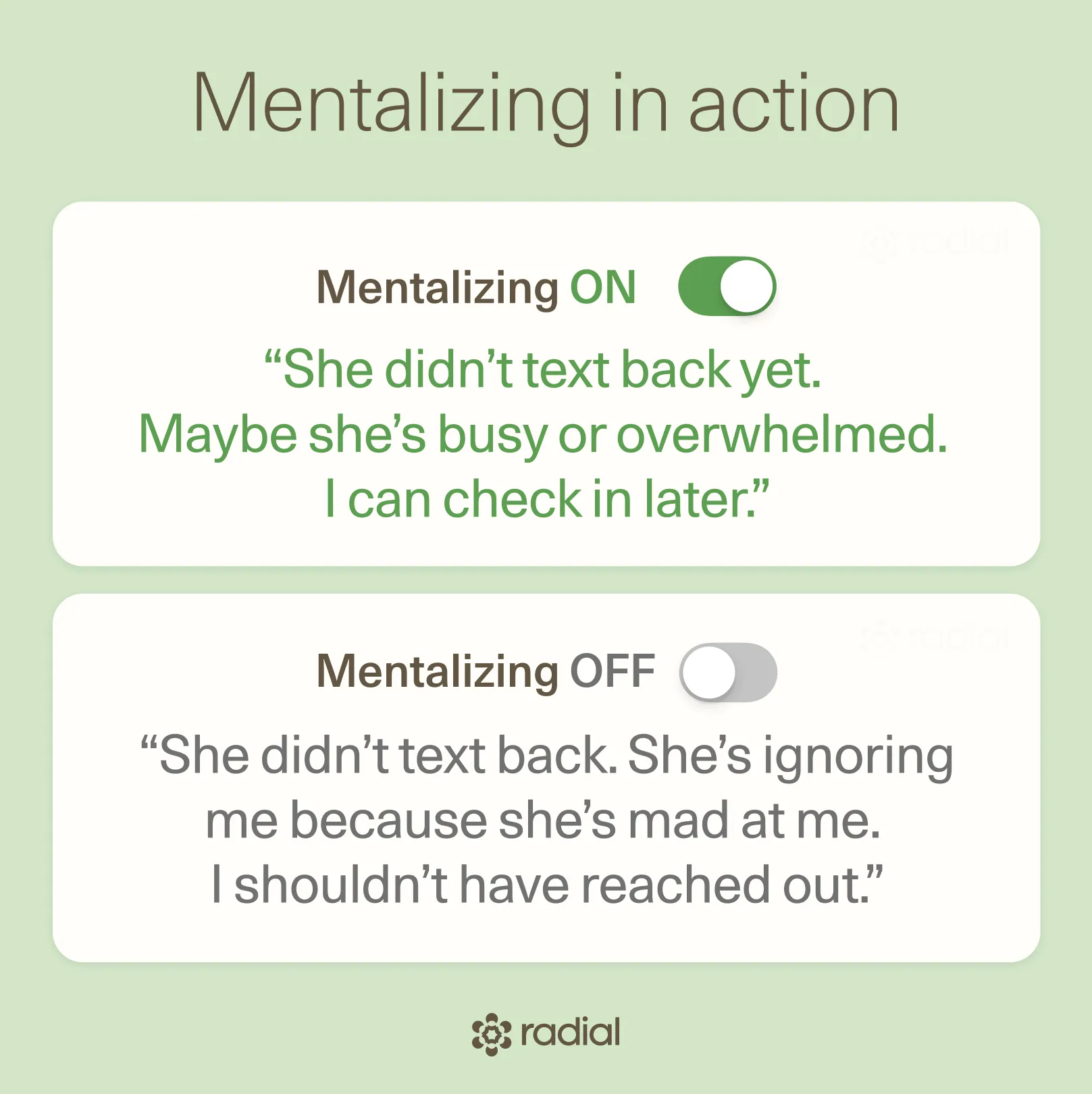
- Jumping to conclusions (“They didn’t reply. They must be mad at me.”)
- All-or-nothing thinking (“This always happens. Nothing ever works out.”)
- Assuming you know what others are thinking (“They think I’m annoying.”)
- Treating feelings as facts (“I feel worthless, so I must be worthless.”)
How does MBT work?
Mentalization-based therapy focuses on helping you slow down and make sense of what’s happening in real time, especially when emotions start to spike or shut down.
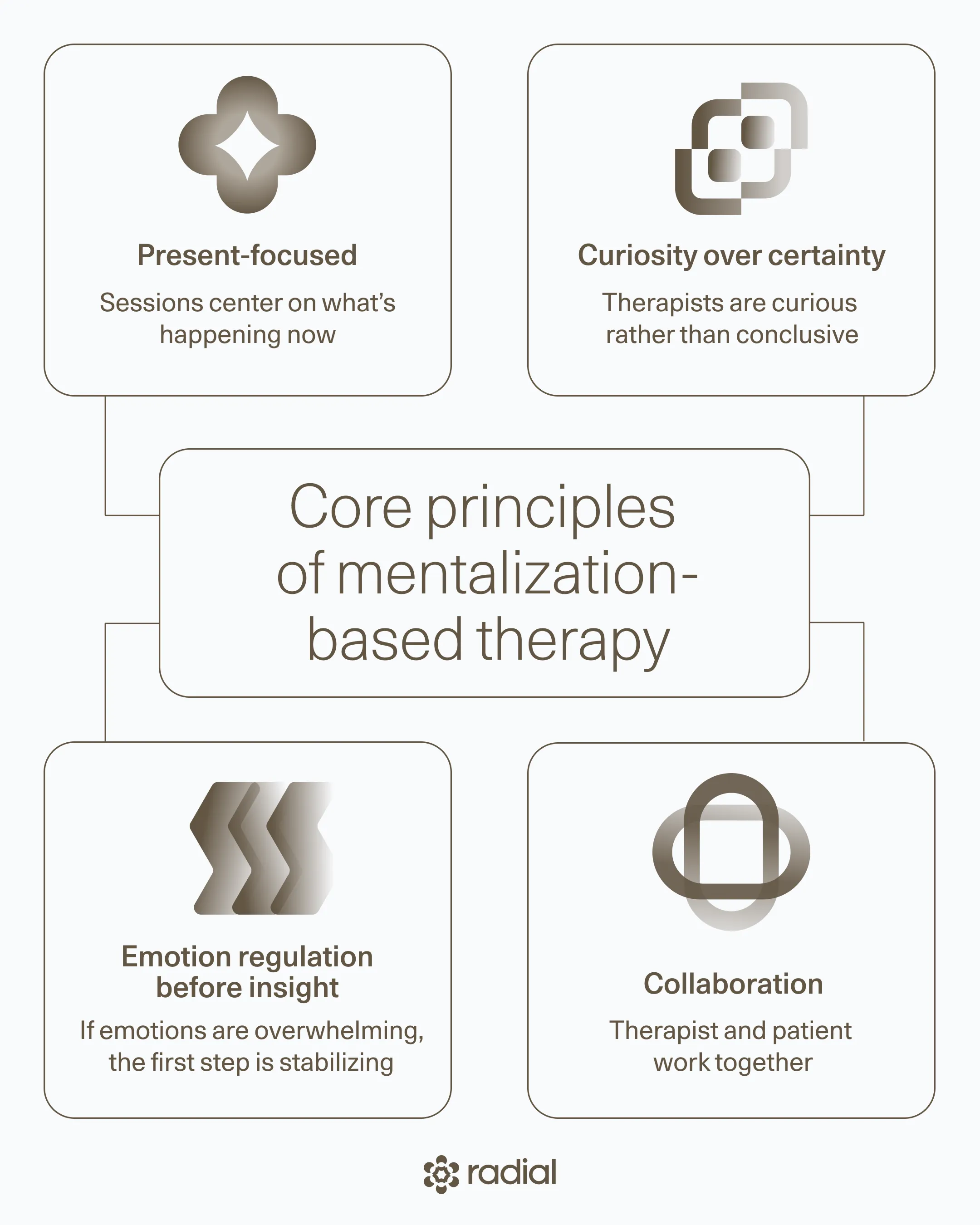
According to the experts, most mentalization-based therapy techniques are guided by these principles:
- Present-focused: Sessions center on what’s happening now—often something that just occurred in your life or even in the therapy relationship itself.
- Curiosity over certainty: The therapist models openness and wondering rather than conclusions.
- Emotion regulation before insight: If emotions are too intense or too shut down, the first step is stabilizing enough to think clearly.
- Collaboration: Therapist and patient work together
Sessions often begin with a recent situation that felt emotionally charged—an argument, a misunderstanding, a spiral, or something that happened in the therapy relationship itself.
“An MBT therapist is trained to recognize your emotional temperature and help adjust it from too hot or too cold to a balance where you can make the most progress in therapy,” says Hurley.
From there, you and your therapist explore mentalization exercises, like:
- What you noticed internally
- What you think the other person might have been experiencing
- Where you may have jumped to conclusions
- How your emotions influenced your reaction
“An MBT therapist is active and direct in therapy, asking a lot of questions with genuine curiosity,” says Gupta. “We give empathic validation, ask for clarification, help generalize insights, and encourage change.”
Rather than offering quick interpretations or advice, the therapist stays curious about your internal experience and helps you explore it together. The goal isn’t to land on a single “right” answer, but to build flexibility in how you understand thoughts, feelings, and intentions, according to Gupta.
MBT may be offered in individual therapy, group therapy, or a combination of both. Groups provide opportunities to practice mentalizing in real time with others, while individual sessions allow deeper exploration of personal patterns.
It’s also a longer-term therapy. Many programs last 12–18 months or longer. That time commitment can feel daunting, but it reflects MBT’s focus on building durable, internal capacities rather than short-term symptom management.
Progress is often gradual. Early changes may look like noticing patterns sooner, recovering from conflicts faster, or feeling slightly more space between emotion and action.
Who is a good candidate for MBT?
Mentalization-based treatment was originally developed and studied as a treatment for personality disorders, particularly borderline personality disorder (BPD). Today, Hurley says it’s considered an evidence-based treatment for several personality disorders and other mental health conditions, including:
- BPD
- Children and Families
- Adolescents
- Narcissistic personality disorder
- Antisocial personality disorder
- Anxiety
- Depression
- Complex trauma
- Obsessive-compulsive disorder
But MBT isn’t only for people with the conditions listed above. “No matter your specific diagnosis, if you struggle with long-standing patterns of difficulty managing your emotions or interpersonal interactions, you are a good candidate for MBT,” says Gupta.
That’s why MBT tends to be a good fit for people who notice:
- Intense or rapidly shifting emotions
- Feeling easily misunderstood or rejected
- Unstable or conflict-heavy relationships
- Impulsive reactions they later regret
- Getting stuck in rigid, self-blaming, or all-or-nothing thinking
You don’t need to be in constant crisis to benefit. Many people come to MBT because they feel stuck in the same interpersonal loops, even after trying other therapies.
Who is not a good candidate for MBT?
On the other hand, MBT may not be the best first approach if:
- You’re mainly looking for short-term, highly structured symptom reduction (for example, therapy that’s focused only on panic attacks or a specific phobia).
- You’re unable to commit to regular sessions, which MBT typically requires.
If any of those situations resonate, that doesn’t mean MBT is off-limits. It may just indicate that it’s not the best option at the moment. For instance, some people start with more stabilizing or skills-based therapy and move into MBT later.
The right fit depends on your goals, current forms of support, and what you’re hoping to change. A qualified therapist can help you think through whether MBT makes sense for you right now.
What’s the difference between MBT and other therapies?
Many therapies can be helpful. The differences come down to what each approach puts at the center of treatment and how change is expected to happen. Here’s a look at how MBT compares to some of the most common options. Of note, MBT is often combined with other therapies, so it might be more of a “yes-and” compared to an “either-or.”
MBT vs. DBT
Dialectical behavioral therapy (DBT) is a skills-based therapy that teaches concrete tools for managing intense emotions, distress, and relationship challenges. While MBT also targets emotional reactivity and relationships, it comes at it from a different angle:
- DBT: Focuses on what to do when emotions surge.
- MBT: Focuses on understanding what’s happening in your mind and in others’ minds during those moments.
DBT may feel more helpful if you want clear tools and structure. MBT may be a better fit if you feel stuck in misinterpretations, rigid thinking, or confusion about why you react the way you do. Many people use both at different points.
MBT vs. CBT
Cognitive behavioral therapy (CBT) focuses on identifying and changing unhelpful thoughts and behaviors. MBT focuses on increasing curiosity and flexibility around thoughts. In practice, that means:
- CBT: Works to replace distorted thoughts with more balanced ones.
- MBT: Works to strengthen your ability to reflect on thoughts and feelings.
CBT can be especially helpful if you’re wondering how to feel better when you’re dealing with specific symptoms like panic, phobias, or obsessive thoughts. MBT may be a better fit when difficulties center more on relationships, emotional volatility, and identity or self-understanding.
MBT vs. traditional psychodynamic therapy
Traditional psychodynamic therapy explores how early experiences shape current patterns, with a strong emphasis on insight and unconscious processes. MBT grew out of psychodynamic traditions, but is more structured and present-focused. Here’s the key difference:
- Traditional Psychodynamic: Emphasizes insight into long-standing themes.
- MBT: Emphasizes strengthening mentalizing in real time.
Both approaches value understanding internal experience, but MBT places more explicit focus on strengthening the capacity to mentalize as the primary mechanism of change.
.webp)
What does the research say about MBT?
Mentalization-based therapy for BPD is well-studied, and research is increasingly showing benefits for other conditions too. Overall, studies suggest MBT can help reduce intense emotional swings and relationship chaos, while improving people’s ability to understand their own thoughts and feelings and make sense of others.
Research also suggests that the benefits of MBT tend to last beyond the end of treatment. In other words, it aims to build skills you keep using, not just offer temporary symptom relief. Most research has studied programs that last 12–18 months or longer, which reflects MBT’s focus on steady, long-term change rather than quick fixes.
Research-backed benefits of MBT include:
- Reduced suicidal behavior and self-harm (particularly in BPD)
- Fewer psychiatric hospitalizations and emergency visits
- Improved emotion regulation and distress tolerance
- More stable relationships and social functioning
- Reduced treatment-resistant depression and anxiety
- Reduced reactivity in people with trauma-related difficulties
- Decreased obsessive-compulsive and rigid thinking
What to expect from MBT
Mentalization-based therapy tends to feel different from highly structured, skills-driven therapies. Instead of moving quickly toward tools or homework, sessions focus on slowing things down and understanding what’s happening in the moment.
According to Gupta and Hurley, common experiences in MBT include:
- Talking through recent emotionally charged situations
- Noticing patterns in how you interpret yourself and others
- Exploring misunderstandings and relationship ruptures
- Practicing staying curious when emotions rise
Emotionally, MBT can feel subtle rather than dramatic. You may not leave every session with a big “aha.”
It’s also normal to feel frustrated at times. Slowing down can feel uncomfortable, especially if you’re used to either pushing emotions away or getting swept up in them. But over time, many people notice progress show up in small, cumulative ways, like:
- Fewer emotional blowups
- Faster recovery after conflict
- More nuanced views of yourself and others
- A greater sense of agency in how your respond
- Catching yourself sooner in a spiral
- Pausing before reacting
- Feeling slightly less certain about a harsh conclusion
Relief within reach
Care covered by your insurance
Radial provides advanced mental health treatment, covered by the insurance you already use.








How to know if MBT might be a good fit for you
You don’t need to perfectly match a checklist to benefit from MBT. Still, certain patterns tend to signal that this approach may be worth exploring. According to the experts, MBT may be a good fit if you:
- Often feel confused about why you react the way you do
- Get stuck in intense emotional loops or spirals
- Struggle with misunderstandings or repeated conflict in relationships
- Feel pulled toward extreme conclusions about yourself or others
- Want to better understand your inner world, not just manage symptoms
It can also help to reflect on what you’re hoping therapy will change. For example:
- Do I want to understand myself better, not just feel “less bad”?
- Do I want help making sense of relationship patterns?
- Am I open to a slower, exploratory style of therapy?
If MBT sounds interesting, here are some questions you can ask potential therapists:
- What training or certification do you have in MBT?
- Do you offer MBT in individual therapy, group therapy, or both?
- How long do people typically stay in MBT in your practice?
- How do you handle moments of high emotional intensity in sessions?
Beyond credentials, pay attention to how you feel with the therapist. MBT relies on a collaborative, curious relationship. Feeling respected, heard, and safe enough to wonder out loud matters.
The bottom line
Struggling to understand your emotions or feel steady in relationships doesn’t mean you’re broken. Mentalization-based therapy offers one path forward by helping you slow down, reflect, and make sense of what’s happening inside you and between you and others—especially when things feel intense.
It’s not a quick fix. But for many people, strengthening this ability makes emotions and relationships more manageable. If what you’ve read about MBT resonates, exploring your options with a Radial therapist can help you decide whether it’s the right next step.
Key takeaways
- Mentalization-based therapy is an evidence-based approach that focuses on improving your ability to understand your own thoughts and feelings and make sense of others’ perspectives.
- MBT therapy may be a good fit if your main struggles involve intense emotions, relationship difficulties, or feeling confused about your reactions.
- MBT is especially well studied for borderline personality disorder and may also help with types of depression, anxiety, trauma-related difficulties, and obsessive-compulsive traits.
- Rather than teaching coping skills or challenging thoughts directly, MBT emphasizes curiosity, reflection, and flexibility in emotionally charged moments.
- MBT is typically longer-term and progress tends to be gradual, but changes often stick around for the long haul.
Frequently asked questions (FAQs)
What is an example of mentalization?
Mentalization is the ability to pause and wonder about what’s happening inside you and someone else, rather than jumping straight to conclusions. For example, instead of assuming “They’re ignoring me because they don’t care about me anymore,” a mentalizing response might be, “I’m feeling hurt, but I don’t actually know why they haven’t responded. There could be other explanations.”
Can MBT help if I don’t have BPD?
Yes. While MBT was originally developed for borderline personality disorder, research and clinical experience suggest it can also help people with depression, anxiety, trauma-related difficulties, and ongoing relationship problems. This is especially true when emotional reactivity is a core issue.
What is the difference between MBT and DBT?
DBT focuses on teaching practical coping skills for managing intense emotions and distress. MBT focuses on understanding what’s happening in your mind and in other people’s minds when emotions surge. Both can be helpful, and some people use them together or at different stages of treatment.
Editorial Standards
At Radial, we believe better health starts with trusted information. Our mission is to empower readers with accurate, accessible, and compassionate content rooted in evidence-based research and reviewed by qualified medical professionals. We’re committed to ensuring the quality and trustworthiness of our content and editorial process–and providing information that is up-to-date, accurate, and relies on evidence-based research and peer-reviewed journals. Learn more about our editorial process.
Let's connect
Get started with finding the right treatment for you or someone you care about
Get startedExplore more posts