What Is Cognitive Behavioral Therapy? How CBT Works and What to Expect

If your mind tends to spiral—jumping from one anxious thought to another or getting stuck in negative loops—cognitive behavioral therapy (CBT) is designed to interrupt that pattern. Contrary to popular belief, you don’t just “talk it out” during a CBT session. Instead, it teaches you how to actually change the way you think, feel, and respond in real time. Here’s everything you need to know about this style of therapy.
Our minds are constantly assigning meaning to what’s happening around us. The problem is, those interpretations aren’t always accurate. And when they skew negative, they can quietly shape how we think, feel, and act in ways that keep us stuck. That gap—between what you believe to be true and what you feel—is exactly where cognitive behavioral therapy (CBT) fits in.
I turned to CBT while navigating depression, and it gave me something I hadn’t found elsewhere: a practical way to change patterns, not just understand them.
In fact, CBT is one of the most widely recommended, research-backed forms of therapy for conditions like anxiety, depression, OCD, and trauma. But despite how often it’s suggested, many people don’t actually know what it’s all about.
This guide breaks it all down. Below, learn what cognitive behavioral therapy is, how it works, and what to expect if you try it.
Connect with our Clinicians
.png)


What is cognitive behavioral therapy (CBT)?
Cognitive behavioral therapy is a form of psychotherapy that helps you identify and change unhelpful patterns of thinking and behavior. The core idea is simple: The way you think influences how you feel and what you do, and by shifting those patterns, you can improve your well-being.
Unlike some forms of therapy that focus heavily on the past, CBT is grounded in the present. It’s less about why something started and more about what’s keeping it going and how to change it.
The core principles of CBT include:
- Thoughts, feelings, and behaviors are interconnected and bidirectional: emotions can influence thoughts and behaviors, and behaviors can shift thoughts
- Unhelpful thinking patterns (also known as cognitive distortions) can fuel distress
- Changing thoughts and behaviors can shift emotional outcomes
- Skills can be learned and practiced over time
- Therapy is collaborative and goal-oriented
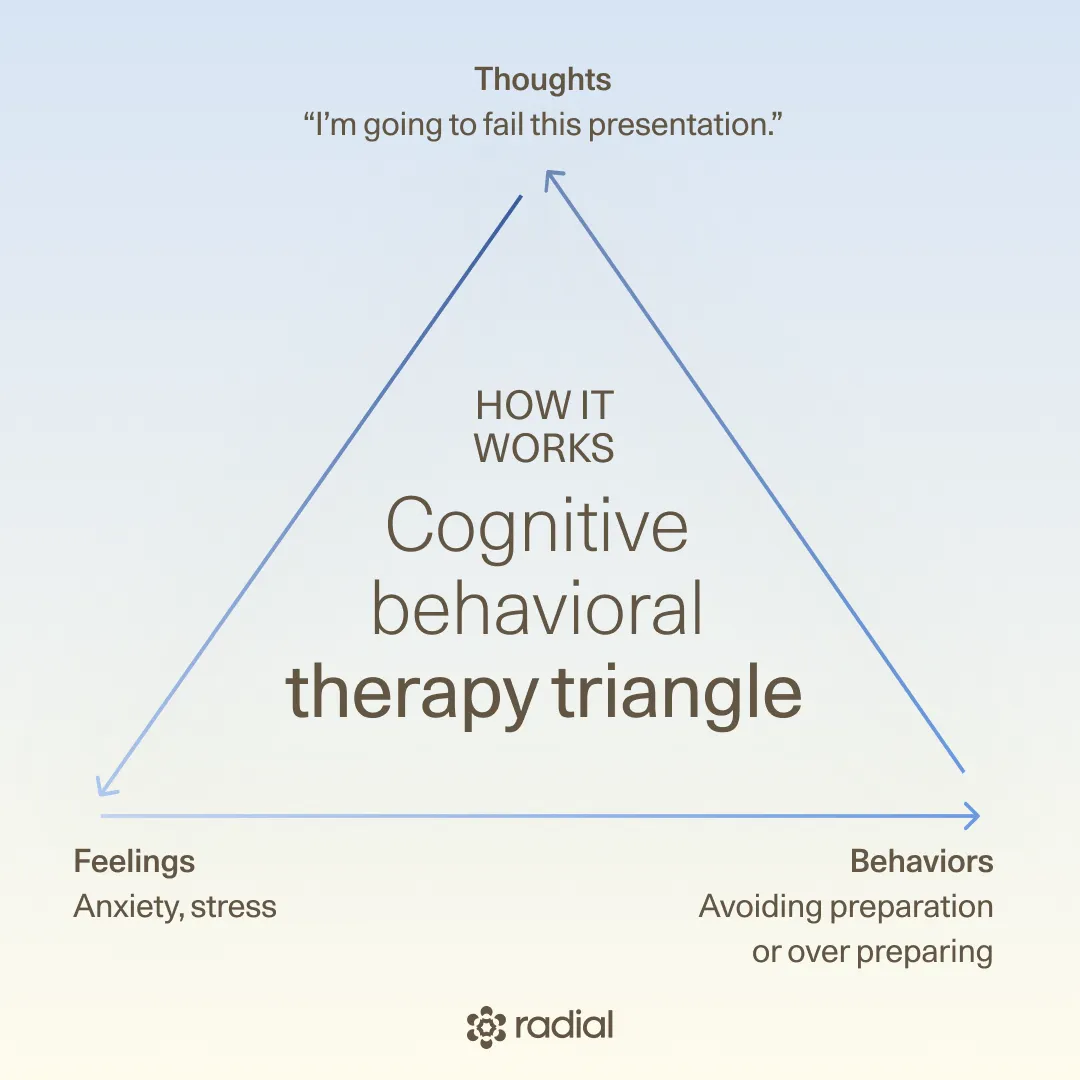
A common way to understand the CBT cycle is through the “CBT triangle,” which shows how thoughts, emotions, and behaviors influence one another.
For example, the thought “I’m going to fail this presentation” can trigger anxiety, which might lead you to avoid preparing or overprepare in a way that increases stress. That response then reinforces the original thought, creating a loop.
These patterns don’t just affect your mindset—they can affect your body, too. Stress triggers the release of stress hormones, which prepare you to respond to a perceived threat. It can also lead to physical responses like a racing heart, muscle tension, or digestive changes.
Over time, when that response is activated too often, it can take a toll on both physical and mental health. In fact, chronic stress has been linked to inflammatory disorders, autoimmune disease, and even heart disease.
CBT helps you step into that loop, slow it down, and change it so the same situation leads to a different outcome.
How does CBT work?
CBT is often introduced as a simple sequence: situation, thoughts, feelings, and behaviors. In practice, though, it’s not one-directional. Each part influences the others, creating a loop that can either reinforce distress or help shift it.
For example, a short email from your boss might trigger the thought, “I did something wrong.” That thought can lead to anxiety. Then the anxiety might cause you to overanalyze your work or avoid responding. This reinforces the original thought, even if it’s not accurate.
In CBT, these are called automatic thoughts, aka quick, reflexive interpretations that feel true in the moment.
Over time, these thoughts can follow predictable patterns known as cognitive distortions. Common types of cognitive distortions include:
- Catastrophizing (“This is going to be a disaster.”)
- All-or-nothing thinking (“If it’s not perfect, it’s a failure.”)
- Mind reading (“They think I’m incompetent.”)
- Overgeneralizing (“This always happens to me.”)
CBT helps you slow this process down and examine it more closely. Instead of taking thoughts at face value, you learn to question them and consider more balanced alternatives, according to Liberty Case, MA, LPC, a therapist at Radial.
At the same time, CBT targets behavior. Avoidance and other coping patterns can reinforce distress, while gradually changing those behaviors can help shift emotional responses.
.webp)
What conditions can CBT treat?
CBT is considered a first-line treatment for many mental health conditions, especially those marked by patterns of unhelpful thinking and behavior. While CBT is often most effective for mild to moderate conditions, it can also play a key role in treating more complex or chronic concerns as part of a broader care plan.
Here are some of the most common conditions CBT is used to treat:
- Depression: CBT identifies thinking patterns that are negative (like hopelessness, guilt, self-blame, or self-criticism) and replaces them with more balanced perspectives, often alongside strategies to help you re-engage in daily life.
- Anxiety disorders: Cognitive behavioral therapy for anxiety—including generalized anxiety disorder, social anxiety, and panic disorder—targets worry loops, catastrophic thinking, and avoidance behaviors that keep anxiety going.
- Obsessive-compulsive disorder (OCD): A specialized form of CBT—often including exposure and response prevention (ERP)—helps individuals gradually face intrusive thoughts without engaging in compulsions.
- Post-traumatic stress disorder (PTSD) and trauma-related disorders: Trauma-focused CBT helps individuals process distressing memories and reduce avoidance, fear responses, and negative beliefs tied to trauma.
- Substance use disorders: CBT is considered a first-line treatment for addiction. It’s used to help people recognize triggers, develop coping strategies, and build skills to prevent relapse.
- Insomnia and sleep disorders: CBT for insomnia (CBT-I) focuses on changing thought patterns and behaviors that interfere with sleep.
- Eating disorders: Approaches like CBT-E (enhanced CBT) are used to address distorted thoughts around food, body image, and control.
- Chronic pain: CBT helps people reframe pain-related thoughts and develop coping strategies that can reduce the emotional burden of chronic conditions.
- Stress and burnout: CBT provides tools to manage overwhelming thoughts, reduce reactivity, and build more sustainable coping strategies.
- Anger management: By identifying triggers and thought patterns, CBT helps individuals respond more calmly and intentionally in high-emotion situations.
It’s also commonly used for challenges that don’t always fit into a single diagnosis, like persistent rumination, low self-esteem, or feeling empty, stuck, or “off.”
The throughline: If your symptoms are worsened by patterns in how you think and respond, CBT is designed to help you change those patterns.
What common CBT techniques do therapists use?
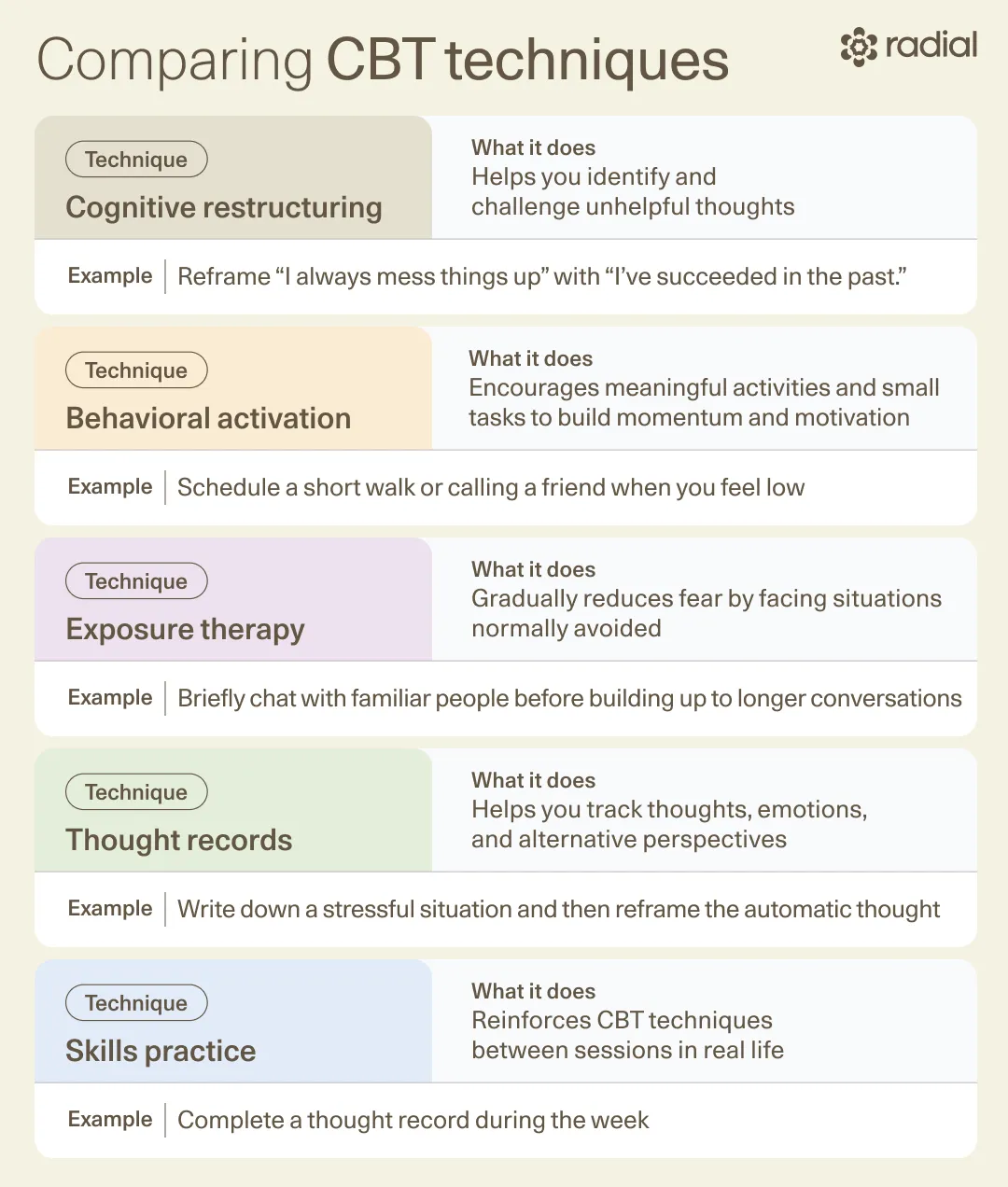
CBT is practical by design, and uses techniques that help shift how you think and respond in everyday situations. Let’s break down the core cognitive behavioral therapy examples.
Cognitive restructuring
One of the core cognitive behavioral therapy techniques is cognitive restructuring, which focuses on changing unhelpful thought patterns.
“[It] involves identifying automatic negative thoughts, evaluating the evidence for and against them, and replacing them with more balanced and realistic thoughts,” says Case.
The goal is to shift your thoughts toward something more accurate, balanced, and grounded in reality.
Behavioral activation
When you’re feeling depressed or low, it’s common to withdraw from activities that once felt enjoyable or meaningful. The problem is, that withdrawal often makes symptoms worse.
Behavioral activation works by helping you gradually re-engage with those activities, even if you don’t feel motivated at first, according to Case. Over time, action can help shift mood.
Exposure therapy
For anxiety-related conditions, avoidance is one of the biggest drivers of ongoing distress. Exposure therapy helps break that cycle.
Instead of avoiding what feels uncomfortable, you work with a therapist to face those situations gradually and safely, says Case. Over time, this reduces the intensity of the fear response.
Thought records and journaling
Thought records are a structured way to slow down a moment and see it more clearly. Typically, you write down what happened, what you were thinking, how you felt, and then challenge those thoughts by looking at evidence and generating a more balanced perspective.
Practicing this regularly helps you start to catch dysfunctional patterns as they’re happening, not just after the fact.
Skills practice between sessions
CBT doesn’t stop when the session ends. Practicing skills between sessions (yes, homework) is a core part of the process. These might include journaling, trying a new behavior, or testing a belief in real life.
“CBT may also incorporate stress-management strategies, such as relaxation and breathing techniques, and behavioral experiments, which allow individuals to test the accuracy of their beliefs in real-life situations,” adds Case.
What happens during CBT treatment?
CBT is typically a structured, time-limited form of therapy. Most treatment plans last around 8 to 20 sessions, though this can vary depending on your goals and needs, according to Case.
Here’s what that process often looks like:
First session and assessment
Early sessions focus on understanding what’s bringing you in and identifying patterns in your thoughts, emotions, and behaviors.
Together, you and your therapist will define specific goals—like reducing anxiety in social situations or improving mood—and begin mapping out the patterns that may be contributing to those challenges.
Identifying thoughts and behaviors
As therapy continues, you’ll start to identify automatic thoughts and the behaviors connected to them.
“Early sessions often focus on identifying patterns in a person’s thinking and understanding how thoughts, emotions, and behaviors are connected,” Case explains. This builds the foundation for the work that follows.
Often, as you start paying attention to your automatic negative thoughts, deeper patterns or "core beliefs" start to emerge. These are beliefs about ourselves and the world that shape the way we process information. Without intention, these beliefs go unchecked and we operate like they're true. The process of CBT helps identify these patterns and determine if these beliefs are accurate. You may determine that a core belief is only partially true (or maybe not at all). CBT provides a pathway to changing core beliefs if they are not serving us.
Learning and practicing CBT skills
Once those patterns are clearer, sessions shift toward learning and applying CBT techniques such as reframing thoughts, testing beliefs, and gradually facing situations that are normally avoided.
“These skills are practiced during therapy sessions and are often assigned as ‘homework’ so they can also be practiced in everyday situations,” Case says.
Homework and practice between sessions
On that note, practicing between sessions is a core part of CBT.
This might include completing thought records, trying a new behavior, or applying a coping strategy in real-life situations. The goal is to take what you’re learning in therapy and actually use it outside of the session—after all, you can’t build a muscle without using it.
Measuring progress
Throughout treatment, you and your therapist will assess your progress. That might mean tracking symptoms, noticing changes in thought patterns, or reflecting on how you’re responding differently to situations.
“The overall goal is for individuals to develop tools they can continue using independently to manage their thoughts, emotions, and behaviors,” Case says.
How effective is CBT?
CBT is one of the most researched forms of psychotherapy, and consistently one of the most effective.
Across studies, CBT has been shown to significantly improve symptoms of depression, anxiety disorders, PTSD, OCD, insomnia, and more. For some conditions, it’s considered a first-line treatment, meaning it’s often recommended before—or alongside—medication.
Part of what makes CBT so effective is its practical, skill-based approach. You learn tools to change how you think and respond, and one of the core cognitive behavioral therapy benefits is being able to carry those skills with you long after therapy ends.
Research also shows that CBT can be equally or more effective than medication for certain conditions, particularly if you want to get rid of depression. And when combined with medication, it can lead to even better outcomes for some people.
That said, CBT isn’t a perfect fit for everyone.
It requires active participation: showing up, practicing skills, and applying them outside of sessions. For people dealing with more severe symptoms, complex trauma, or conditions that require stabilization first, CBT may need to be combined with other treatments or adapted accordingly.
And like any form of therapy, progress can take time. It’s normal for things to feel uncomfortable at first, especially when you’re challenging long-standing patterns or facing situations you’ve been avoiding.
How does CBT compare to other therapies?
CBT is often one of the first therapies people hear about, but it’s not the only option. Different approaches focus on different goals, timelines, and ways of working through problems.
At a high level, CBT stands out for being structured, present-focused, and skill-based. Other therapies may go deeper into emotional processing, relationships, or past experiences.
Here are the key differences to keep in mind:
- CBT vs. medication: CBT teaches skills you can use long-term, while medication focuses on symptom relief. For many people, a combination of both works best.
- CBT vs. psychodynamic therapy: CBT is more focused on present-day patterns and practical strategies, while psychodynamic therapy explores how past experiences shape current behavior.
- CBT vs. dialectical behavior therapy (DBT): While CBT focuses on changing thought patterns, DBT builds skills for managing intense emotions and improving relationships. It’s often used for people who need more support with emotional regulation.
- CBT vs. exposure and response prevention (ERP): ERP is a specific type of CBT used primarily for OCD. It focuses on gradually facing fears and resisting compulsions, and is considered a gold-standard OCD treatment.
The right approach depends on what you’re dealing with, what kind of support you’re looking for, and how you prefer to work through challenges. In many cases, therapists may integrate elements from multiple approaches.
Who is a good candidate for CBT?
CBT can be a strong fit for many people, but it tends to work best for those who are open to a structured, hands-on approach to therapy. You may be a good candidate if you:
- Want practical tools to manage your thoughts and emotions, not just insight
- Are open to examining and challenging your thinking patterns
- Prefer a structured, goal-oriented approach to therapy
- Are willing to practice skills between sessions
- Are dealing with anxiety, depression, OCD, or other pattern-driven symptoms
- Want a shorter-term, focused treatment approach
On the flip side, CBT may be less ideal if you:
- Are looking for a more open-ended, exploratory therapy focused on past experiences
- Need more support with emotional regulation or crisis stabilization first
- Are dealing with complex trauma that requires deeper processing before skills-based work
- Prefer a less structured or more conversational therapy style
In these cases, other approaches—or a combination of therapies—may be a better fit.
Relief within reach
Care covered by your insurance
Radial provides advanced mental health treatment, covered by the insurance you already use.








What to look for in a cognitive behavioral therapist
Finding the right therapist can shape how effective CBT feels. That’s why Case recommends looking for a provider with:
- Training in CBT: A licensed therapist who specifically uses CBT
- A structured, goal-oriented approach: Sessions should have direction and clear goals
- A focus on practical skills: You should be learning tools to use outside of sessions
- Collaboration: CBT is a two-way street—you and your therapist work together to challenge patterns and build new ones
- Strong fit: Feeling comfortable and supported makes it easier to engage and apply what you learn
Also consider logistics, like whether you prefer in-person or virtual sessions, whether the therapist accepts your insurance, and how often you’re able to meet.
If you’re not sure where to start, therapy directories (like Psychology Today or your insurance provider’s network) can help you find CBT-trained providers in your area, or connect with a therapist through Radial.
The bottom line
CBT is a practical, evidence-based approach that helps you understand how your thoughts, emotions, and behaviors are interconnected and provides tools to change those patterns in real time. It’s structured and skill-based, with the goal of helping you build strategies you can use long after therapy ends. While it’s not one-size-fits-all, CBT can offer a clear, actionable path forward if you’re feeling stuck in cycles of anxiety, depression, or negative thinking.
Key takeaways
- CBT helps you identify and change patterns in your thoughts, emotions, and behaviors so you can respond to situations in more balanced, effective ways.
- It’s a structured, skill-based approach that focuses on present-day challenges and gives you practical tools you can use both in and outside of therapy.
- CBT is widely used to treat conditions like anxiety, depression, OCD, and PTSD.
- Common techniques include cognitive restructuring (challenging unhelpful thoughts), behavioral activation (re-engaging in meaningful activities), and exposure therapy (gradually facing avoided situations).
- CBT works best when you actively practice the skills between sessions, because lasting change comes from applying them in real life.
Frequently asked questions (FAQs)
Can you do CBT on your own?
Yes. For mild symptoms or everyday stress, many CBT techniques can be practiced on your own using books, apps, or online programs. But working with a therapist adds structure, personalization, and accountability, which can be especially helpful for more complex concerns, says Case. For many people, a combination of both works best.
What is the typical duration of cognitive behavioral therapy?
CBT is usually a short- to medium-term treatment, often lasting around 8 to 20 weekly sessions. The exact timeline depends on your goals, the severity of your symptoms, and how consistently you practice the skills between sessions.
Is CBT better than medication?
It depends on the situation. CBT can be as effective as medication for some conditions, especially depression. The key difference is that CBT teaches skills you can use long-term, while medication focuses on symptom relief. For many people, a combination of both leads to the best outcomes.
Deep dive recommendations
- Guide for therapists/clients who want a religious/spiritual orientation to CBT treatment: https://spiritualityandhealth.duke.edu/index.php/religious-cbt-study/therapy-manuals/
- Burns, D. D. (2017). Feeling Good : The New Mood Therapy. Blackstone Audio, Incorporated.
- Puder, David (host). (2024, January 12). Cognitive Behavioral Therapy with Judith Beck. (No. 202). The Psychiatry Podcast.
Editorial Standards
At Radial, we believe better health starts with trusted information. Our mission is to empower readers with accurate, accessible, and compassionate content rooted in evidence-based research and reviewed by qualified medical professionals. We’re committed to ensuring the quality and trustworthiness of our content and editorial process–and providing information that is up-to-date, accurate, and relies on evidence-based research and peer-reviewed journals. Learn more about our editorial process.
Let's connect
Get started with finding the right treatment for you or someone you care about
Get startedExplore more posts