Understanding Dialectical Behavior Therapy: How It Works and Who It Helps

If your emotions feel intense, fast-moving, or hard to control—and other therapies haven’t quite helped—dialectical behavior therapy (DBT) may offer a different kind of support. DBT focuses on practical skills for getting through overwhelming moments, communicating more clearly, and gradually creating a life that feels more stable and manageable.
If you’ve ever felt like your emotions show up bigger or faster than you’d like, you’re not alone. For some people, those intense reactions make everyday situations—relationships, stress, conflict—harder to navigate than they seem to be for others. Dialectical behavior therapy was created to help with exactly that.
It’s a structured, skills-based approach that focuses on learning how to manage overwhelming emotions, get through tough moments, and communicate more effectively with the people around you.
DBT is based on a simple idea: Your experiences make sense, and change is still possible. You don’t have to push your feelings away or pretend things are fine. Instead, DBT offers practical tools you can use in real time when emotions spike, tension rises, or situations feel unmanageable.
This guide breaks down what DBT is, how it works, and who it tends to help most. So if you’re exploring therapy options and looking for something concrete and supportive, you’re in the right place.
What is dialectical behavior therapy (DBT)?
In simple terms, “dialectical” refers to holding two truths at once. In DBT, that means recognizing that emotional reactions have real reasons behind them while also working toward changing the reactions that are unhealthy. Acceptance and skill-building aren’t opposites here—they work together.
This perspective shaped how DBT was developed. In the late 1980s, psychologist Marsha Linehan created DBT to support people experiencing chronic suicidal thoughts and borderline personality disorder, a disorder she also suffered from. Since then, the approach has been extensively studied and adapted for other conditions tied to emotional dysregulation, including depression, anxiety, eating disorders, PTSD, and substance use disorders.
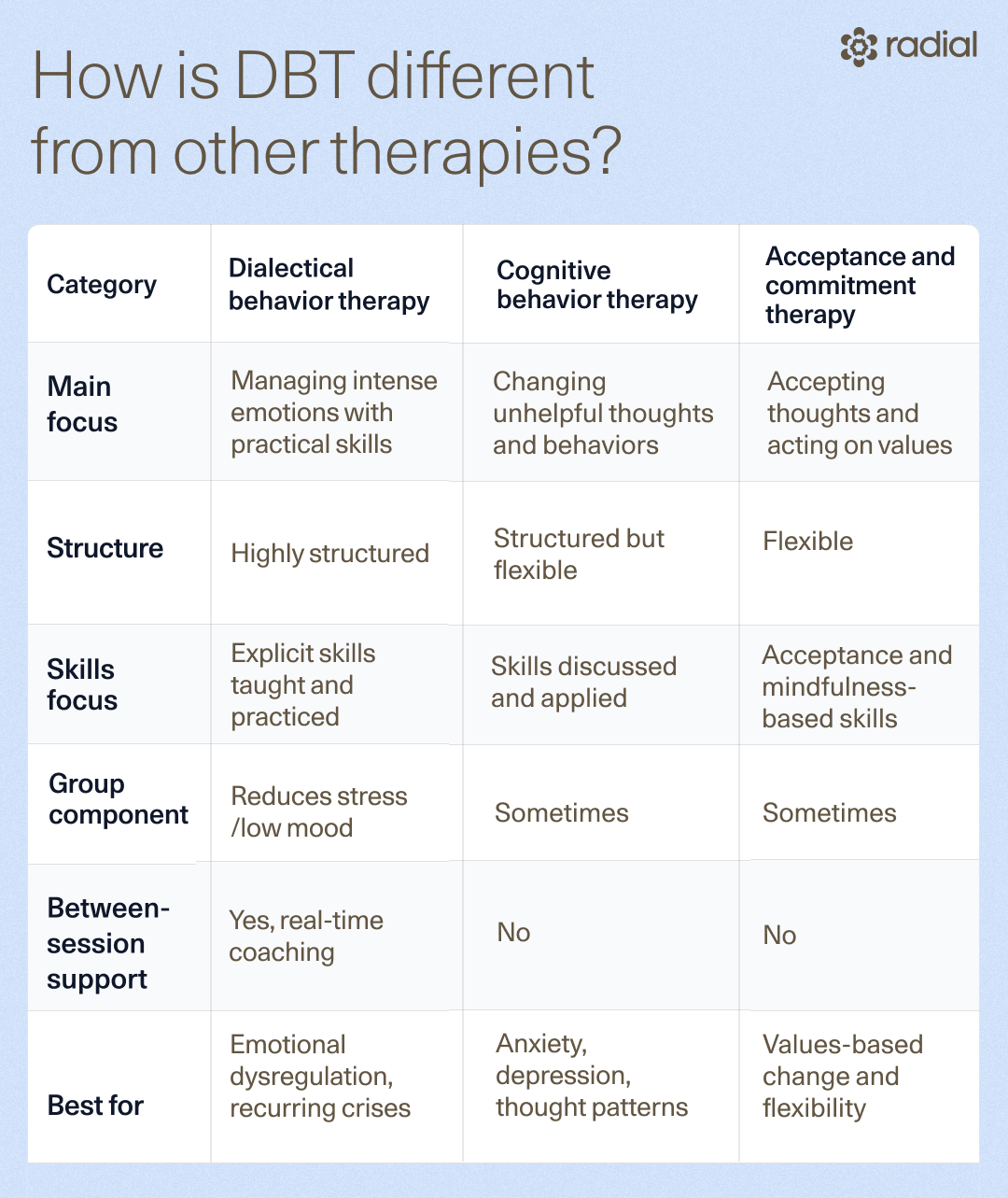
How is DBT different from other therapies?
You might see DBT mentioned alongside other types of therapy, which can make it hard to tell what actually sets it apart. The biggest differences usually come down to how structured the therapy is and what it focuses on when emotions run high.
- DBT vs. Cognitive Behavioral Therapy (CBT): DBT grew out of CBT, but it puts more focus on emotions. While CBT often works on changing unhelpful thought patterns, DBT is more about learning what to do when feelings take over.
- DBT vs. traditional talk therapy: Talk therapy is often open-ended and insight-focused. DBT is more hands-on. You learn specific skills, practice them between sessions, and use them in real situations, not just talk about them afterward.
- DBT vs. Acceptance and Commitment Therapy (ACT): ACT focuses on acceptance and living in line with your values. DBT also emphasizes acceptance, but it offers more step-by-step tools for managing intense emotions and behaviors when things feel out of control.
- DBT vs. DBT-informed therapy: Some therapists use DBT techniques without offering the full program. Comprehensive DBT includes skills training, individual therapy, and support between sessions. For people dealing with significant emotional dysregulation, having that full structure can make a meaningful difference.
- DBT vs. Mentalization-Based Treatment (MBT): Whereas DBT grew out of cognitive behavioral therapy for the treatment of BPD, MBT was developed based on attachment theory at the Anna Freud Centre in London, and focuses less on a broad range of skills. MBT focuses on restoring the ability to be curious in moments of distress, lowering the need for “distress tolerance” as the distress of feeling “in the dark” about the thoughts and feelings of others is reduced. DBT later incorporated the “THINK” skill based, in part, on the science behind MBT.
What is DBT used to treat?
DBT can be especially helpful when emotions feel intense or overwhelming, particularly when they escalate quickly. According to Stephanie Hartselle, MD, FAPA, DFAACAP, a psychiatrist and clinical associate professor at Brown University, it’s commonly used to treat:
- Borderline personality disorder (BPD): DBT is considered a gold-standard treatment for BPD, particularly for reducing self-harm, suicidal behaviors, and relationship instability.
- Depression, including treatment-resistant depression: DBT can help when depression is tied to intense emotions, impulsive behaviors, or difficulty coping during emotional lows.
- Anxiety disorders: DBT skills can be useful for managing emotional overwhelm, panic, and avoidance, especially when anxiety feels reactive or hard to regulate.
- Obsessive-compulsive disorder (OCD): While DBT for OCD isn’t a first-line treatment, some people use DBT skills alongside other approaches to manage distress and emotional reactivity.
- Post-traumatic stress disorder (PTSD): DBT can help stabilize emotions and reduce harmful coping behaviors, particularly before or alongside trauma-focused work.
- Eating disorders: DBT is often used to address bingeing, purging, or restrictive behaviors linked to emotional distress.
- Substance use disorders: DBT skills may help people cope with urges and emotional triggers that contribute to substance use.
Connect with our Clinicians


How does DBT work?
DBT isn’t just one weekly therapy session where you talk and go home. Instead, “in a true DBT program, clients should expect weekly individual therapy, weekly skills training in a group setting, access to on-call phone coaching, and a commitment involving daily homework assignments to practice the core skills of DBT,” says Hartselle.
That might sound like a lot at first, but the structure is intentional. DBT was designed for people who need support not just in theory, but in the moments when emotions spike and coping feels hardest.
According to Hartselle, here’s what that usually looks like.
DBT pre-assessment / pre-treatment
Before DBT officially starts, there’s often a pre-treatment phase. This is where you and your therapist talk through what DBT involves, what the expectations are, and whether it feels like a good fit.
This ensures everyone is on the same page. DBT works best when people understand the commitment and feel ready to try the skills, even if it feels uncomfortable at first. You should also have space to ask questions and raise concerns before jumping in.
Skills training in groups
Skills training is a core part of DBT. It usually happens in a group setting, but it’s more like a class than group therapy. You’re there to learn specific tools, not to share the ins and outs of your story (unless you want to).
DBT skills are taught in four main areas, each focused on a different part of emotional life:
Mindfulness
Mindfulness might make you think of sitting perfectly still or emptying your mind. In reality, it’s much simpler than that. In DBT, examples of mindfulness are noticing what’s happening in your body, thoughts, and surroundings without jumping straight into a reaction. That pause gives you a little more choice in what you do next.
Distress tolerance
Distress tolerance skills help you get through intense moments without making them worse. Think crisis-level emotions, urges, or overwhelm. These skills focus on surviving the moment safely, even when nothing feels okay.
Emotion regulation
Emotion regulation skills help you understand your emotions, reduce emotional vulnerability, and keep feelings from swinging as wildly. Over time, this can make emotions feel more predictable and less controlling—a core benefit of DBT.
Interpersonal effectiveness
These skills focus on communication and boundaries. They help you ask for what you need, say no when you need to, and handle conflict without blowing things up or shutting down.

Individual therapy
Alongside skills group, DBT includes one-on-one therapy. This is where you talk about what’s happening in your life and how the skills apply to your specific situations.
Individual sessions often focus on patterns, like what’s getting in the way, what’s working, and how to use DBT techniques more effectively in real situations.
Phone coaching
One unique part of DBT is between-session support, often called phone coaching. This gives you a way to reach out for brief guidance when you’re struggling in the moment — not after everything has already gone wrong.
The goal isn’t to replace therapy, but to help you practice using skills when they matter most.
Consultation team
DBT therapists also meet regularly with other DBT providers for consultation and support. While you’re not part of these meetings, they help therapists stay effective, supported, and consistent, all of which can benefit your treatment.
What does DBT feel like?
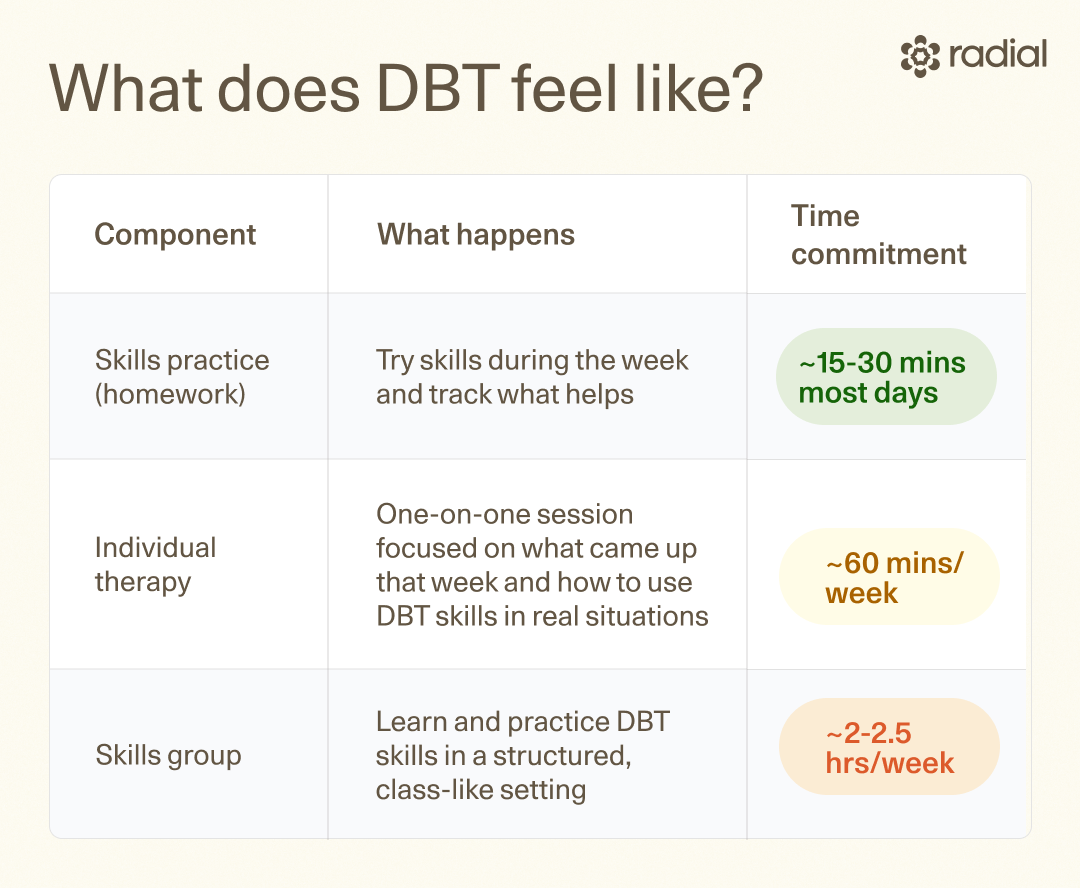
DBT often feels more active than traditional talk therapy. You’re not just talking about what’s hard—you’re learning practical ways to handle it, one step at a time.
At first, that can feel unfamiliar. Trying new skills, tracking emotions, or slowing down reactions takes effort, especially when emotions are intense. If it feels awkward or hard early on, that’s not a sign you’re doing it wrong. It’s a natural part of learning something new.
Over time, many people find DBT feels grounding. The structure can be reassuring, especially if emotions have felt unpredictable or overwhelming. Instead of guessing what to do in difficult moments, you start to build a toolbox you can reach for when things get tough.
Emotionally, DBT encourages compassion alongside change. You’re not expected to eliminate emotions or “get it right” all the time. Progress often shows up in small but meaningful ways, like reacting a little less intensely, recovering more quickly after conflict, or feeling more confident navigating situations that used to feel unmanageable.
DBT isn’t about perfection or quick fixes. It’s about building steadiness, skill by skill. For many people, that growing sense of capability—knowing you have options when emotions spike—can be deeply reassuring.
What are the stages of DBT?
DBT is often described as happening in stages, says Hartselle. But it’s important to know that these stages aren’t rigid. People may move back and forth, spend longer in one stage, or focus on only the stages that feel most relevant. DBT meets you where you are and adjusts as your needs change.
According to Hartselle, here’s the breakdown:
Stage 1: Stabilization and safety
This is where DBT usually starts. The focus is on reducing behaviors that feel dangerous, overwhelming, or out of control (think: self-harm urges, suicidal thoughts, or patterns that keep life in crisis mode).
At this stage, the goal is to build enough stability to get through day-to-day life more safely. Skills like distress tolerance and emotion regulation are especially important here.
Stage 2: Processing emotional pain
Once things feel more stable, DBT may shift toward working through painful emotions and past experiences. This can include grief, trauma, or long-standing emotional wounds that haven’t had space to be addressed yet.
This stage often feels more reflective, but it’s still grounded in skills. The focus is on experiencing emotions without becoming overwhelmed by them.
Stage 3: Building a more fulfilling life
In this stage, DBT looks beyond crisis management. The focus turns to improving quality of life; things like relationships, self-respect, work, and personal goals.
Skills are still used, but now they support growth rather than just survival. Many people describe this stage as feeling more forward-looking and hopeful.
Stage 4: Finding meaning and connection
Some DBT models include a fourth stage that focuses less on symptoms and more on how a person wants to live. This can include strengthening relationships, developing a sense of purpose, or reconnecting with values, spirituality, or community.
Not everyone reaches or needs this stage, and that’s completely okay. When it’s part of treatment, the focus is often on maintaining skills while exploring what brings meaning, fulfillment, or connection beyond managing emotions.
Standout Box:How can I help my loved one in DBT therapy for BPD?: Learning about DBT, and even practicing some of the skills yourself, can be a great way to support a loved one getting this therapy. Shari Manning at Behavioral Tech, the parent organization for DBT training, wrote a helpful book on the topic.
Who is DBT for?
“DBT can help anyone work toward appreciating the life they have and addressing emotional dysregulation,” says Hartselle. DBT might be a good fit for you if you:
- Feel emotions strongly and have a hard time calming down once they’re activated
- Experience rapid mood shifts or emotional overwhelm
- Struggle with impulsive behaviors during intense emotions
- Feel stuck in repeating patterns in relationships
- Want practical tools, not just insight
- Are willing to practice skills between sessions, even when it feels uncomfortable
- You’ve tried other therapies, but didn’t feel like they were effective enough
That said, there are pros and cons of DBT, so it isn’t the right fit for everyone. It may be harder if:
- You’re not able to commit the time or energy required for skills practice
- You’re looking for a purely open-ended, insight-based therapy
- You’re not ready to actively work on changing behaviors right now
- Access barriers (like cost, scheduling, or availability) make full DBT difficult
If DBT doesn’t feel like the right place to start, that’s completely okay. Therapy isn’t one-size-fits-all. Some people begin with CBT, ACT, or supportive talk therapy, and return to DBT later. Others combine DBT skills with other treatments in a way that fits their needs.
How effective is DBT?
“When the program is offered in full, it has been one of the most studied and effective therapeutic methods,” says Hartselle.
Over time, research has shown that it can help treat conditions like:
- Borderline personality disorder: DBT was originally created for BPD, and research consistently shows that it helps people feel more emotionally steady, reduce self-harm and suicidal behaviors, and experience fewer crises over time.
- Chronic suicidal thoughts or self-harm urges: Studies show that DBT can make these thoughts and urges feel less intense and less frequent by giving people tools to get through high-risk moments more safely.
- Depression and anxiety: DBT for depression or anxiety can be helpful when things are emotionally overwhelming, especially for people who get stuck in spirals or haven’t found enough relief with other therapies.
- Substance use or eating disorders: Research suggests DBT helps by addressing the emotional triggers behind urges, making it easier to pause, cope, and choose safer alternatives instead of acting on impulse.
- PTSD: Research on a DBT-based approach for PTSD shows that when people have tools to manage intense emotions first, trauma treatment can feel safer and be more effective.
Relief within reach
Care covered by your insurance
Radial provides advanced mental health treatment, covered by the insurance you already use.








How to find and choose a DBT provider
Looking for a DBT provider can feel overwhelming. You don’t need to figure everything out at once—the goal is simply to understand what kind of support is actually being offered. Here are some tips to keep in mind as you look:
- Look for comprehensive DBT when possible: This typically encompasses individual therapy, skills training, and some form of between-session support so you have all the resources you need.
- Be cautious with “DBT-informed” labels: These can be helpful, but they don’t always include the full DBT structure.
- Prioritize fit and collaboration: DBT should feel respectful and supportive, not judgmental or rushed. Your comfort is essential.
- Remember that access matters: Cost, scheduling, and availability are real factors, and starting with partial DBT support is still valid if that’s what’s most accessible.
If you’re feeling unsure, asking potential providers these questions can help you get the information you need to decide what feels like a good next step:
- Do you offer comprehensive DBT or DBT-informed therapy?
- What parts of DBT are included?
- How often would we meet, and what’s the time commitment?
- What DBT training have you completed?
- What support is available between sessions?
The bottom line
Dialectical behavior therapy is a skills-based approach designed to help people manage intense emotions and navigate life more steadily. It doesn’t offer quick fixes or ask you to ignore how hard things feel. Instead, DBT focuses on building practical tools you can use in real moments, when emotions spike or coping feels hardest. If DBT sounds structured, that’s by design—many people find that structure grounding over time. And if it doesn’t feel like the right fit right now, that’s okay. Learning about your options is already a meaningful first step.
Key takeaways
- Dialectical behavior therapy is a structured, skills-based therapy designed to help people manage intense emotions and emotional overwhelm.
- DBT can be especially helpful for people who feel emotions strongly, experience recurring crises, or haven’t found enough relief with other therapies.
- DBT focuses on learning practical tools for real-life moments, not just talking about problems after they happen.
- The four core DBT skills—mindfulness, distress tolerance, emotion regulation, and interpersonal effectiveness—work together to support emotional stability and healthier relationships.
- Progress in DBT is usually gradual. Small changes—like calmer reactions or quicker recovery after hard moments—are meaningful signs that the skills are working.
Frequently asked questions (FAQs)
What is dialectical behavior therapy?
Dialectical behavior therapy is a structured, skills-based form of therapy designed to help people manage intense emotions, cope with distress, and navigate relationships more effectively. It focuses on learning practical tools you can use in real-life situations, especially when emotions feel overwhelming.
What are the four techniques of DBT?
The four DBT skill areas are:
- Mindfulness: Noticing what’s happening in the moment
- Distress tolerance: Getting through intense moments without making them worse
- Emotion regulation: Understanding and reducing emotional intensity over time
- Interpersonal effectiveness: Communicating clearly and setting boundaries
These skills are taught and practiced together, since emotional challenges rarely show up in isolation.
What’s the difference between DBT and CBT?
DBT grew out of CBT, but it puts more emphasis on emotions and coping during moments of crisis. While CBT often focuses on changing thought patterns, DBT focuses on building skills to manage emotional overwhelm, impulsive behaviors, and relationship stress.
Is DBT only for borderline personality disorder?
No. While DBT was originally developed for borderline personality disorder, it’s now used for many conditions linked to emotional dysregulation, including different types of depression, anxiety, PTSD, eating disorders, and substance use disorders. DBT is less about diagnosis and more about how emotions show up and affect daily life.
How long does DBT usually last?
A full DBT program often lasts around six months to a year, though timelines vary. Some people repeat skills cycles or continue individual therapy longer. Progress tends to be gradual, and many people continue using DBT skills well beyond formal treatment.
Editorial Standards
At Radial, we believe better health starts with trusted information. Our mission is to empower readers with accurate, accessible, and compassionate content rooted in evidence-based research and reviewed by qualified medical professionals. We’re committed to ensuring the quality and trustworthiness of our content and editorial process–and providing information that is up-to-date, accurate, and relies on evidence-based research and peer-reviewed journals. Learn more about our editorial process.
Let's connect
Get started with finding the right treatment for you or someone you care about
Get startedExplore more posts