High-Functioning Depression, Explained: Symptoms, Diagnosis, and What Actually Helps

Key takeaways
- Functioning depression isn’t a real diagnosis, but it does describe real depressive symptoms that are hidden by a person’s ability to keep up with their daily responsibilities.
- It may be a sign of persistent depressive disorder, especially if symptoms like low mood and fatigue have lasted for years.
- Being outwardly functional and productive doesn’t mean that symptoms are mild or not serious enough to warrant treatment.
- Treatment options can include psychotherapy, medication, and advanced options like TMS, esketamine, or ECT when standard options haven’t provided enough relief.
Even though you’re showing up for work and caring for your family, you might ask yourself, “Why do I feel empty, even though things in my life seem fine?” Things you used to love feel uninteresting, and you’re tired most of the time. You may have even started wondering if you might be depressed or if this is just the way things are. If this sounds like how you’ve been feeling, you might be experiencing what is sometimes referred to as “functioning depression.”
Functioning depression is an informal term used when someone has depressive symptoms but is still able to meet day-to-day responsibilities, often so well that other people don’t realize that anything’s wrong. Depression doesn’t always mean that a person isn’t able to function in their daily life. In fact, outward signs of functioning depression are often a poor measure of what’s really going on inside — outward competence can hide inner distress, BJPsych Bulletin suggests. If you've been experiencing symptoms for a while, you might think it’s just stress or part of your personality.
In this article, we’ll look at what functioning depression can look like, how it differs from other forms of depression, and the treatments that can help, including options that can bring relief when antidepressants and therapy haven’t helped enough.
Connect with our Clinicians



What is functioning depression?
“Functioning depression is a colloquial term commonly used to describe people who manage to keep up with their daily obligations while experiencing persistent depression symptoms,” says Ariel Hurley, LCSW, MSSW, MPH, Regional Clinical Director at Radial.
It’s not a formal diagnosis listed in the Diagnostic and Statistical Manual of Mental Disorders (DSM), but that doesn’t mean a person doesn’t have a diagnosable condition. Depending on how severe and long-lasting a person’s symptoms are, clinicians might diagnose it as persistent depressive disorder (PDD) or major depressive disorder (MDD).
PDD, previously known as dysthymia, is a condition marked by a chronically depressed mood that has occurred more often than not for at least two years, says the National Institute of Mental Health. It also causes people to have symptoms like low self-esteem, changes in sleep and appetite, and low energy. While major depressive disorder is often marked by a clearer shift in mood, PDD can start to feel like a person’s baseline. A person who has felt tired and emotionally flat for a very long time may start to think that they’ve always felt that way or that it’s just who they are.
Functioning depression vs. major depression: what’s the difference?
Functioning depression is not an official diagnosis like major depressive disorder. Rather, it's an informal term used to describe the state of feeling depressed while still maintaining the ability to keep up with daily responsibilities. A person who seems to function well can still meet the diagnostic criteria for major depressive disorder, or they may have another form of depression known as persistent depressive disorder/dysthymia.
“Depression presents differently for everyone, and symptoms can vary in how intense or challenging they are to deal with over time,” Hurley notes.
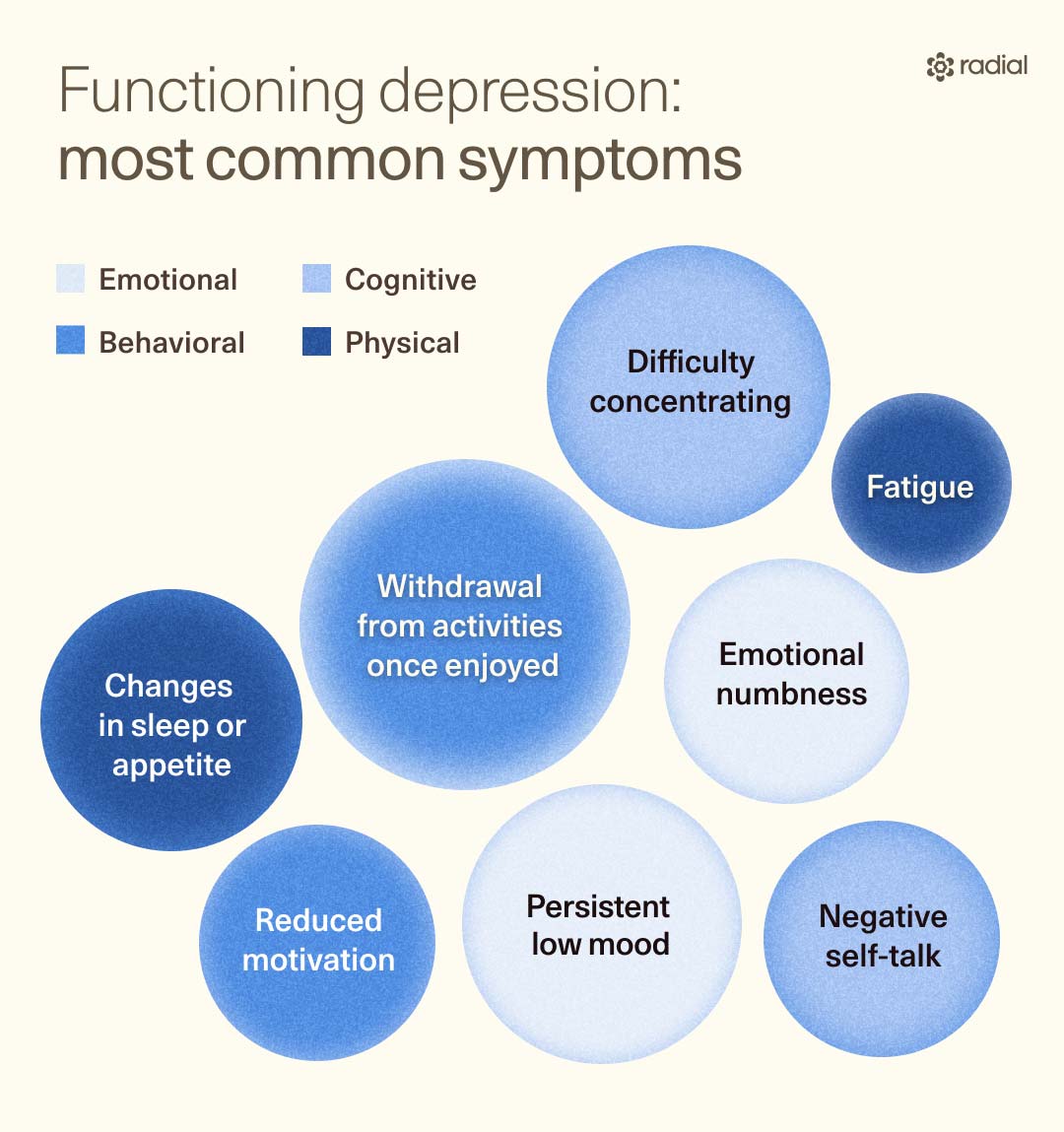
What are symptoms of functioning depression?
Functioning depression is characterized by chronic but manageable symptoms. High-functioning depression symptoms are often the same as with other forms of depression. While this makes it harder to recognize, it doesn’t mean that these symptoms are mild. Oftentimes, it takes a great deal of effort and energy just to keep up with basic responsibilities.
“They may appear ‘put together’ on the outside but internally struggle with persistent low mood, exhaustion, and difficulty enjoying activities that used to bring them joy,” Hurley explains.
The National Institute of Mental Health says that common depression symptoms include:
Emotional signs
- Low or flat mood: Feeling empty, sad, numb, or emotionally “flat” much of the time.
- Loss of pleasure: Not getting the same enjoyment from the things you used to enjoy.
- Irritability: Feeling frustrated or easily annoyed more often than usual.
- Hopelessness: Feeling pessimistic about your life and the world.
- Guilt or worthlessness: Being more self-critical or feeling that you are failing, even though you’re still managing a lot.
Cognitive signs
- Problems concentrating: Finding it more challenging to focus and stay mentally engaged.
- Indecisiveness: Struggling to make choices that normally wouldn’t require a lot of thought.
- Forgetfulness: Having trouble remembering important details or often losing track of what you were doing.
- Thoughts of death or suicide: Thinking about death, self-harm, or ending your life.
Behavioral signs
- Social withdrawal: Pulling back from friends and family.
- Loss of interest: Disengaging from hobbies, relationships, or other parts of life.
- Slowing down or restlessness: Moving or speaking more slowly or feeling unable to settle down.
Physical signs
- Fatigue: Feeling exhausted even though you’re still managing to get things done.
- Sleep changes: Sleeping much more or less than usual.
- Changes in appetite: Eating more or less than usual, or having unexplained changes in weight.
- Aches and pains: Headaches, digestive problems, or other physical symptoms that don’t have an obvious physical explanation.
Why does functioning depression often go unnoticed?
Functioning depression often goes unnoticed because people learn how to mask or minimize their symptoms. They might fear judgment or think that what they are feeling isn’t serious enough to warrant concern. “When you are able to keep up with work, relationships, and household responsibilities, it’s easy to minimize the amount of pain you’re in,” Hurley says.
Masking
Some people are very good at appearing okay. “Often, people with ‘high-functioning depression’ have learned how to mask their internal distress to appear like everything is ‘fine,’ which makes their symptoms easy for loved ones to miss,” Hurley says.
They keep up with everyday tasks to mask what they feel inside, even though it takes an enormous amount of effort. If you’re still getting things done, you might tell yourself that you're “not that depressed.” For many people, the fear of being seen as weak or unreliable can make it harder to admit they’re struggling.
That’s why the term “high-functioning” can be so problematic. Functioning labels are often criticized in neurodiversity and disability communities because they imply that people should be judged based on how well they meet traditional expectations about productivity and independence. But the label ignores how much effort people have to put into masking their challenges and hiding their need for support.
Normalization
When depression lasts for a long time, a person might tell themselves, “I’ve always been this way.” The Lancet Psychiatry notes that dysthymia can be hard to tell apart from a person’s usual personality, which can make persistent depression harder to recognize.
“Someone who appears to be ‘functional on paper’ may feel like their suffering isn’t valid, despite the fact that it’s interfering with their ability to enjoy life or to be present in the way they want to,” Hurley notes. “Feeling like you need to appear okay on the outside when you’re suffering internally is exhausting and can lead to more entrenched emotional distress over time.”
.jpg)
Why does functioning depression happen?
Functioning depression doesn’t have a single cause. Depression develops through an interaction of causes that can include genetic influences, activation of your body’s chronic stress response, and social factors, explains the World Health Organization.
These factors also shape how people cope with symptoms. For example, research in Brain Sciences links perfectionism and self-criticism to depression. Cultural expectations about self-sufficiency mean people are less likely to even acknowledge how distressed they feel. Sometimes, being able to function reflects resilience, but it can also stem from sheer necessity when someone is juggling work, financial pressure, and caregiving responsibilities.
How is functioning depression diagnosed?
While functioning depression isn’t a diagnosis in and of itself, a healthcare professional will look at your symptoms and decide if you meet the criteria for a condition like persistent depressive disorder or major depressive disorder.
Hurley says it's important to monitor your symptoms and consider talking to a professional if you find it increasingly difficult to meet the demands of your daily life, since this may signal a progression to major depressive disorder.
During an evaluation, your provider will ask questions about the symptoms you are experiencing, how long you’ve had them, and how they affect your life, says the Canadian Journal of Psychiatry. A comprehensive evaluation includes a review of the medications you are taking, your medical history, substance use, sleep, and other mental health symptoms. This can help them identify other medical conditions that might contribute to your symptoms, since some conditions, like ADHD and depression, can overlap.
What often stops people from getting a diagnosis is the idea that if you’re still functioning, then it can’t be that bad. “You don’t have to wait until you’re at a breaking point to seek support,” Hurley says. “Some people may experience a low mood that lasts for months or even years without ever feeling like it majorly impacts their functioning, which may be a sign of persistent depressive disorder.”
Talking about the specific symptoms you’re feeling is important, but also be sure to mention just how much effort it takes to keep getting things done despite the low mood, fatigue, loss of pleasure, and other challenges.
.png)
What are treatment options for functioning depression?
Treatments for functioning depression should be individualized based on a person’s underlying diagnosis, symptom pattern and severity, other health conditions, the options you’ve already tried, clinical needs, and personal preferences. Depression recovery stories often feature more than one treatment option. Psychotherapy and medication are common options, while options like TMS and esketamine may be appropriate for some people depending on how they’ve responded to past treatments.
- Psychotherapy: Different types of therapy can be helpful in the treatment of functioning depression. Cognitive behavioral therapy (CBT) can help identify and change the thinking patterns that reinforce depression. Mentalization-based therapy is another approach that can help people understand their own and other people’s thoughts.
- Medication: SSRIs, SNRIs, and other antidepressants are also first-line treatments. These are sometimes used in conjunction with psychotherapy, but some people may benefit from other treatments if these options do not provide sufficient relief.
- Advanced treatments: When depression symptoms don’t respond well enough to standard treatments, additional options may be helpful. Transcranial magnetic stimulation (TMS) is an FDA-cleared treatment for depression that uses magnetic pulses to stimulate brain areas that are linked to mood, says the National Institute of Mental Health. Esketamine is an FDA-approved treatment for adults with treatment-resistant depression. ECT or an implantable vagal nerve stimulator may be considered if symptoms are severe and persistent. is another option to consider if symptoms are severe.
- External neuromodulation: The Proliv™Rx device is another option that may be helpful. This is an in-home wearable device that stimulates peripheral nerves and can relieve depression symptoms when medication has not provided enough relief or has caused intolerable side effects, says the journal Transcranial Magnetic Stimulation.
If previous treatments haven't provided enough relief, talking to a provider at Radial can help you decide if any of these options are appropriate next steps for you.
Relief within reach
Care covered by your insurance
Radial provides advanced mental health treatment, covered by the insurance you already use.








The bottom line
How well you’re functioning on the outside isn’t a reliable measure of how you might be struggling on the inside. Functional depression is hard to recognize because feeling low often starts to feel like your new normal, so it might be easy to write off persistent exhaustion, sadness, and lack of enjoyment as a sign of stress or to think you should be able to handle it on your own.
But you don’t have to wait until you’re not able to function for your symptoms to deserve attention. “It’s important to consult a professional if your symptoms are present most of the day, or for more days than not, even if it feels like they’re not as severe or impairing as major depression,” Hurley says.
Frequently asked questions (FAQs)
Is functioning depression a real diagnosis?
No, the term functioning depression is an informal term and not a formal medical diagnosis. It describes people who keep up with the demands of daily life while experiencing depression symptoms, often for long periods of time. Some people who experience functional depression meet the diagnostic criteria for persistent depressive disorder (PDD) or another type of depression.
How can I help someone with functional depression?
To help someone with depression who still seems to be functioning well in daily life, focus more on how they say they feel than on how productive they are. Avoid minimizing their feelings or symptoms, or attributing them to "stress.” Encourage them to talk to a mental health professional, and consider helping out with practical daily tasks so they’ll feel less pressure to appear “fine.”
How do I talk to a doctor if my symptoms don't feel "bad enough"?
You don’t have to wait for things to get “bad enough” to ask for help. Tell your doctor about what you’ve been feeling and how long it’s lasted, but also about the enormous amount of effort it takes to mask symptoms and keep functioning. Even if you can still get things done, depression symptoms take away from your ability to enjoy your life fully, so it’s worth getting help so you can feel more like yourself.
What happens if functioning depression goes untreated?
Untreated depression symptoms can lead to poorer outcomes, says the Journal of Affective Disorders. Constantly pushing through exhaustion, low mood, and other symptoms takes a toll that can make recovering even harder. Getting support now, rather than waiting for things to get worse, can help you reduce symptoms and make your daily life easier to manage.
Deep dive recommendations
- Be Well Sis: The Podcast. High functioning with Dr. Judith Joseph
- European Psychiatry. Dysthymia through time: A review
- Canadian Journal of Psychiatry. Persistent depressive disorder: Commentary on Parker and Malhi
Editorial Standards
At Radial, we believe better health starts with trusted information. Our mission is to empower readers with accurate, accessible, and compassionate content rooted in evidence-based research and reviewed by qualified medical professionals. We’re committed to ensuring the quality and trustworthiness of our content and editorial process–and providing information that is up-to-date, accurate, and relies on evidence-based research and peer-reviewed journals. Learn more about our editorial process.
Let's connect
Get started with finding the right treatment for you or someone you care about
Get startedExplore more posts