What is Proliv™Rx? A Guide to the New At-Home Depression Treatment

Imagine an effective, non-pharmaceutical depression treatment you could use at-home that didn’t come with as many side effects as traditional antidepressant medications. Too good to be true? Nope—the FDA recently approved a new medical device, Proliv™Rx, which may offer just that.
Disclaimer: Owen Muir, MD, DFAACAP is the Chief Medical Officer Radial and the Chief Medical Officer at Neurolief, the manufacturer of Proliv™Rx.
Proliv™Rx is a wearable device for depression that recently secured FDA approval. Unlike most medical devices which receive FDA clearance (a quicker designation for low-risk devices), ProlivTMRx underwent more rigorous and comprehensive testing because it’s a new technology. But novelty isn’t the only thing this device offers. Proliv™Rx has minimal side effects, may significantly reduce depression symptoms, and boasts a 31.7% remission rate in clinical trials.
The treatment itself is also relatively straightforward: put on the Proliv™Rx device, which looks like a headband, for 40 minutes twice a day. The device then delivers gentle brain stimulation that changes the way neurons related to our senses and mood operate.
It’s a potential option for people who have tried and didn’t see results from at least one antidepressant medication. The FDA also approved it as an adjunctive treatment, meaning it can be used alongside medication, therapy, and other treatments.
Continue reading to learn more about this new depression treatment, what to reasonably expect from this device, and if it’s worth discussing with your mental healthcare provider.
What is Proliv™Rx?
The Proliv™Rx is a noninvasive neuromodulation therapy developed by a company called Neurolief. Recently, the FDA approved this device for adults with major depressive disorder who did not experience adequate improvement in symptoms from one or more antidepressant medications.
“When people are depressed, their brains are firing in patterns that are out of sync with themselves and out of sync with the world,” says Owen Muir, MD, DFAACAP, chief medical officer at Radial and Neurolief. There are many potential avenues to bring the brain back into sync. Successful mental health treatment is about finding the right approach for each individual patient. And for some, that approach could be this Neurolief device.
“Clinical trials with Proliv™Rx showed us that it was possible to stimulate sensory nerves using very low power,” explains Dr. Muir, “And it is remarkably safe to use that sensory input to rewire your brain circuits and get out of that depressive loop.”
Admittedly, the device itself might look like something out of a sci-fi movie, but it’s safe and easy to use. To start, someone puts the headband around their head with the thickest part of the band on the forehead. They then wear the device for forty minutes (during which time they could potentially watch part of an actual sci-fi movie). The device is prescribed for twice daily use, ideally in two forty-minute sessions spaced at least five hours apart.
What is neuromodulation?
There’s a lot to unpack with Proliv™Rx, but let’s start with a very brief overview of neuromodulation therapies in general. These treatments typically send targeted electrical stimulation, magnetic impulses, or other signals such as pharmacologic agents to precise areas of the brain associated with mood and emotional regulation.
Repeated sessions with neuromodulation stimulation reshapes how neurons in the brain communicate, helping the brain to get out of unhelpful loops and strengthening neural pathways that encourage emotional regulation and better overall mood.
Connect with our Clinicians

.png)
%20(1).webp)
How does Proliv™Rx work?
Some neuromodulation therapies (think: ECT) require anesthesia or sedation, include the use of invasive devices that must be implanted via surgery, and/or can induce seizures.
By contrast, the Proliv™Rx device delivers a gentler brain stimulation, no anesthesia or surgery required. Plus, seizures aren’t an observed side effect in clinical trials. But how exactly does the device work? That explanation requires us to dive into the anatomy of the sensory nerves.
Proliv™Rx and sensory nerves
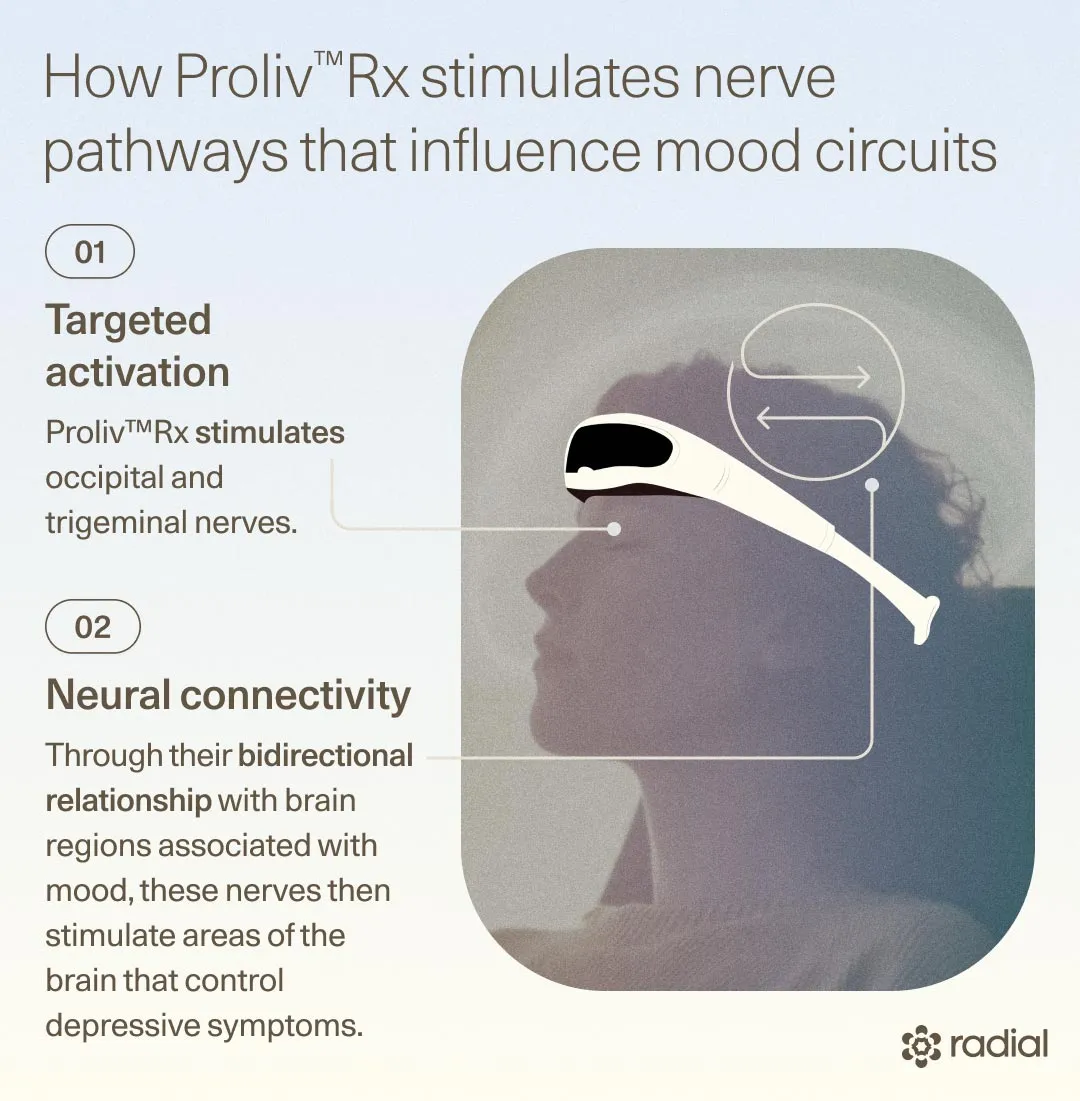
To potentially reduce depression symptoms, Proliv™Rx uses external combined occipital and trigeminal afferent stimulation. Try saying that five times fast (or just use the term’s acronym eCOT-AS). This term basically means that this device targets two main nerve groups:
- Occipital nerves: A group of three nerves at the back of the head that provide sensory information from the top of the head, bottom of the scalp, and eyes to the brain.
- Trigeminal nerve: The largest and most complex of the cranial nerves, the trigeminal nerve has one major branch that goes to the forehead, and this is generally the part of the trigeminal that is stimulated by ProLiv RX. The trigeminal has other branches too, and those branches have various other functions, including to help control facial muscles for tasks like chewing or smiling. The different branches provide sensory data from the face also. When you feel the rain on your face, that's your trigeminal.
The unexpected connection between sensory nerves and depression
If you’re anything like me, you’re probably wondering what exactly sensory nerves have to do with depression. It isn’t the most obvious connection, and recently, researchers have been discovering important ways sensory nerve pathways influence mood and vice versa.
As a starting point, Dr. Muir points out that our sensory nerves feed us information about the world around us. One of our brain’s jobs is to make sense of that input. If, for example, it’s a cold day out, the sensory nerves will deliver a “freezing” signal to the brain which will then react emotionally. In response, we might take action, such as putting on more layers or making a hot drink. Dr. Muir expanded this metaphor, saying the experience of depression is the world feeling emotionally cold.
Let’s say someone used to love reading fantasy novels. If they develop depression, books may no longer provide the same emotional pay-off or relaxation, and they may struggle to engage in this hobby. From a scientific standpoint, this lack of pleasure from something someone used to enjoy is called anhedonia, a common depression symptom.
It occurs because depression interrupts neural mechanisms that make experiences feel rewarding, which is why a hobby someone used to love can feel flat or distant. Over time, this may have a ripple effect on the sensory experience of the world, hobbies someone used to enjoy, and potentially even how they experience physical sensations.
A new way to target depression
So depression modulates the brain and may change how you experience the environment around you. But the interesting thing about connected pathways in the brain is that they’re often bidirectional. This means that sensory nerves can influence neural pathways associated with depression too.
“Once you realize that sensory input is the way the brain communicates with the environment, then one cheat code is to modify that input without having to go directly to the brain itself or go through the bloodstream to the neurotransmitters,” says Dr. Muir, “We can target those brain circuits by using sensory inputs.”
And that’s where Proliv™Rx comes in. It changes the sensory input for those occipital and trigeminal nerves, which are easy to access and have a direct impact on mood-regulating neural pathways.
What is Proliv™Rx treatment like?
40 minutes is a long time to commit to anything, and this treatment requires two 40 minute sessions each day. For some, this can be a drawback, though luckily, those 40 minutes aren’t dead time where you can’t do anything else. Instead, you can go about your day, though Dr. Muir states it may be best to do something relaxing while wearing the device.
To get a better idea of what a Proliv™Rx session looks like, here’s what happens during a session:
- To start: Put the Neurolief device on with the larger part directly over your forehead. The Proliv™Rx comes with an app that can help with how to wear it and may offer recommendations on the dose of the stimulation, though your psychiatrist should be on hand to answer questions as well.
- During treatment: Dr. Muir himself has used Relivion, Neurolief’s other device that looks and operates similarly to Proliv™Rx but with a different stimulation pattern that works for migraines. “It just feels like a massage,” says Dr. Muir, “It’s a tingly sensation.” He compares it to a massage gun that you might use after a run or hard workout, but for the brain.
- After treatment: You can go about your day as normal. Dr. Muir mentions that sessions can be done from the privacy of your home, meaning only you and the prescribing doctor have to know your using the device.
It really is that simple to use, as showcased in adherence rates in clinical trials. Of the 47 who used the device in the largest clinical trial, only three patients withdrew, and the investigators discontinued one other patient due to side effects.
“Anything that's good enough that people are going to use it twice a day for 40 minutes a day,” says Dr. Muir, “at over a 90% rate of adherence has got to be pretty pleasant.”
What does the research say about Proliv™Rx?
One limitation of Proliv™Rx is that there haven’t been a ton of clinical trials on this device. Most of the data we do have comes from the “MOOD” study which enrolled 124 participants. It was a “double-blind multicenter randomized sham-controlled study,” meaning some participants used the device, while others used a sham (aka an inactive device). Neither the participants nor healthcare providers overseeing their treatment knew which was which.
- Who: 124 participants across 13 clinical centers in the United States and Israel
- How long: Eight-week double-blind phase where participants had two 40 minute sessions a day with the device or sham. This was followed by an eight-week open-label phase where the researchers and participants knew which treatment was administered.
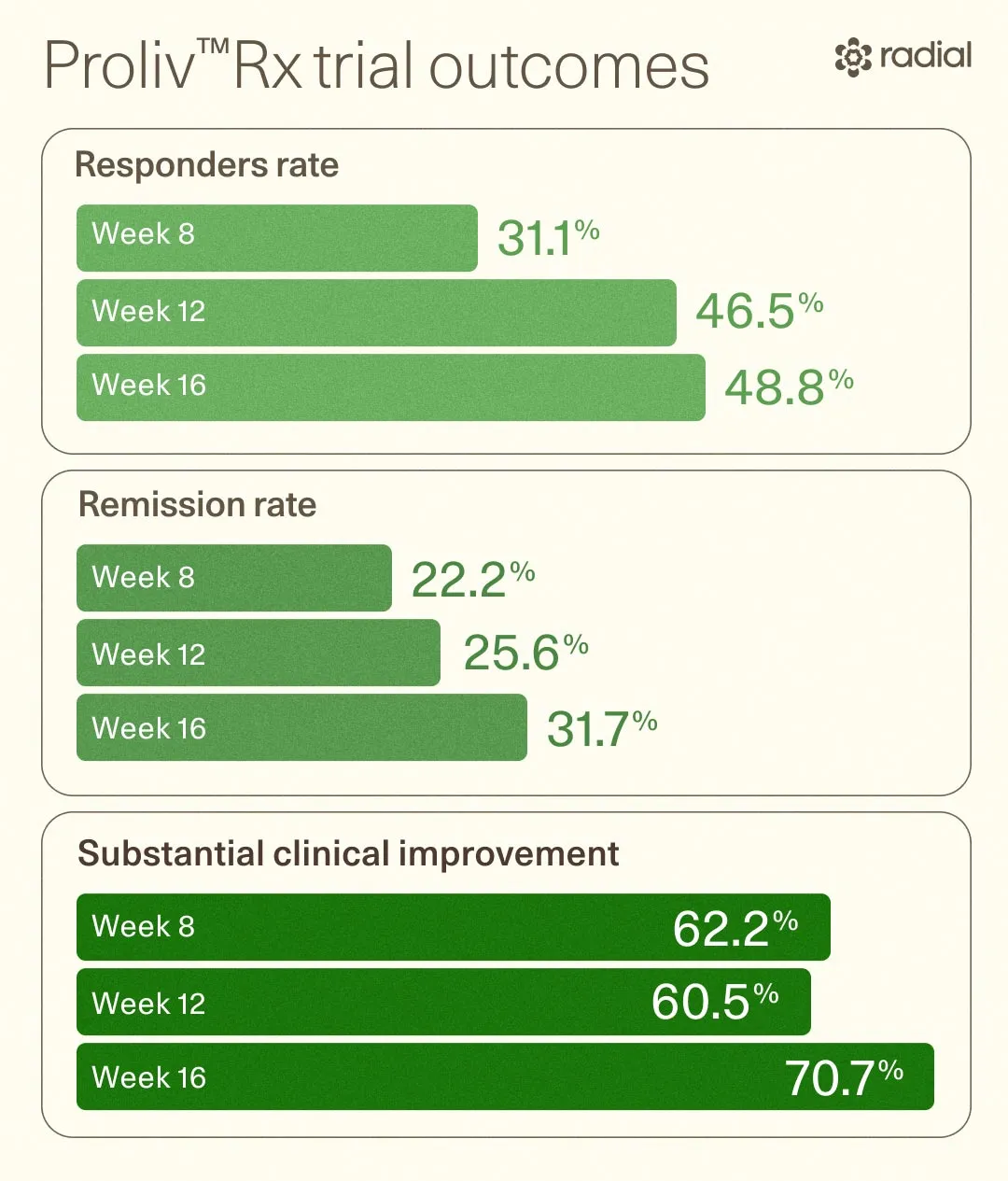
- Symptom improvement rates: The sham group had a 6.01 point improvement on a depression symptom scale, while the group with the device’s symptoms improved by 8.62 points. This is considered a statistically significant difference.
- Remission rates: 21.3% of people in the Proliv™Rx group went into remission within eight weeks compared to 6% in the sham group. For the participants who continued using the Proliv™Rx device for 16 weeks, the remission rate was 31.7%.
Who may be a good candidate for Proliv™Rx?
Clinical trials on Proliv™Rx have included participants who previously tried at least one other treatment, whether that was an antidepressant medication, transcranial magnetic stimulation (TMS), or another option that requires a prescription. The device might work for others, but there isn’t evidence supporting (or negating) if it helps treat depression for others.
According to Dr. Muir, this could be a suitable option for someone who:
- Has depression and wants it to be over
- Didn’t respond to at least one other prescription treatment
- Wants a treatment that can be done in the privacy of their home
- Wants a gentle treatment that’s easy to do consistently
- Doesn’t want the side effects of another medication
Just remember, a licensed physician must prescribe this device, similar to an antidepressant or an in-clinic psychiatry treatment like TMS. That means a healthcare provider must assess someone’s symptoms and prescribe this after they’ve already tried at least one other treatment.
What are Proliv™Rx’s side effects?
Compared to antidepressant medications, Proliv™Rx has relatively few side effects, mostly physical sensations around the scalp. Notably, no one in the MOOD study reported worsening depression symptoms from the device.
They did however report side effects like:
- Mild headaches
- Burning sensation
- Skin irritation
- Mild pain or discomfort
- Scalp itching
- Skin redness
And that’s it, at least from the clinical trials. Compared to the laundry list of side effects we’ve all heard on pharmaceutical drug commercials, this is a small list. Plus, some of the irritation or redness may disappear as someone uses the device more and learns how to adjust the headband to fit their scalp comfortably.
“The breathtaking safety compared to other treatments is worth thinking about,” adds Dr. Muir, “It's both potent and safe, and that's a hard landing to stick.”
How does Proliv™Rx compare with other depression treatments?
Proliv™Rx is definitely the new kid on the block, so let’s look at how it compares to already established depression treatments. If you discover other treatments that sound useful as you read, the good news is Proliv™Rx may be used alongside talk therapy, medications, and many other treatments.
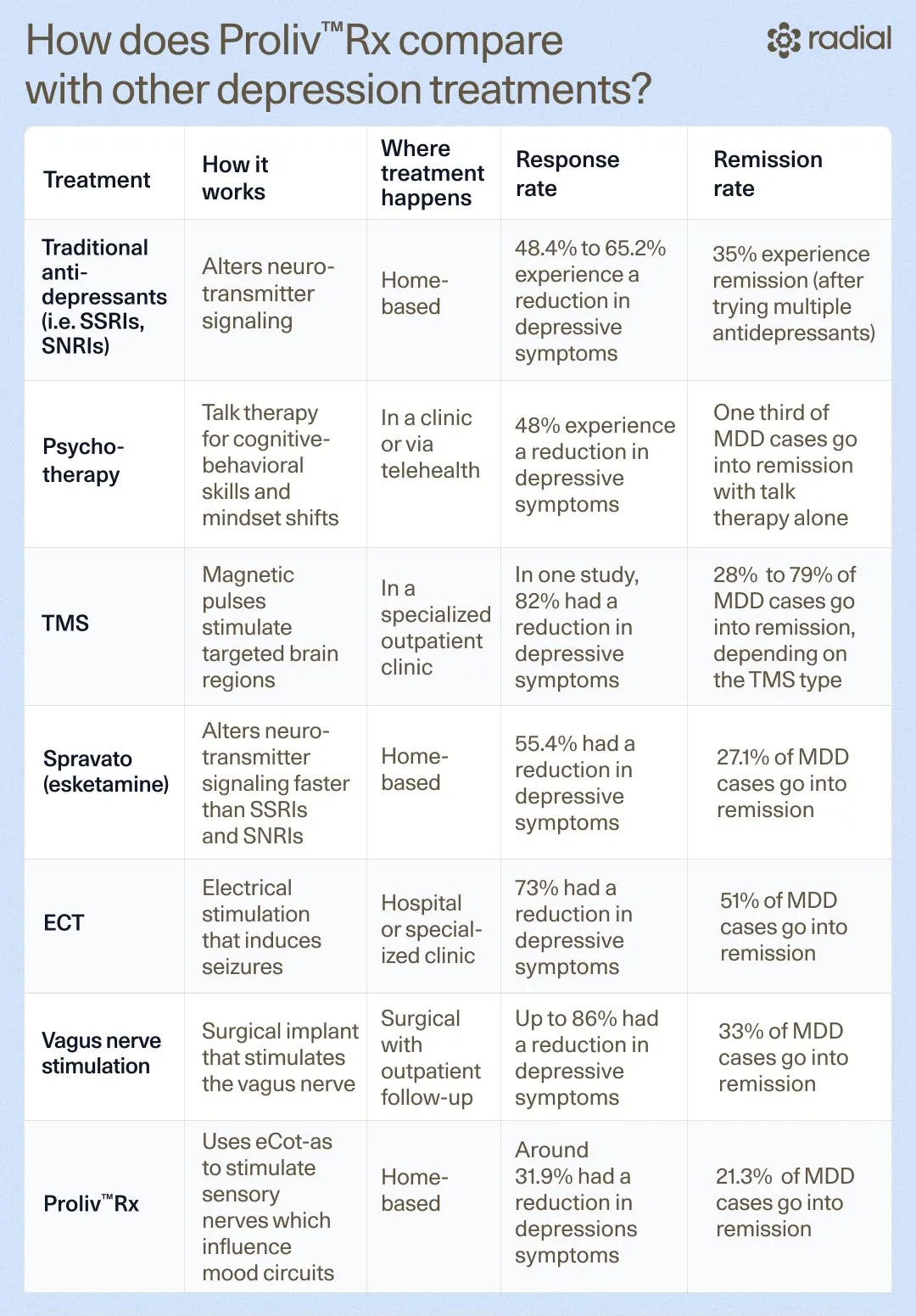
Traditional antidepressants
- How they work: Oral medications that alter neurotransmitter signaling
- Benefit: Considered a “first-line treatment” so it may be easier to get covered by insurance, especially for those who have yet to try a depression treatment.
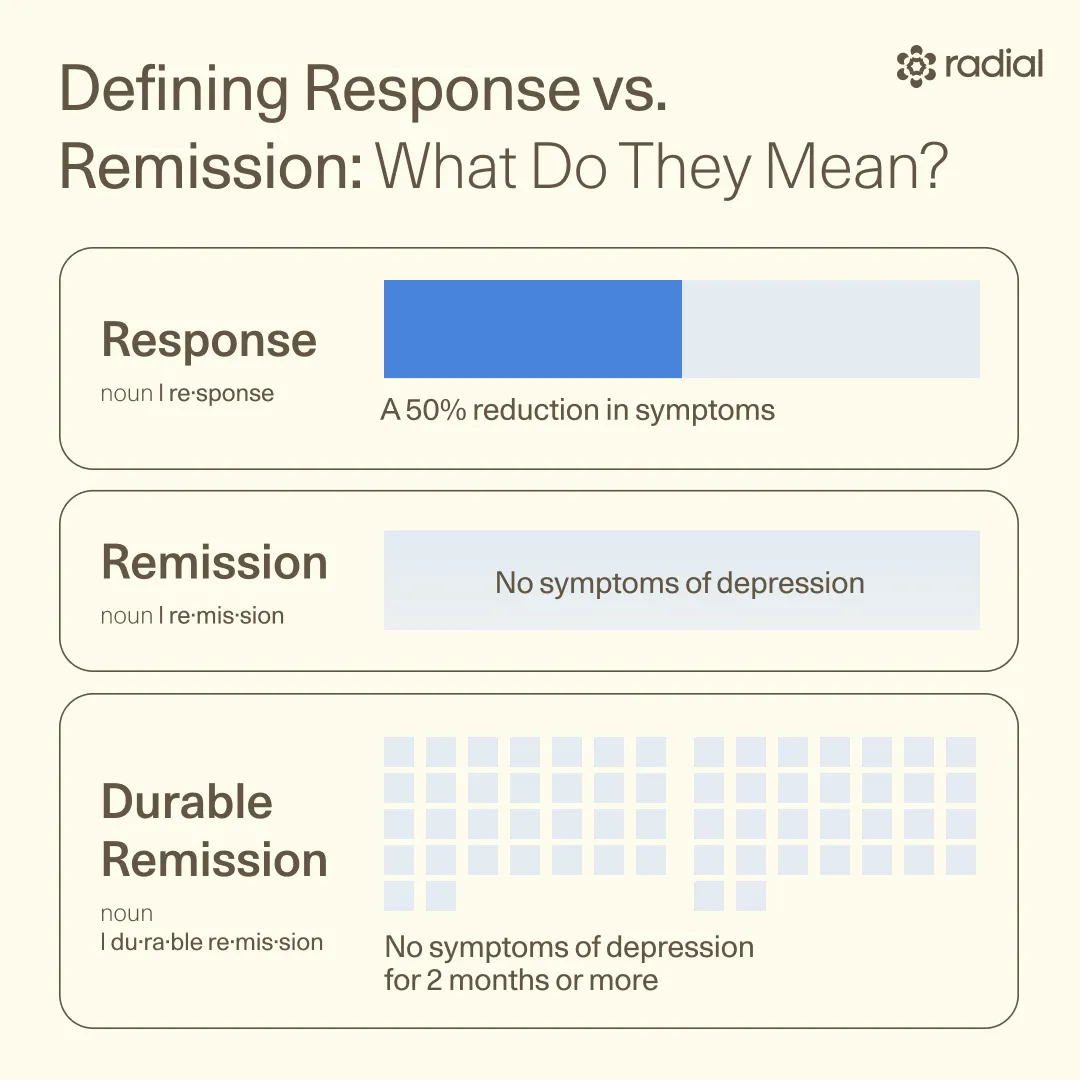
- Remission rate: 35% experience remission (after trying multiple antidepressants)
- Response rate: 48.4-65.25% experience some reduction in depressive symptoms, depending on which antidepressants they try and how long they take one or more of these medications
- Limitation: Most of these medications have a substantial side effect profile that makes it difficult for some people to continue taking them.
Psychotherapy
- How it works: Talk therapy sessions with a licensed mental healthcare provider that focus on behavioral and cognitive skill development and ways to change depressive thought patterns
- Benefit: Noninvasive treatment option that can work alone or alongside other treatments; often, talk therapy provides space to build skills and thought patterns that lead to sustainable improvements in mental health.
- Remission rate: One third of MDD cases go into remission with talk therapy alone
- Response rate: 48% experience a reduction in depressive symptoms from talk therapy alone; this could be higher if psychotherapy is combined with other treatments
- Limitations: Two-thirds of major depressive disorder cases don’t go into remission with talk therapy alone, so it may be a better adjunct treatment.
TMS
- How it works: A machine that uses magnetic pulses to stimulate targeted brain regions involved in mood regulation
- Benefit: Accelerated TMS can work within five days, is noninvasive, and works well for treatment-resistant depression.
- Remission rate: 28% to 79% of MDD cases go into remission, depending on the TMS type
- Response rate: In one study, 82% of participants experienced a reduction in depressive symptoms after 30 TMS sessions
- Limitations: Not all TMS treatments are accelerated; non-accelerated TMS has a slower response time and lower remission rates. It can be hard to get some insurance providers to cover accelerated TMS.
Spravato (esketamine)
- How it works: A medication administered via a nasal spray that alters neurotransmitter signaling faster than SSRIs and SNRIs
- Benefits: Spravato offers similar effects as SSRIs and SNRIs but works much faster, providing more prompt depression relief.
- Remission rate: 27.1% of MDD cases go into remission
- Response rate: 55.4% experience a reduction in depressive symptoms
- Limitations: Research found varied response rates and can induce side effects that might be uneasy for some, such as disassociation
Electroconvulsive therapy (ECT)
- How it works: Electrical stimulation that induces seizures that causes neural circuits involved in mood regulation to activate
- Benefits: ECT boasts a high efficacy rate, especially for more severe depression.
- Remission rate: 51% of MDD cases go into remission
- Response rate: 73% experience a reduction in depressive symptoms
- Limitations: Requires many in-person clinic visits that are lengthy, and the treatment requires anesthesia. It may also cause memory problems.
- How it works: This surgical implant stimulates the vagus nerve, a nerve between the brain and gut that influences mood. While there are take-home and even OTC VNS devices that are not implanted, none are currently FDA cleared for depression.
- Benefits: A depression treatment with promising results in clinical trials that runs “in the background” as someone goes about their day-to-day.
- Remission rate: 33% of MDD cases go into remission
- Response rate: Up to 86% of people see a reduction in symptoms after one year with the VNS device
- Limitations: Requires surgery and has some side effects, like voice alteration or a cough. It provides gradual improvements in depression symptoms, not a quick fix.
Proliv™Rx
- How it works: This wearable device uses eCot-as to stimulate sensory nerves which influence mood circuits
- Benefits: Noninvasive, at-home treatment that can be done in tandem with other treatment options.
- Remission rate: 21.3% of MDD cases go into remission
- Response rate: Around 31.9% experienced a reduction in depression symptoms
- Limitations: Doesn’t work as fast as other treatments, such as accelerated TMS, and there is still limited clinical research since it’s a newer option.
Important note: Always take these percentages with a grain of salt. Each came from a particular study that was done under very specific conditions and with a particular group of patients. When comparing options, talk to your mental health professional to learn more.
When to talk with a mental health professional
If interested in the Proliv™Rx device, remember that it’s a prescription treatment, meaning a psychiatrist will write a prescription if they decide this is the best treatment option after a thorough evaluation.
When choosing a mental healthcare provider, look for one who offers a wide range of treatment options and a psychiatry clinic that’s well-versed in newer treatments, like Proliv™Rx as well as more established options like TMS, such as Radial.
The bottom line
Proliv™Rx is a new treatment with an excellent safety profile that’s intended for those who have already tried at least one prescription depression treatment. It has meaningfully reduced depression symptoms in clinical trials. The device can be used alongside talk therapy, medications, and other treatments, making it a great add-on option too.
Relief within reach
Care covered by your insurance
Radial provides advanced mental health treatment, covered by the insurance you already use.








Key takeaways
- Proliv™Rx is a wearable device that may help relieve depression symptoms or send depression into remission.
- It was recently FDA-approved for those with MDD who have not responded to at least one medication for depression. It can be used alongside depression medications, therapy, and other treatments.
- The device boasts an excellent safety profile and can be used as a standalone treatment or in collaboration with talk therapy, medications, and other treatment options.
- However, it is a newer depression treatment, and there are limited clinical trials on its efficacy. As it rolls out to the public and more research is done on this device, we will have a fuller picture of what it can do.
- To learn more about if Proliv™Rx is right for you, talk to a mental healthcare provider. Ideally, that provider should be well-versed in an array of effective depression treatments, such as the team at Radial.
Frequently asked questions (FAQs)
How much does Proliv™Rx cost?
Proliv™Rx is currently undergoing a phased launch, and the company has yet to disclose the price. Since the device is FDA-approved for those with major depressive disorder who did not respond to at least one medication, it may be covered by private insurance companies. It is currently covered by healthcare plans through the U.S. Department of Veterans Affairs (VA), and it may be covered by other insurance plans.
How long does Proliv™Rx take?
In clinical trials, people experienced a reduction of symptoms in as little as eight weeks. However, remission rates and symptom reduction rates improved for those who used the device for sixteen weeks, suggesting results may improve over time.
Who is Proliv™Rx for?
Proliv™Rx is FDA-approved for people with major depressive disorder (MDD) who didn’t experience improvement from one or more depression medications, or were unable to tolerate side effects. It is available via prescription only, meaning someone must first see a psychiatrist who can assess their symptoms and determine if this is the right option.
Deep dive recommendations
- The Carlat Report. ProLivRx: A New Approval in Depression.
- The Carlat Report. ProLivRx: How It Works.
- Frontier Psychiatrists. ProLivᵀᴹ Rx in the News!
- Frontier Psychiatrists. FDA-Approved Breakthrough! Neurolief Brings ProLivᵀᴹ Rx to the World!
Editorial Standards
At Radial, we believe better health starts with trusted information. Our mission is to empower readers with accurate, accessible, and compassionate content rooted in evidence-based research and reviewed by qualified medical professionals. We’re committed to ensuring the quality and trustworthiness of our content and editorial process–and providing information that is up-to-date, accurate, and relies on evidence-based research and peer-reviewed journals. Learn more about our editorial process.
Let's connect
Get started with finding the right treatment for you or someone you care about
Get startedExplore more posts