How to Help Someone With Depression: What Actually Makes a Difference

When you're trying to figure out how to help someone with depression, the answer lies in the everyday ways you show your support. It may help to have some key phrases at the ready, but it's often less about finding the right words and more about listening to their experiences, and being a steady, supportive presence in their life.
When a close friend started to seem a bit more distant, I told myself not to read too much into it. Work gets hectic, and sometimes people just need a little space. But when her texts became fewer and further between, I worried about saying the wrong thing or pushing too hard by bringing it up.
"Many people struggle with not knowing what to say, fear that they’ll push their loved one too far, or unintentionally make things worse by calling attention to it," explains Ariel Hurley, LCSW, MSSW, MPH, lead therapist at Radial in New York. "The good news is that you don’t always have to find the perfect words to open up the conversation, and you don’t have to fix everything all at once; sometimes showing up, staying present, and asking is enough."
In this article, learn how to support someone with depression, what actually helps, what to avoid, and how you can keep showing up, even when it feels hard.
How to tell if someone may be struggling with depression
The most common warning signs that someone is struggling with depression include pulling away from others, losing interest in activities they used to enjoy, feeling low energy most of the time, and noticeable changes in sleep or appetite.
But various types of depression can show up differently for everyone. Other common signs include:
- Seeming more irritable or on edge than usual
- Talking in ways that seem defeated or hopeless
- Canceling plans often or becoming harder to reach
- Letting basic routines, self-care, and daily responsibilities slide
"When you’ve noticed changes in someone you care about—they’re more isolated, seem unusually exhausted or down, or no longer show interest in activities they used to enjoy—it’s natural to feel concerned and at a loss for how to help," Hurley says.
Healing happens through strong relationships
Compassionate, experienced mental health professionals focused on evidence-based care




What actually helps when someone is depressed
Helping someone with depression isn’t finding the perfect words or fixing what they’re going through. It’s about making it a little easier for them to stay connected when they’re going through something really hard. Sometimes sitting in silence, using no words but being present, is also impactful.
Depression tends to narrow a person's world and makes simple tasks feel harder. Someone might look fine on the outside but struggle with simple things like responding to a text or fixing a meal. Your support reduces the effort required to stay engaged and reminds them they’re not alone.
- Your presence matters: You don’t need to know exactly what to say to someone who is depressed. Regular contact helps keep the connection open without adding pressure.
- Don't try to cheer them up: Forced positivity can backfire and even feel dismissive and unreasonably optimistic. Even well-intentioned encouragement can sometimes reinforce the guilt and shame that often go hand-in-hand with depression.
- Consistency over intensity: Consistent support, like a quick text or call, helps maintain connection and shows they can rely on your steadiness.
- Lower expectations for engagement: Depression makes simple tasks feel hard, so keep invitations low-pressure and open-ended.
- Follow their lead, but don't disappear: Withdrawal is common in depression, but staying present while respecting their boundaries can counter it.
- Focus on connections and not solutions: Remember your job isn't to solve their depression; it's to help them feel less alone in it.
Hurley suggests asking your loved one for the type of support they actually want, like regular check-ins by text or concrete plans. “Allowing them the opportunity to name what they would find helpful gives them autonomy and decreases the chance you’ll shift into problem-solving mode or project what you think they need," she suggests.
How to start a conversation (and what to say)
The best way to start a conversation with someone who is depressed is to keep it simple and low-pressure. Try something like "I've noticed you don’t seem like yourself lately, and I just want you to know I'm here if you need to talk."
Simple ways to start the conversation
You don't need to find the perfect words or follow a script. You just need to be curious, non-judgmental, and present. People who are depressed often feel like a burden and want to retreat, but reaching out reminds them they matter to you.
Hurley says lowering the stakes is one way to help people speak more freely. Talking during a walk or while cooking can make it feel like a conversation and not a confrontation.
When you talk, stick to your own observations without trying to diagnose. Questions to ask a depressed person should be gentle and open-ended like: ‘You’ve seemed a bit different lately, is everything okay?’ “If you jump to naming a diagnosis or start with ‘I think you’re depressed’, this can cause someone to shut down rather than open up," she explains.
What to say:
- "Hey, I've noticed you haven't quite seemed like yourself lately. I just wanted to check in."
- “You mean a lot to me, and I want you to know that I'm here for you, whatever that means for you. Help me know how I can support you right now."
- "I'm here to talk if something's been going on, no pressure."
- "I've been a little worried about you. How have things been feeling for you lately?"
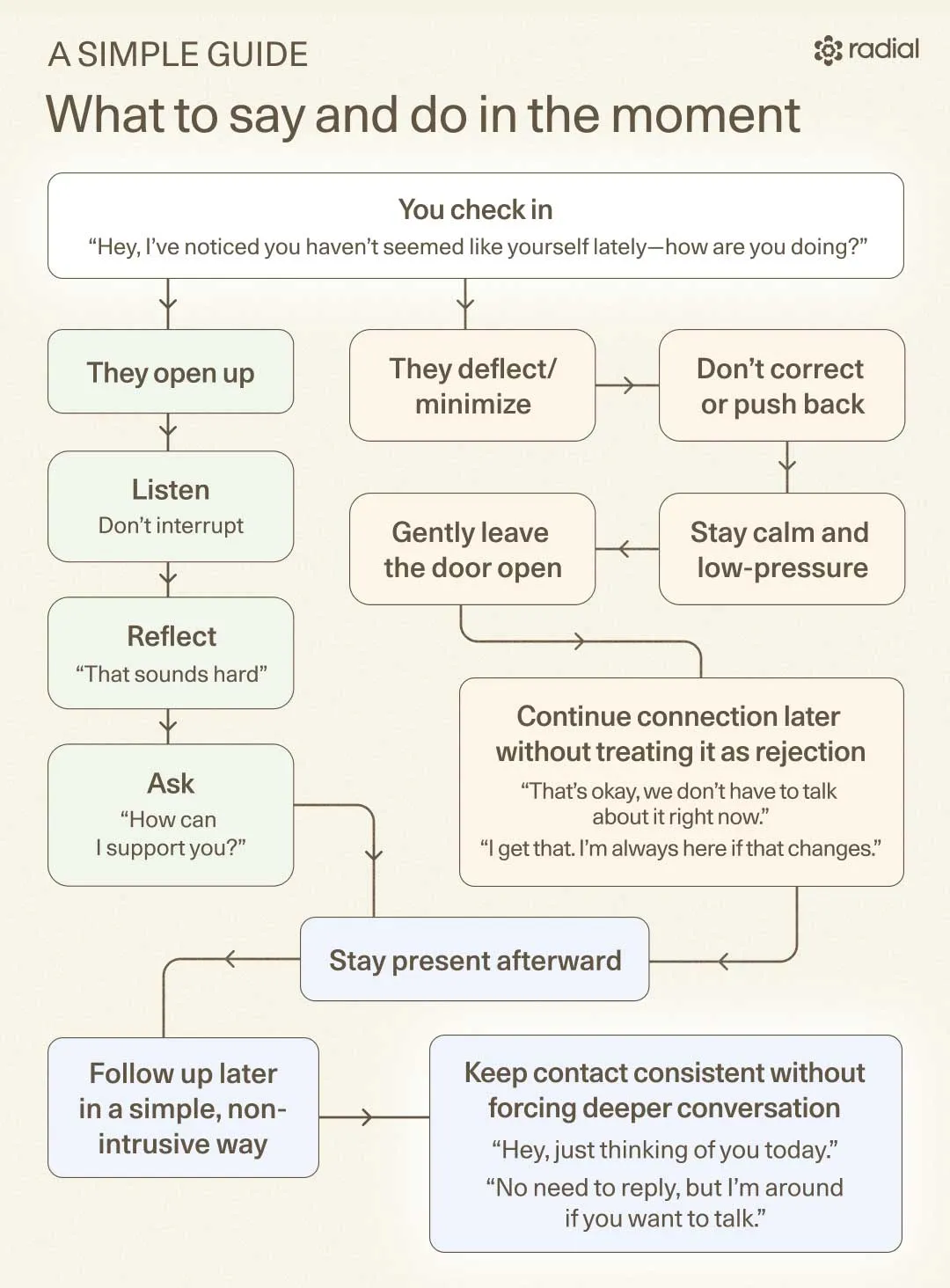
How to respond when they open up
When someone shares they're struggling, your instinct might be to rush in with solutions or reframe their experiences, but this can backfire. It may unintentionally suggest, "I don't think you can figure this out on your own." What they need isn’t solutions, but to feel understood.
You might also pull back or freeze because you're not sure what to say next. This might be the first time they’ve shared their feelings, which can bring up vulnerability and shame. "Normalizing their experience without minimizing it, and spending more time listening than speaking can help them feel less alone and like you’re really hearing them, which is often what people need most when they’re suffering."
What to say:
- "That sounds really hard."
- "I'm glad you told me."
- "I don't have all the answers, but I'm always here to listen."
- "I can hear how much this has been affecting you."
What if they don't want to talk?
When someone appears to be struggling but doesn't want to talk, you might be tempted to push harder. But respecting their boundaries and pace is its own form of support, even if it might not feel like you’re doing enough.
What to say:
- "That's OK. We don't have to talk about it right now."
- "You don't have to go through this alone, even if you don't feel like talking today."
- "Just know that I'm here if you ever want to talk about it."
- "I won't push, but I'm here whenever you feel like talking."
What to avoid
While you might worry about how the conversation might go, being aware of what not to say can make it easier to avoid comments that might hurt more than help.
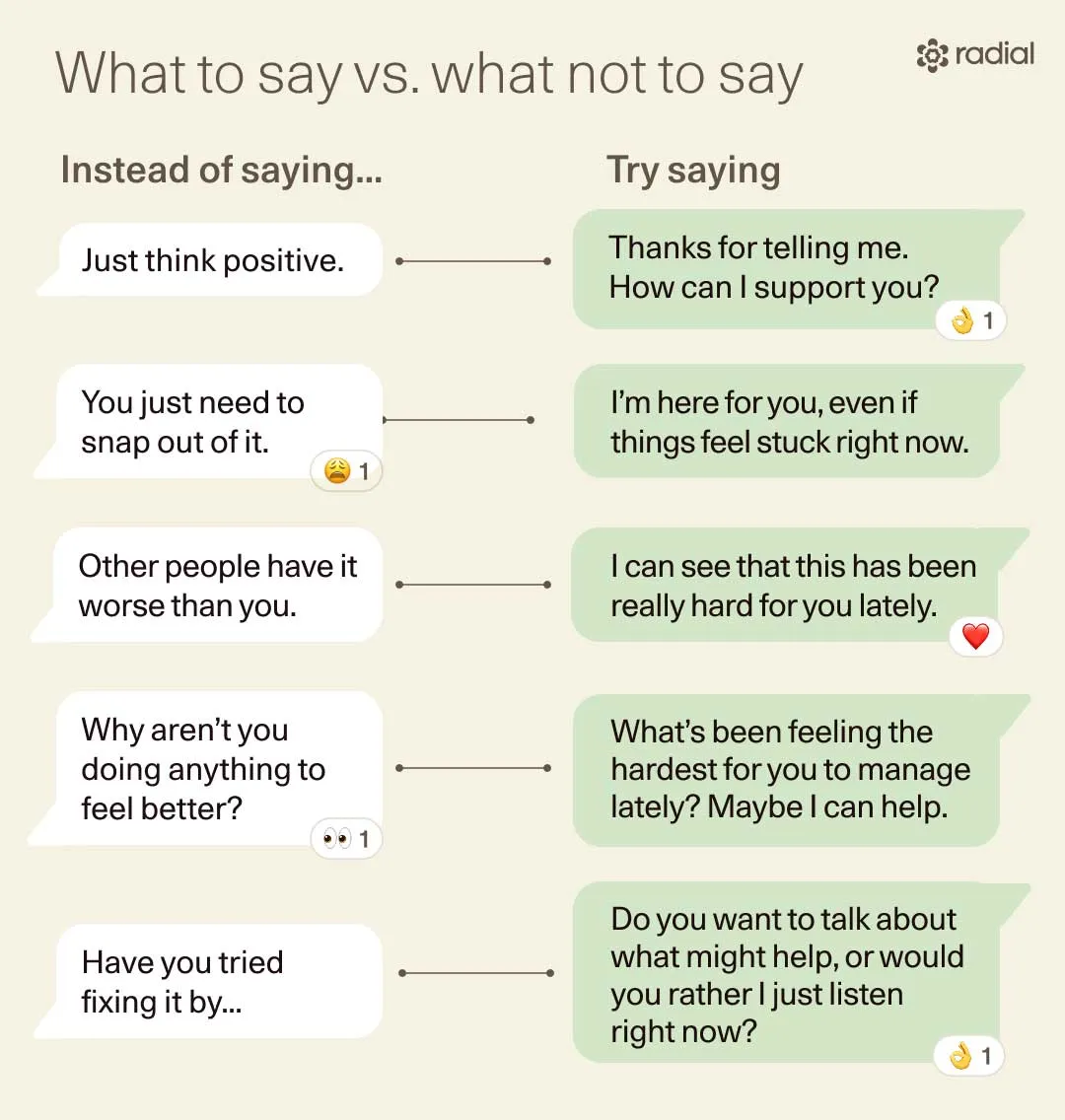
- Saying things like "You look fine," or "...but so many things are going well for you": Unsupportive or invalidating comments minimize their pain and contribute to guilt and shame. Believe them, even if it doesn't seem to match what you can see on the outside.
- Making it about you: If you shift the focus to your own experiences, they may feel like you're not really hearing what they are saying.
- Jumping straight to solutions: Moving immediately into fix-it mode shuts down the conversation.
- Taking things personally: Remember that while they might pull back, this isn't about you. It's part of depression, and not a reflection of you or your relationship.
How to support someone day to day
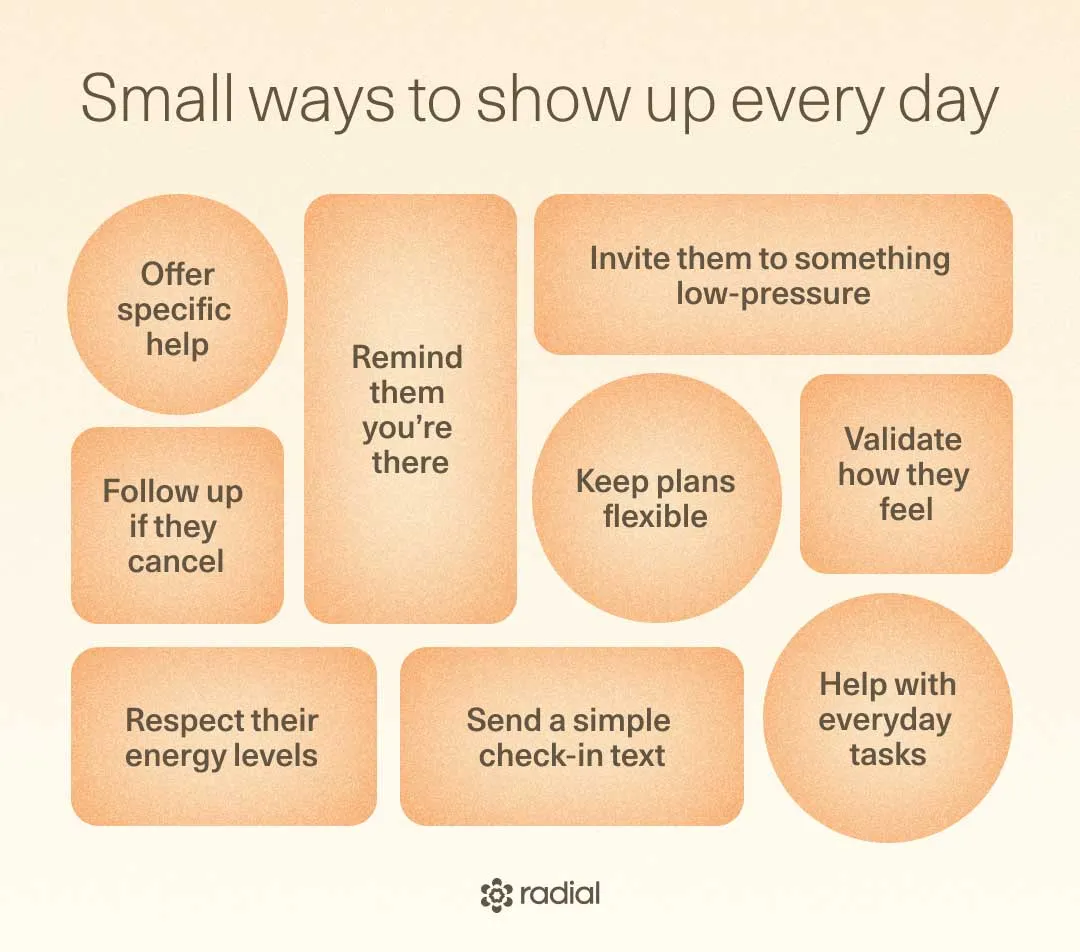
When you are living with someone with depression, support is about showing up consistently. These actions might sometimes feel small, but they are steady and repeatable. It’s what shows that you care and that they can count on you to be there.
Tactic 1: Stay connected (even if they withdraw)
Depression causes people to pull away, even from the people they love and trust the most. Making a point to stay in touch, whether that means sending a text, sharing a funny video, or stopping by to say hi, helps them stay more connected.
Wondering exactly how to comfort a depressed person over text?
Examples:
- "Hey, no need to respond, but I wanted to let you know that I was thinking about you today."
- "I'm going to be around this week, so if you'd like a little company, I'd love to hang out for a bit. Would you like me to stop by for a cup of coffee?"
- "I’m going to drop something off later this week. Don’t worry, I won’t stay long!"
Tactic 2: Offer specific, practical help
People who are depressed often worry that they are a burden or struggle to make decisions about what they need. "Instead of leaving the conversation at vague offers, such as ‘let me know if you need anything’, offer concrete options that are easier to receive and accept," Hurley suggests.
Examples:
- “I’m heading to the pharmacy. Is there anything I can grab for you?”
- "I'm not doing anything Saturday if you'd like some help tidying up a little."
- "I can handle scheduling some of your appointments if that would make things easier."
Tactic 3: Encourage small steps (without pressure)
Big goals can feel overwhelming or impossible when someone is depressed. Small, low-pressure suggestions feel more doable and less like an obligation. It may be easier for them to say yes if you frame it as an invitation to help you.
Examples:
- "Hey, want to take a quick walk with me? I've been feeling cooped up, and I'd really like the company."
- "Would you like to sit outside for a few minutes, just to chat and get some sunshine?"
- "I'm going to watch a show later. Do you want to watch an episode with me?"
Tactic 4: Help maintain basic daily structure
Depression doesn't just affect a person's mood; it also disrupts aspects of daily life like eating and sleeping. When someone's in the middle of it, even regular self-care can feel out of reach or pointless. Gently helping someone hold on to some type of structure can give them something to anchor their day.
Examples:
- "Have you eaten today? I'd love to bring you something if not."
- "I'm making dinner. Do you want to join me or can I bring you a plate?"
- "I'm going to bed soon, but I'll text you in the morning to say hi."
When and how to encourage professional support
Encourage professional help by bringing it up gently and offering to stay involved if they’re open to it. Hurley notes that some people with depression may feel like a burden or worry you’re trying to pass them off, so it’s important to approach the conversation in a way that feels supportive, not dismissive.
Encourage professional help
Depression often requires professional treatment, especially if the symptoms are beginning to impact daily functioning, strain relationships, or have lasted for some time. Hurley says that even finding a therapist can feel overwhelming, so breaking it down into smaller steps and framing treatment as an addition rather than a replacement can help people feel more open to getting support to get rid of depression .
You can encourage professional support by saying things like:
- "You deserve to feel better and you don't have to handle this on your own."
- "Would it be OK if we looked at some of the options together?"
- "Have you ever thought about talking to a therapist about this? It really helped when I did."
- "I could help you research some of the options to figure out what might be right for you."
Learn about treatment options
Common treatment options that you might explore include:
- Talk therapy: Working with a therapist to discuss and process thoughts, emotions, and patterns can be effective, but may take time to see results.
- Medication: Antidepressants prescribed by a medical provider can adjust brain chemistry and improve mood, but generally take about 6 weeks to work and may cause unwanted side effects.
- Neuromodulation: Techniques like transcranial magnetic stimulation (TMS) or electroconvulsive therapy (ECT) are highly effective options for more severe or treatment-resistant depression, but are usually not covered by insurance as first-line treatments.
What if they don't want help?
While you hope for a positive response, resistance to help is common, especially early on. "Just because your loved one is pushing back on seeking professional help doesn’t mean they don’t want to get better," Hurley says. Hesitancy may come from concern about costs, not believing they are ‘sick enough’ to need help, and negative past experience with care.
- Don't force or argue: Arguing rarely helps. “Ask them what feels like the biggest barrier so you can help them address it in a way that feels manageable for both of you," Hurley suggests.
- Stay supportive and consistent: Even if they initially turn down your efforts, keep checking in to show they are not alone.
- Respect their boundaries, but don't disappear: Give them space if they ask for it, but don't withdraw completely.
- Keep communication open: Let them know the door stays open without making it seem like a source of pressure. Open, emotionally supportive interactions can help reduce depressive symptoms.
Remind them that having a brain disease like depression isn’t a personal failing or weakness. Every brain has the potential to become sick, and speaking to a professional can be a meaningful step toward feeling better.
When to be more concerned (and what to do)
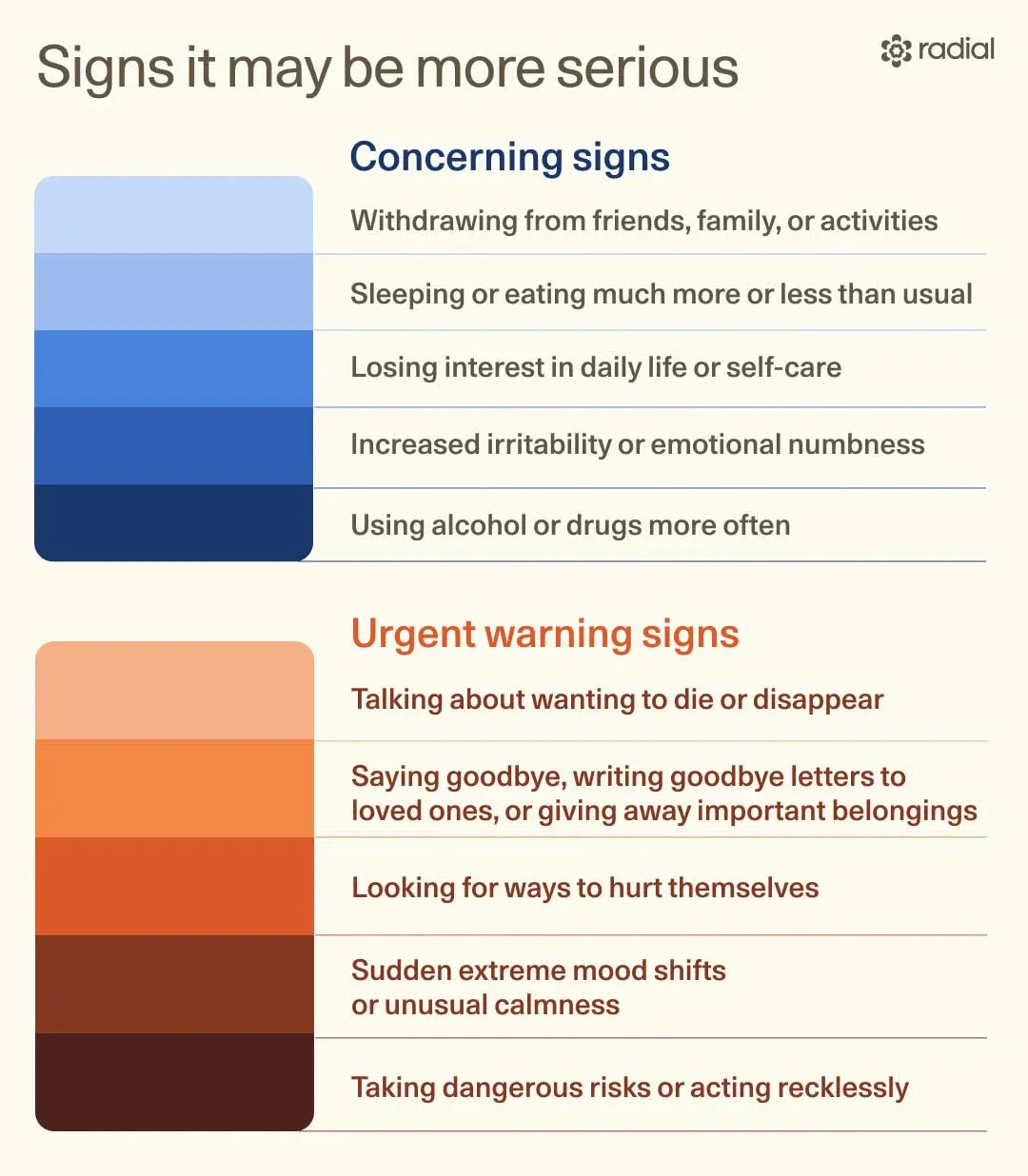
Support from loved ones isn't always enough, and more immediate action is needed, which can feel scary. It’s understandable to worry about misreading the situation or overreacting. In these situations, trust your instincts and don’t try to argue yourself out of it. It’s crucial to take warning signs seriously.
Signs to watch for:
- Talking about wanting to die, not being here, or feeling like a burden
- Sudden withdrawal from everyone, even the people they’re closest to
- Giving away possessions or putting things in order with no explanation
- Hopeless, absolute statements like "nothing will ever get better"
What to do:
- Ask directly about suicide: Research shows that asking doesn't put the idea in someone's head, but this fear does stop people from asking about it. You can ask, "Are you thinking about hurting yourself?"
- Stay with them if the risk feels immediate: Don't leave them alone if you think there is an immediate danger.
- Contact outside support: In the U.S., the Suicide & Crisis Lifeline is available by calling or texting 988 24 hours a day.
- Call 911 if there is immediate danger.
What success looks like
People searching for how to help a friend with depression often feel unsure about where to start, especially when it sometimes feels like nothing they've tried has helped. But the truth is that recovery from depression rarely looks as dramatic or linear as the plot of a Hallmark movie.
For many, it doesn't necessarily look like getting better in the way that people expect, at least not at first. It’s normal to have many ups and downs. While it might not feel like much has changed from the outside, your presence helps make their experience less difficult while they're in it.
"A depressive episode is not always linear, and often, people have stretches of better days followed by challenging ones. Staying present and showing up through the ebbs and flows signals that your care isn’t conditional on how they’re doing," Hurley explains.
.jpg)
Taking care of yourself while supporting someone else
Supporting someone who is depressed can lead to caregiver burnout, Hurley says. "Taking care of yourself by maintaining your own routines, relationships, and prioritizing yourself when it’s necessary is what makes sustained support possible," she says.
Taking a step back to care for yourself ensures you have the energy and stability you need to keep showing up for a depressed friend.
- Be honest about what you can sustain: Caring deeply doesn’t mean you have to be available at all times. Decide what level of support you can realistically sustain, then stick to it.
- Don't do it alone: Talking to your own support system or a therapist can offer perspective and strength. This can be particularly important when you are supporting a depressed partner.
- Watch for signs of burnout: Feeling exhausted and overwhelmed are clear signs, but also pay attention to more subtle symptoms of compassion fatigue, such as resentment and dread.
- Know where your role ends: You're there to support them, not treat them.
Relief within reach
Care covered by your insurance
Radial provides advanced mental health treatment, covered by the insurance you already use.








The bottom line
Supporting someone with depression isn't about having all the answers. It's about being present, patient, and consistent in small ways that help the other person feel less alone in their depression. You don't have to fix things for your support to make a real difference in your loved one's life.
Key takeaways
- Depression often causes people to withdraw, which is why staying present in their lives in small, supportive ways is so crucial.
- Focus on being a consistent, calming presence in their life rather than pressuring them into treatment.
- Some situations require immediate action if safety is a concern.
- Progress takes time and may not always be obvious, so don't expect instant results.
Frequently asked questions (FAQs)
What are the signs that someone's depression is getting worse?
Worsening depression often involves more frequent or more intense symptoms and increased difficulty with daily functioning. If mood and function decline, it may be a sign that their depression is getting worse. The Beck Depression Inventory is a clinical tool commonly used to measure severity, with higher scores indicating more severe symptoms.
How often should I check in with someone who is depressed?
There isn't a single recommended schedule that is right for every person or situation. Factors such as your relationship with the person and the severity of their symptoms play a role. Evidence suggests check-ins should be regular and consistent, but flexible. If you are worried, brief and frequent interactions may be helpful, as long as the other person seems receptive.
What are small things that actually help someone with depression?
Small things that can help someone with depression include validating their emotions and offering practical support. This can include checking in without adding pressure, listening to them without trying to "fix" the problem, and helping them with daily tasks. Staying present, even when the conversation gets difficult, is what matters most.
Deep dive recommendations
- National Alliance on Mental Illness. Guidance for caregivers.
- CAMH. A psychiatrist's tips for helping someone with depression.
Editorial Standards
At Radial, we believe better health starts with trusted information. Our mission is to empower readers with accurate, accessible, and compassionate content rooted in evidence-based research and reviewed by qualified medical professionals. We’re committed to ensuring the quality and trustworthiness of our content and editorial process–and providing information that is up-to-date, accurate, and relies on evidence-based research and peer-reviewed journals. Learn more about our editorial process.
Let's connect
Get started with finding the right treatment for you or someone you care about
Get startedExplore more posts