
Contamination OCD: What It Looks Like and What Helps

Key takeaways
- Contamination OCD is more than being clean or cautious. Obsessions and compulsions can cause significant distress and disrupt daily life.
- Contamination fears take many forms. They can involve germs, illness, chemicals, spreading contamination to others, or feeling emotionally or mentally “dirty.”
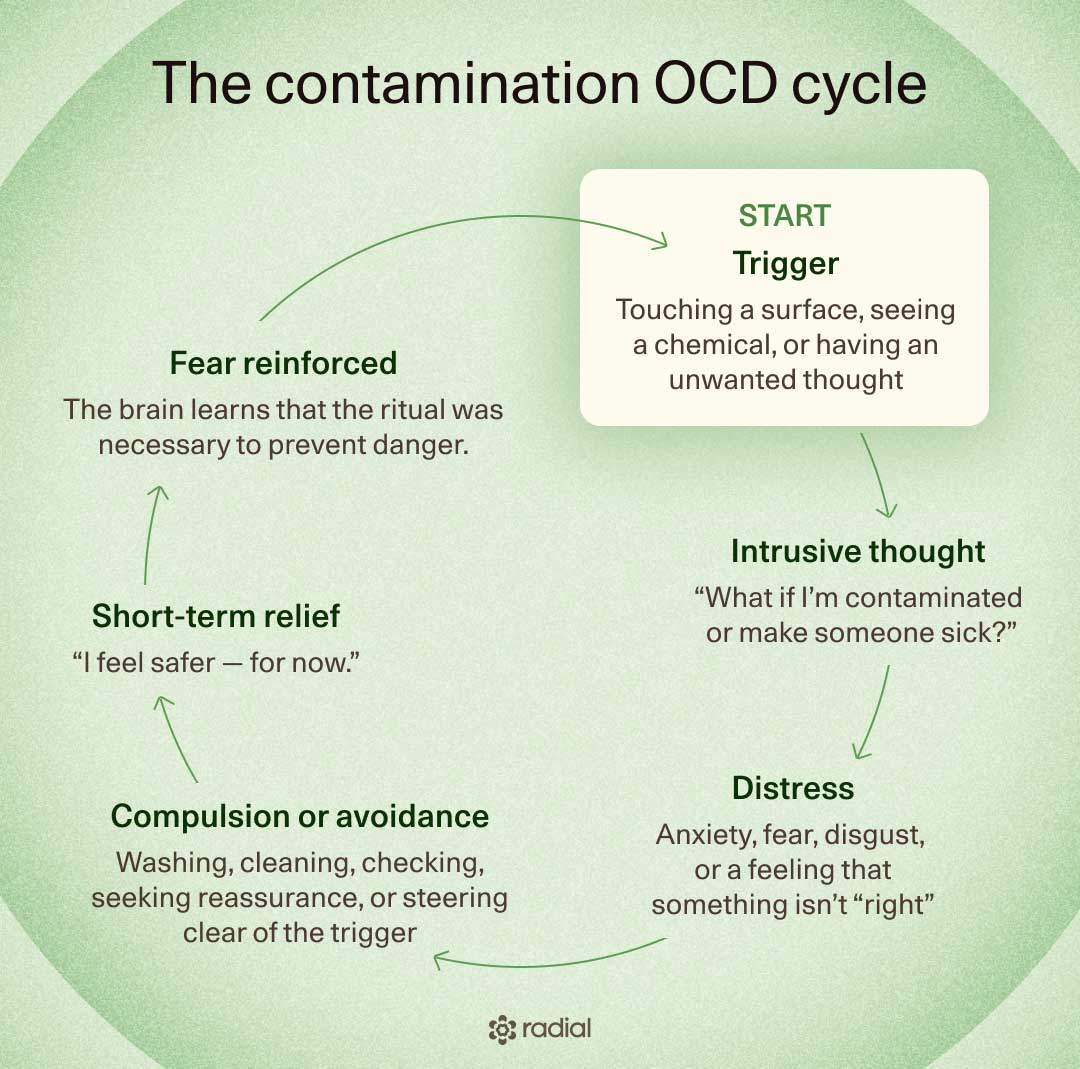
- The OCD cycle can be hard to break. Washing and other rituals offer temporary relief but reinforce fears over time.
- Effective treatment is available. Exposure and response prevention (ERP) is a first-line, evidence-based psychological treatment for OCD. Medication, particularly SSRIs, may also help manage symptoms.
- Support matters. Loved ones can encourage recovery by showing empathy without reinforcing compulsions or repeatedly offering reassurance.
Contamination OCD can turn everyday routines into an exhausting cycle: washing that never feels finished, “clean” spaces that must be protected, and a growing list of things to avoid. Before long, you may spend hours each day fending off perceived threats, while your safe spaces — and your world — shrink smaller and smaller. This is the reality of contamination OCD.
But contamination fears aren’t always about germs. For some people, they involve chemicals, other people, or even unwanted thoughts. If you’re searching for contamination OCD examples or wondering whether your own habits have crossed a line, you’re in the right place.
Here’s what contamination OCD looks like, why the cycle persists, and what can help — including treatment options and ways loved ones can offer support.
Healing happens through strong relationships
Compassionate, experienced mental health professionals focused on evidence-based care




What is contamination OCD?
Contamination OCD is a common presentation of obsessive-compulsive disorder (OCD) characterized by persistent fears or concerns about contamination, including germs, illness, toxins, or other perceived contaminants. These fears may also involve concerns about spreading contamination to others, according to a review published in the International Journal of Molecular Sciences. To ease the anxiety, you might repeatedly wash your hands or disinfect objects, avoid things you perceive as contaminated, or perform other rituals.
Contamination OCD is just one subtype of OCD, not a separate diagnosis. You can experience multiple types, but the underlying cycle of obsessions and compulsions is similar, per research in the Journal of Obsessive-Compulsive and Related Disorders:
- Obsessions: Unwanted, intrusive thoughts, images, or urges that cause significant distress.
- Compulsions: Repetitive behaviors or mental rituals meant to ease distress, or prevent something bad from happening. These can include washing, mentally reviewing thoughts, checking, or seeking reassurance.
What do contamination fears center on?
Contamination OCD can involve a range of fears, including germs, illness, chemicals, other people’s perceived flaws, or even a vague sense that something is “dirty.” Contamination may also seem to spread far beyond the original contact. For example, you may have a distressing fight with another person associated with "bad energy" and then perceive the clothes you were wearing as permanently tainted and refuse to let those garments touch others in your closet.
“Contamination OCD can appear very differently in each person,” says board-certified psychiatrist Erica J. Lee, MD. Here are some common themes.
Germs, illness, and bodily fluids
This is probably the best-known (and most studied) form of contamination OCD. Fears may center on catching or spreading illness through contact with germs, viruses, bodily fluids, waste, spoiled food, or other potential sources.
Chemicals and environmental toxins
Some people fear exposure to chemicals, toxins, or poison. They may repeatedly clean, check product labels for contaminants, or avoid places where they believe exposure is likely, such as hospitals, schools, or workplaces, says Dr. Lee. These fears can make everyday activities difficult and contribute to agoraphobia, social anxiety, or panic, she adds.
Fear of spreading contamination to others
Contamination fears can also involve making someone else sick or passing along perceived moral or emotional flaws. “The fear of spreading contamination, like germs or illness — or even moral/emotional bad traits — to others is common in contamination OCD,” says Dr. Lee.
Fears of spreading contamination to others can overlap with responsibility-related or harm-related OCD themes, particularly when individuals experience excessive responsibility for preventing harm to loved ones. Similar worries (especially the fear of spreading germs) can also occur in postpartum OCD.
Worrying about harming or contaminating loved ones may lead people to withdraw or isolate themselves, contributing to depression and social anxiety, says Dr. Lee.
Emotional contamination
“Emotional contamination refers to intrusive thoughts that being near, touching, or thinking of another person will transfer undesirable emotions or behaviors onto yourself,” says Dr. Lee. It can feel as though you’ve “caught something” from being around someone you consider bad or harmful. “This results in higher anxiety and fears of transforming into a bad person,” she says.
The fear may extend to objects or places associated with that person, too. For example, someone might avoid a pencil that person touched or a room they spent time in, or avoid any shared spaces where interactions have occurred..
Mental contamination
Mental contamination involves feeling dirty or impure without any physical contact with a contaminant. Even imagining something distressing, immoral, or disgusting can trigger the sensation, according to research in the Journal of Obsessive-Compulsive and Related Disorders. The source may be hard to pinpoint, and washing may not make the feeling go away.
Research has linked mental contamination with trauma and post-traumatic stress disorder (PTSD) symptoms, as well as scrupulosity OCD, which involves religious or moral obsessions and compulsions.
What do contamination compulsions look like?
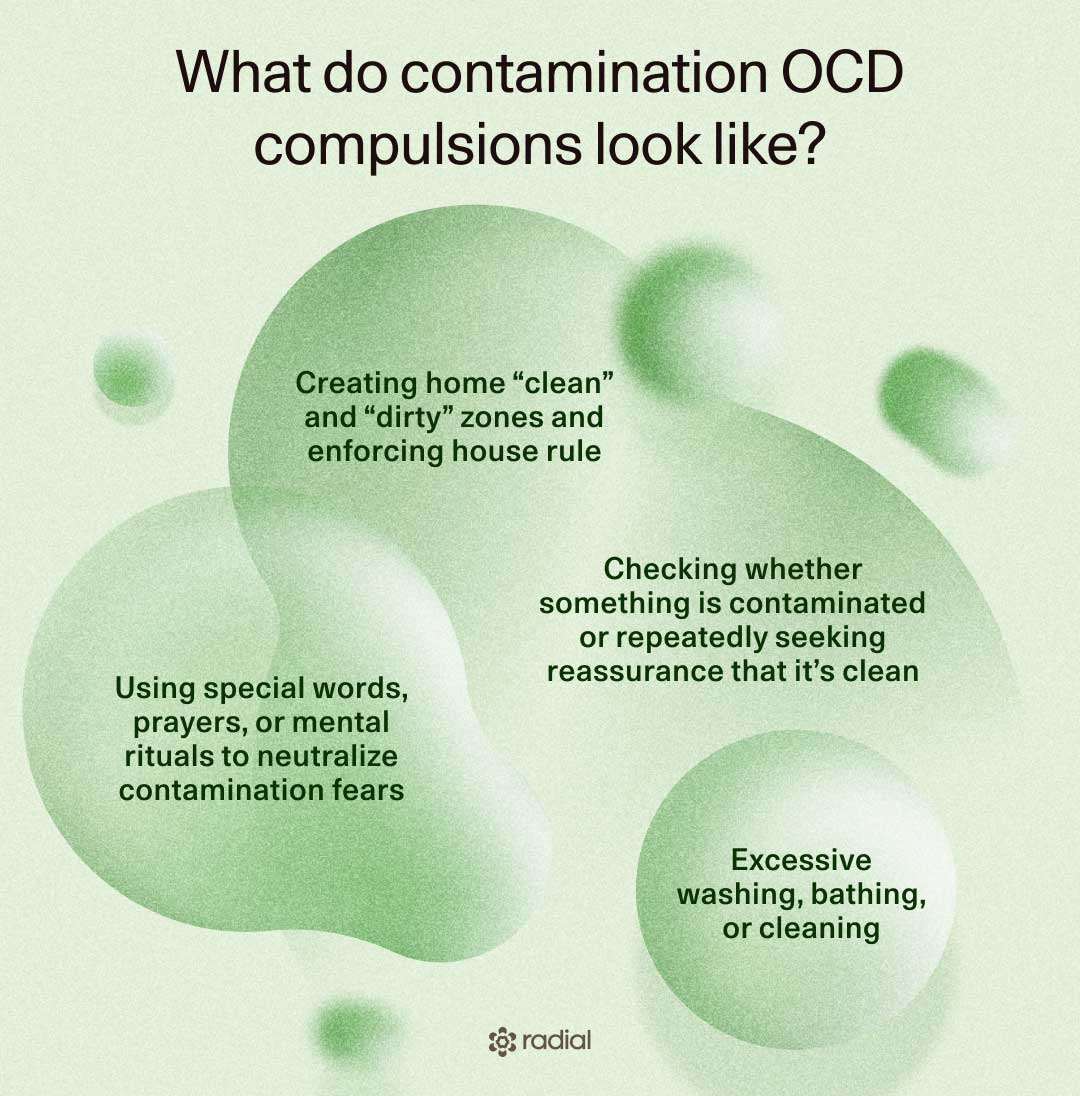
In contamination OCD, compulsions often involve washing, cleaning, checking, or avoiding anything that triggers fears of contamination, per a review published in the International Journal of Molecular Sciences. They may include:
- Excessive handwashing or bathing
- Repetitive cleaning, disinfecting, or sterilizing
- Performing rituals to prevent contaminating loved ones
- Creating “clean” and “dirty” zones at home
- Requiring others to follow decontamination rules, like removing shoes or showering upon entry
- Checking whether something is contaminated or repeatedly seeking reassurance that it’s clean
- Using special words, prayers, or mental rituals to neutralize contamination fears
Avoidance is another common compulsion, says Dr. Lee. Someone might steer clear of certain objects, people, or public places — or restrict themselves to specific rooms at home. They may not clean obsessively, but their fear can still dictate their daily routines and significantly limit their quality of life.
Why washing never feels like enough
Washing, cleaning, or disinfecting may bring temporary relief in contamination OCD: people with the condition might feel calmer or finally feel okay after a compulsive behavior, but that feeling doesn’t last, says Dr. Lee.
Over time, compulsions reinforce the OCD cycle by providing temporary relief from distress. This relief can negatively reinforce the behavior, making the individual more likely to repeat the ritual when similar thoughts, feelings, or triggers occur. As Dr. Lee explains, “the feeling of relief is brief, thus making it more likely that the patient will continue the cycle of engaging in the compulsion through this intermittent reinforcement.”
That’s why chasing the feeling of being completely clean can become an endless cycle: the relief fades, and the urge to wash returns.
How is contamination OCD different from being clean or careful?
Being mindful of germs, toxins, and illness is normal, but contamination OCD goes beyond everyday caution (or even health anxiety): it can make fear and rituals run your life.
People with contamination OCD may feel compelled to perform rituals to ease distress or prevent a feared outcome, like becoming seriously ill or making someone else sick.
Over time, obsessions and compulsions can take a major toll on your day-to-day life. According to research in Child Abuse and Neglect, they can:
- Take up at least an hour a day
- Interfere with work, relationships, or daily activities
- Cause significant distress
That’s why contamination OCD is more than being hygienic or careful — and why casually calling yourself a “germophobe” or “so OCD” can minimize a real condition, create stigma, and make people less likely to seek help.
What causes contamination OCD?
There’s no single cause of OCD. Genetics, neurobiology, psychological experiences, and social factors can all play a role.
Research is still evolving, but current findings point to several factors:
- Genetics: Different OCD symptoms may be linked to different combinations of genetic variations, according to a literature review in the International Journal of Molecular Sciences.
- Neurobiology: OCD is associated with dysfunction in serotonin, glutamate, dopamine, and neurotrophic factor systems.
- Trauma: Traumatic experiences and significant stressors may contribute to the onset or worsening of OCD symptoms in some individuals. Research has identified associations between trauma exposure and OCD, although the relationship is complex and trauma has not been established as a universal cause. Estimates of post-traumatic onset range from 30% to 78%, according to research in Child Abuse & Neglect.
Major stressors can also trigger or worsen symptoms. During the COVID-19 pandemic, for example, contamination precautions like frequent disinfecting and social distancing may have intensified obsessions and compulsions in some vulnerable people, per a population-based study published in the Journal of Psychiatric Research.
The takeaway: There are many factors that contribute to OCD. It’s not anyone’s fault or a sign of weakness.
How is contamination OCD diagnosed?
Diagnosing contamination OCD starts with an evaluation by a licensed mental health professional. A medical checkup may also help rule out other conditions that can cause similar symptoms.
Your clinician will ask about your contamination OCD symptoms, your medical and family history, and how obsessions and compulsions affect your daily life. According to the National Library of Medicine, they may explore whether you:
- Experience difficulty controlling obsessions or compulsions, even when recognizing that the thoughts or behaviors may be excessive or unreasonable
- Spend at least an hour a day on obsessions or compulsions (clinically significant distress or impairment is an alternative criterion)
- Feel temporary relief after performing rituals
- Experience significant distress or disruption to daily life
Providers may also use tools like the Yale-Brown Obsessive-Compulsive Scale (Y-BOCS) to assess symptom severity. Online quizzes can help you prepare, but they can’t diagnose OCD.
Before your appointment, consider sharing:
- Time spent on obsessive thoughts and rituals
- Activities or places you avoid
- Household rules around contamination
- Past treatments
It can feel uncomfortable to discuss symptoms, but your clinician isn’t there to judge. Being open about what you’re experiencing helps them make an accurate assessment and recommend appropriate care.
How is contamination OCD treated?
Like other types of OCD, contamination OCD is typically treated with specialized therapy, often alongside medication. The first-line therapy is exposure and response prevention (ERP), a type of cognitive behavioral therapy (CBT).
Exposure and response prevention (ERP)
ERP is considered the “gold standard” for OCD and is “highly effective,” says Dr. Lee. It involves gradually facing feared situations — such as touching an object you consider contaminated — without performing the usual compulsion, like washing your hands.
In other words, through ERP you learn to gradually confront feared situations, thoughts, or sensations while resisting compulsive responses. Through repeated practice, you develop greater tolerance for uncertainty and distress while learning that you do not need to perform rituals to manage uncomfortable experiences.
Here’s how it works, according to Dr. Lee:
- Understand the OCD cycle. “The therapist first provides psychoeducation on the cycles of obsessions and compulsions,” she says. You learn how facing fears without performing rituals — and allowing yourself to “feel the fear” — can reduce its intensity over time.
- Build an exposure hierarchy. “The therapist and patient will work together to build an exposure hierarchy of fears,” ranking situations from least to most distressing, explains Dr. Lee.
- Practice at your own pace. Exposures are introduced gradually, with your therapist helping you manage distress without resorting to compulsions. ERP therapy teaches the brain that the feared outcome that led to the ritual did not happen, and therefore the ritual is not necessary.
“Exposures are initially distressing, and the distress does fade significantly over time” with repeated practice, says Dr. Lee. “It is rewarding for the patient to feel like they accomplish small goals as they move forward.”
That said, ERP can be a “challenging therapy,” according to Dr. Lee. Some people even find it difficult to tolerate, per research in CNS Spectrums. That’s why it’s important to work with your clinician to create a plan that feels manageable and moves at your pace.
Medication
ERP is the foundation of contamination OCD treatment, but medication can offer additional support. Selective serotonin reuptake inhibitors (SSRIs) are commonly prescribed for OCD, often at higher doses than those used to treat major depressive disorder (MDD), according to a study in Psychiatry Research Case Reports.
When first-line treatment isn’t enough
If therapy and medication aren’t providing enough relief, other options may help. One is transcranial magnetic stimulation (TMS), a noninvasive, FDA-cleared treatment that uses magnetic pulses to target brain circuits involved in OCD. It’s often combined with ERP and/or medication.
Some TMS protocols also use symptom provocation: briefly bringing to mind or engaging with a specific contamination trigger to activate the relevant brain circuits during treatment.
More intensive support, such as an intensive outpatient program, may also be an option.
Not sure what approach makes sense for you? An experienced clinician can help you explore your options. Radial offers deep TMS, medication management, and ERP therapy for OCD.
How can you support someone with contamination OCD?
Supporting someone with contamination OCD means showing empathy without reinforcing their compulsions. That balance can be tricky, says Dr. Lee: “The best approaches center warmth towards their loved one while stepping back from encouraging their compulsions, including reassurance seeking (Am I okay? Is it safe?), which can inadvertently stop their loved one from learning that a feared outcome does not happen.”
One common pitfall is family accommodation, or when loved ones change their own behavior to help someone avoid distress, per research in Expert Review of Neurotherapeutics. For example, you might repeatedly reassure them that something is clean or safe. Though well-intentioned, accommodation can reinforce the OCD cycle and is associated with more severe symptoms and greater impairment.
“Family and friends often care deeply about their loved one and want to relieve their suffering, especially as it is difficult to sit with someone feeling intense distress and not try to intervene or distract,” says Dr. Lee. Here’s how to help without feeding the OCD cycle:
- Learn about OCD. Understanding the condition can help you recognize what your loved one is experiencing.
- Lead with empathy. Acknowledge their effort as they face fears and resist compulsions.
- Set healthy boundaries. Offer support without participating in rituals or repeated reassurance.
- Encourage professional support. A therapist can help your loved one — and your family — navigate recovery.
- Make changes gradually. Work with the care team to reduce accommodation over time rather than abruptly withdrawing support.
Reducing family accommodation should be approached collaboratively, ideally with guidance from an OCD-trained therapist. Loved ones can remain emotionally supportive while gradually reducing participation in compulsions and reassurance rituals.
Relief within reach
Care covered by your insurance
Radial provides advanced mental health treatment, covered by the insurance you already use.








The bottom line
Contamination OCD can make everyday life feel like a constant battle against invisible threats, but it’s treatable, and you don’t have to navigate it alone. If symptoms are affecting your life, don't wait to seek support. Radial can connect you with a licensed clinician — virtually or in person — to explore evidence-based treatments and build a plan tailored to you.
Frequently asked questions (FAQs)
Does contamination OCD ever go away?
“Contamination OCD and other forms of OCD are treatable,” says Dr. Lee. Treatments like ERP and SSRIs can lead to “significant decreases in distress” and decreased time spent on compulsions, she says.
How common is contamination OCD?
Contamination OCD is one of the most common subtypes of OCD, affecting up to 46% of people with the disorder, per research in CNS Spectrums.
Can contamination OCD involve food?
Yes, someone with contamination OCD may have fears related to food. “Patients can have intrusive obsessions that their food is contaminated by germs, dirt, chemicals, [or] bodily fluids,” says Dr. Lee. This can lead to food avoidance or elaborate preparation rituals, she adds.
Clinicians should distinguish contamination OCD from other causes of food-related fears, including avoidant/restrictive food intake disorder (ARFID), specific phobias, restrictive eating disorders, and psychosis, adds Dr. Lee.
Editorial Standards
At Radial, we believe better health starts with trusted information. Our mission is to empower readers with accurate, accessible, and compassionate content rooted in evidence-based research and reviewed by qualified medical professionals. We’re committed to ensuring the quality and trustworthiness of our content and editorial process–and providing information that is up-to-date, accurate, and relies on evidence-based research and peer-reviewed journals. Learn more about our editorial process.
Let's connect
Get started with finding the right treatment for you or someone you care about
Get startedExplore more posts


