Understanding the Y-BOCS: How OCD Symptoms Are Scored and Tracked Over Time

Y-BOCS isn’t a personality test, label, or a crystal ball. It’s a practical tool clinicians use to measure how much OCD is interfering with daily life, and whether that interference is improving with treatment. If you’ve seen Y-BOCS mentioned in a report or research paper, this guide will help you understand what that number actually represents (and what it doesn’t).
Obsessive-compulsive disorder (OCD) is often misunderstood. It’s frequently reduced to being “neat,” “organized,” or “particular,” but for people actually living with OCD, the experience is far more intrusive and disruptive. Symptoms can consume hours, generate intense distress, and quietly interfere with work, relationships, and basic daily functioning.
“To treat OCD well, clinicians need a way to understand not just what someone is experiencing, but how much those symptoms are taking from them,” says MaryEllen Eller, MD, a board-certified psychiatrist at Radial. “That’s where the Yale-Brown Obsessive Compulsive Scale, or Y-BOCS, comes in.”
The Y-BOCS is a clinician-guided scale used to identify common OCD symptoms, measure how severe they are, and track changes over time with treatment. Think of it as a shared framework that helps turn a complicated internal experience into something clinicians and patients can talk about more clearly.
If you’re newly diagnosed, supporting a loved one, or considering next-step care, you may see Y-BOCS scores mentioned in intake notes, research studies, or treatment plans. Below, we’ll explain what the Y-BOCS measures, how it works, what score ranges generally indicate, and why context matters more than the number alone.
What is the Yale-Brown Obsessive-Compulsive Scale (Y-BOCS)?
The Y-BOCS is the gold-standard scale used to measure how severe OCD symptoms are and how they change over time, says Eller.
Developed by researchers at Yale University and Brown University in the late 1980s, the Y-BOCS is now the most widely used tool for assessing OCD severity in both research and clinical care. In 2010, the scale was updated to address some limitations of the original version. The update also introduced a self-report format, allowing people who have already been diagnosed with OCD to complete the assessment on their own.
“What makes the Y-BOCS especially meaningful is that it doesn’t [just] focus on the content of a person’s obsessions or compulsions,” says Eller. “The scale looks at impact: how much time symptoms take, how distressing they feel, how hard they are to resist, and how much control a person has over them. In other words, it measures how OCD is affecting a person’s ability to live their life.”
If you’ve been diagnosed with OCD, the Y-BOCS is a questionnaire you can complete on your own or with a clinician. Either way, it measures the same core areas. But doing it with a clinician allows for clarification, follow-up questions, and real-world context—one reason clinician-administered scores are usually given more weight.
If you search for the Y-BOCS online, you might find older versions of the scale. The original version (Y-BOCS-I) was designed for clinicians to administer during an interview, not for people to complete on their own. In 2010, researchers updated the Y-BOCS-I scale and created two versions: the Y-BOCS-II, which clinicians use in evaluations, and the Y-BOCS-II-SR, which is a self-report version that people with OCD can fill out themselves.
Connect with our Clinicians
.webp)

How does the Y-BOCS work?
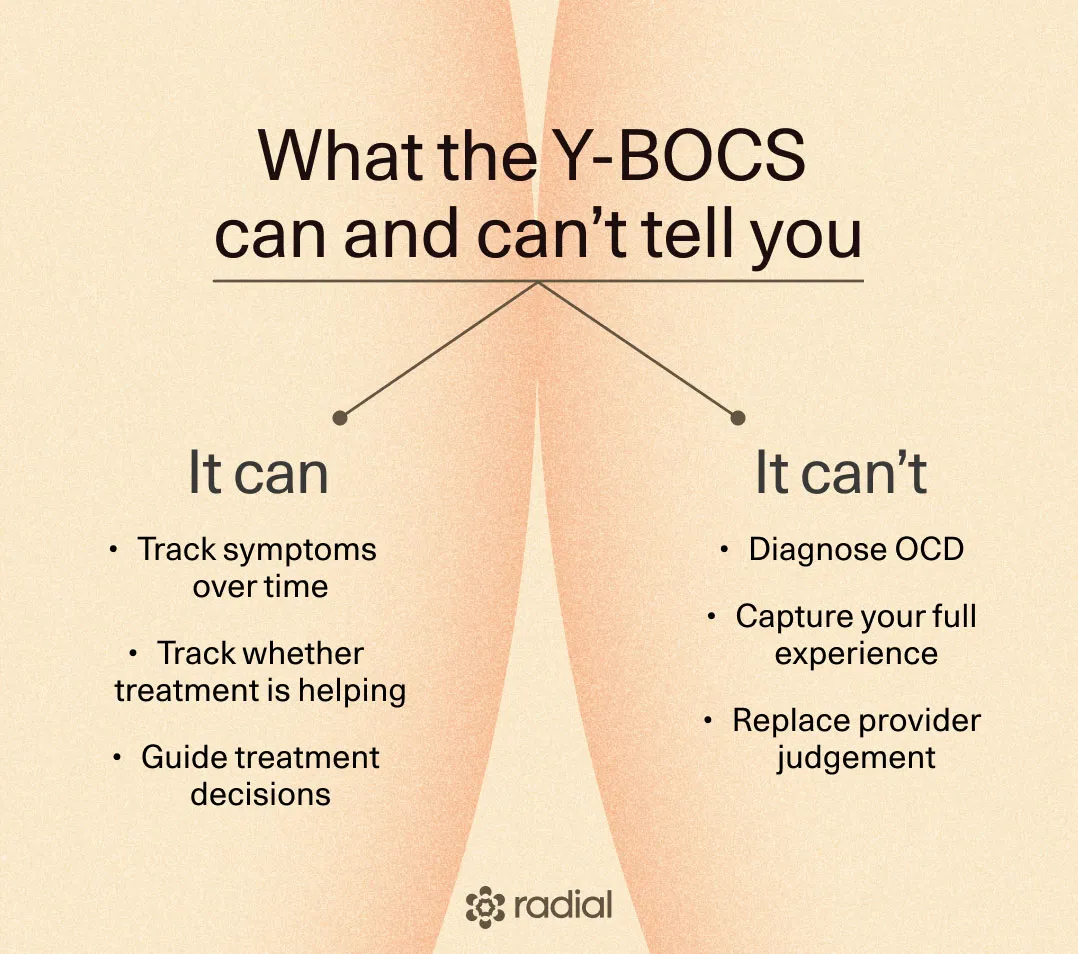
At its core, the Y-BOCS is a short set of questions that looks at two main areas: obsessions and compulsions. It includes 10 questions total: five about obsessions, and five about compulsions.
Each item is rated on a scale from 0 to 4 based on the past week, with higher numbers reflecting greater severity in that area. Rather than asking what your thoughts are about, the questions focus on how those thoughts and behaviors affect your life. Specifically, the Y-BOCS looks at:
- How much time symptoms take up
- How much distress they cause
- How much they interfere with daily activities and relationships
- How hard they are to resist
- How much control you feel you have over them
After answering all the questions, the scores are added together to produce a total between 0 and 50, which reflects overall symptom severity from mild to extreme. The OCD assessment typically takes about 10–20 minutes to complete and is designed for adults (a separate version, called the CY-BOCS, is used for children and adolescents).
It can help to think of the Y-BOCS less as an OCD test and more as a severity ruler. It doesn’t decide whether someone has OCD on its own. (For example, it’s possible to have significant obsessive thoughts and to score high on Y-BOCS without actually having OCD). Instead, it helps quantify how heavy the symptoms feel and how much they’re getting in the way of daily life.
Y-BOCS scoring and severity ranges
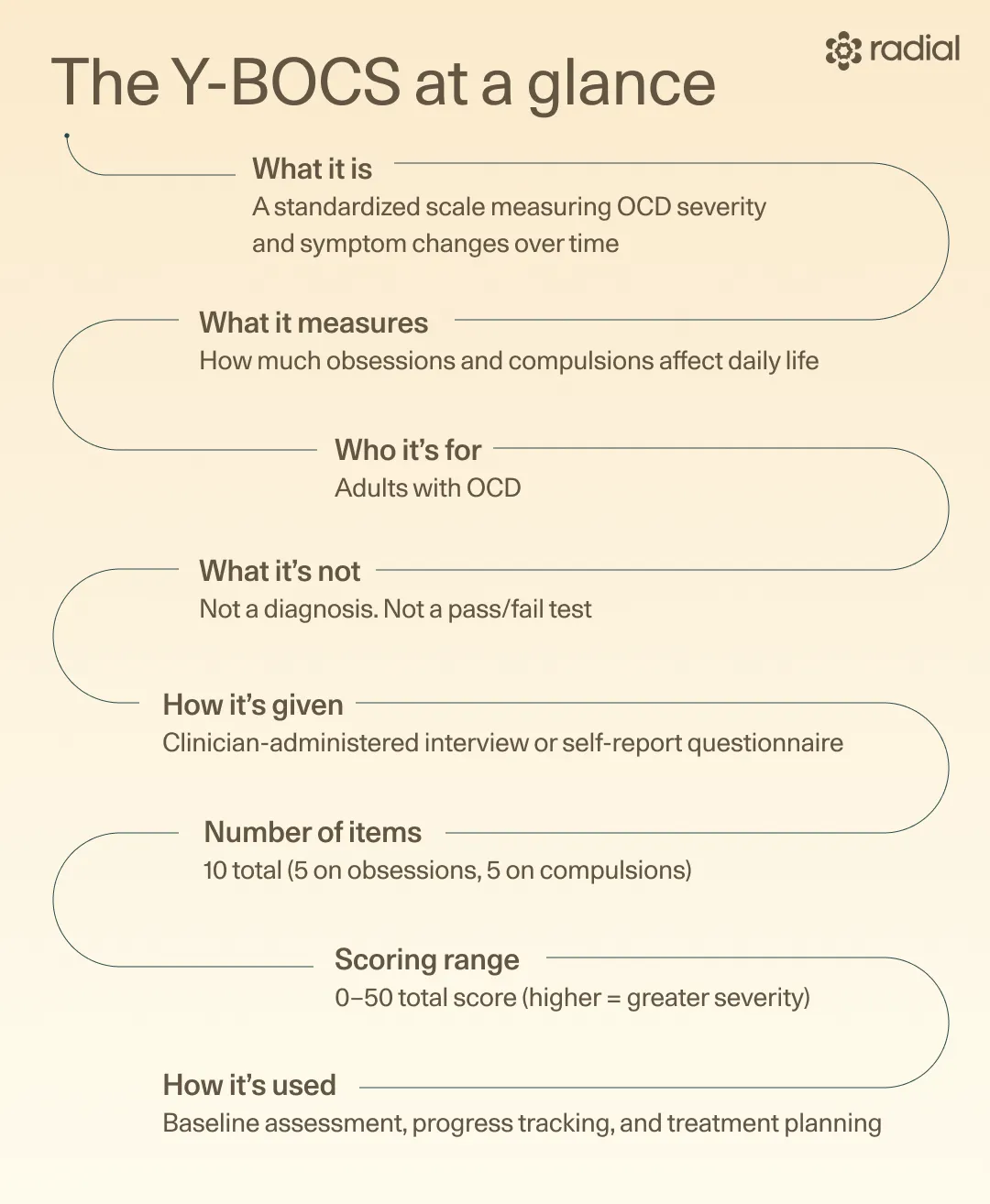
Once a total score is calculated, clinicians use broad severity ranges to describe how much OCD is interfering with daily functioning and to help guide treatment decisions. According to Eller, these include:
- Subclinical: Minimal or no functional impairment
- Mild to moderate: Symptoms are present and disruptive, but manageable
- Severe to extreme: Symptoms significantly interfere with daily functioning and quality of life
In many clinical settings, those groupings are further broken down as:
- 0–9: Subclinical
- 10-19: Mild
- 20-29: Moderate
- 30-39: Severe
- 40-50: Extreme
These categories are meant to create a shared language between patients and providers, not to box people into fixed labels. Two people with the same score can experience OCD very differently depending on their coping skills, insight, support systems, and current life stressors.
That’s why a single score is best understood as a snapshot in time. What tends to matter most clinically is the pattern: whether scores are trending down, staying stable, or increasing, and how that lines up with how someone actually feels in their day-to-day life.
“OCD symptoms often shift—one obsession fades while another appears—but progress can still be seen as distress decreases, control increases, and daily life opens back up. For many patients, this is incredibly validating,” says Eller. “Improvement doesn’t have to mean the complete absence of symptoms. Often, it starts with feeling less stuck, less overwhelmed, and more free.”
What a Y-BOCS score can—and can’t—tell you
If you’ve seen your own Y-BOCS score (or a loved one’s), it’s natural to want to decode it. The number can offer useful information, but it isn’t the whole story. Here’s a breakdown of how to interpret Y-BOCS results.
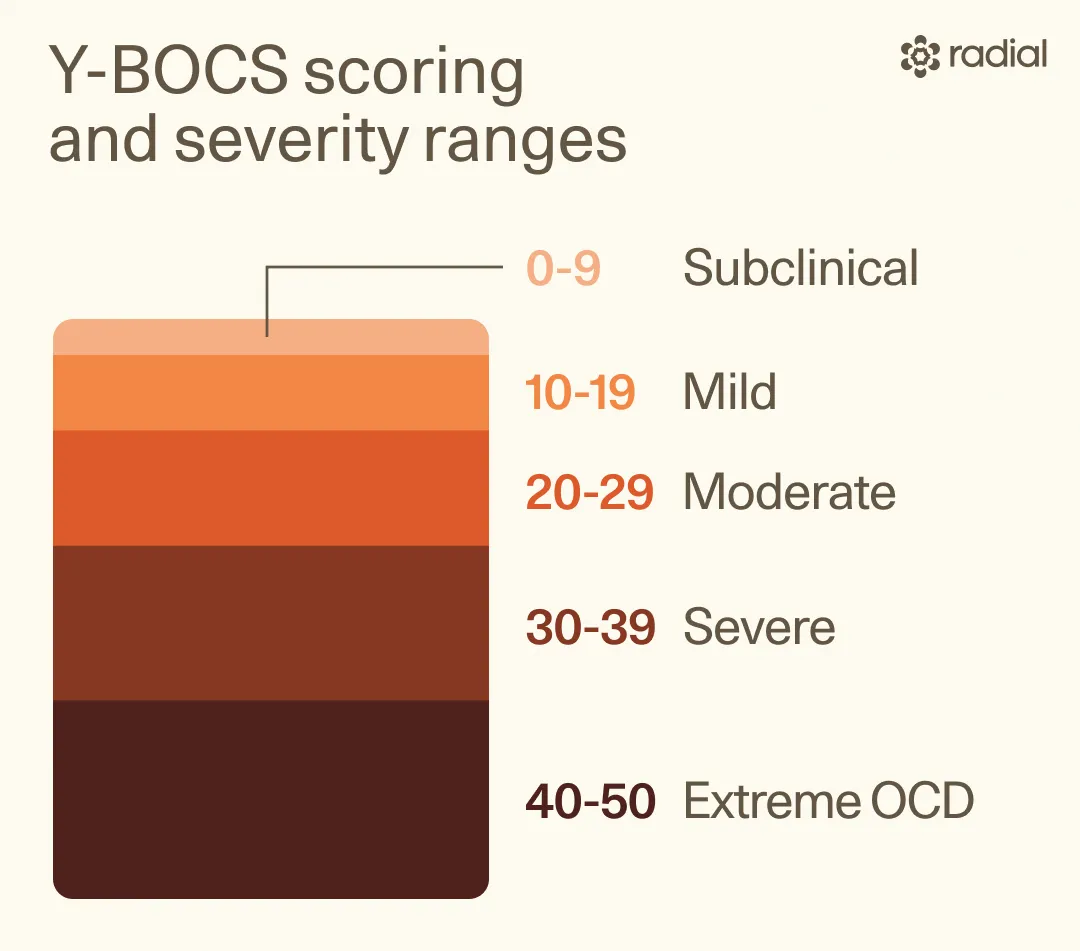
What it can do
These are some of the ways a Y-BOCS score is meant to support you and your care:
- Tracking symptoms over time: When you re-take the Y-BOCS over time, it can illuminate whether symptoms are becoming more manageable or more intense (even if the specific thoughts or rituals change).
- Seeing whether treatment is helping: Many people don’t notice small improvements day to day. A gradually lowering score can reflect meaningful shifts like less distress, more control, or fewer disruptions to daily life.
- Shaping the focus of treatment: If obsessions are causing more trouble than compulsions (or the other way around), your provider may adjust OCD treatment accordingly.
What it can’t do
These are some important limitations to keep in mind when looking at a Y-BOCS score. These limits don’t mean the Y-BOCS is flawed; they just explain what it wasn’t designed to do.
- Diagnose OCD: A score by itself can’t confirm or rule out OCD. Diagnosis comes from a full clinical evaluation and conversation.
- Capture your full experience: A single number can’t reflect your values, insight, coping skills, or what living with OCD actually feels like for you.
- Replace your provider’s judgment: The Y-BOCS is one OCD screening tool to help guide care among many. Your story, goals, and preferences matter just as much.
How clinicians use the Y-BOCS in OCD treatment
“At its core, the Y-BOCS is a clinical compass,” says Eller. “It helps guide evidence-based care, track meaningful progress, and remind both clinicians and patients of an essential truth: OCD is real, it is measurable, and it is treatable. And with the right support, change is not just possible—it’s expected.”
Here’s how clinicians use Y-BOCS to make thoughtful, individualized decisions about care:
- Initial assessment: Early on, the Y-BOCS helps establish a baseline. It gives your provider a clearer sense of how much OCD is interfering with your life right now and where the biggest pressure points are.
- Monitoring progress: Because you can repeat this OCD symptoms test, it allows your provider to look for patterns. A gradually lowering score can suggest that treatment is reducing distress or improving control, even if some symptoms are still present.
- Adjusting treatment intensity: If scores stay high or increase, your provider may talk with you about modifying therapy approaches, adjusting medication, or exploring more intensive levels of care. If scores are improving, it may reinforce staying the course.
- Supporting insurance documentation: In some cases, Y-BOCS scores are used to help document medical necessity for certain treatments or higher levels of support.
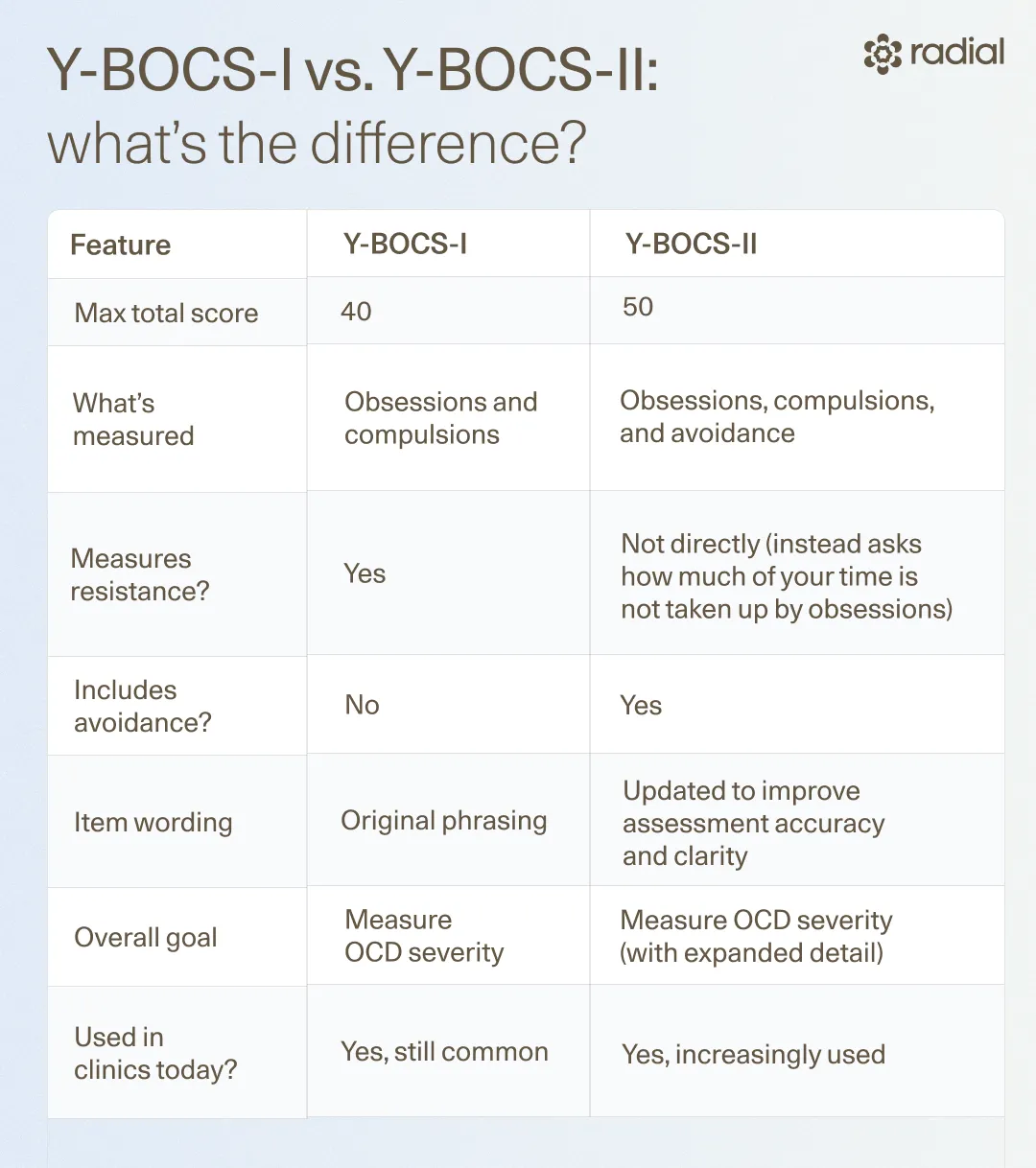
Y-BOCS-I vs. Y-BOCS-II: What’s the difference?
If you’ve seen both names and wondered whether they’re completely different tests, the short answer is no.
The Y-BOCS-II is simply an updated version of the original Y-BOCS. It was created to reflect more current thinking about OCD and to make some of the questions clearer and easier to interpret. Both versions are designed to answer the same big question: how much is OCD interfering with your life right now?
Some of the changes in Y-BOCS-II include:
- Clearer wording in certain questions
- A self-report version that people with OCD can complete themselves, written in more straightforward, non-technical language
- Less emphasis on how much someone tries to “resist” their obsessions, since resistance can vary widely and isn’t always a reliable way to measure severity
- Avoidance of certain situations, places, thoughts, or objects is treated as its own symptom of OCD, not just a side effect of obsessions or compulsions
- Small refinements to how items are organized
- A total score range of 0–50 to better differentiate people with severe OCD
Both versions still look at obsessions and compulsions in very similar ways. Which one you see often comes down to your clinic’s preference or a provider’s training. From a patient perspective, it usually doesn’t change what your score means or how treatment decisions are made.
Y-BOCS limitations and common misunderstandings
The Y-BOCS is a well-studied and widely trusted tool. But like any tool, it has limits. That’s why it’s helpful to think of the Y-BOCS as a flashlight, not a spotlight: It helps illuminate part of the picture, but isn’t meant to capture the whole story.
Understanding those limits can prevent unnecessary worry and help you use the score in a healthier, more realistic way. Here’s what to keep in mind if you’re considering taking the assessment:
- Self-scoring can be misleading: Seeing a Y-BOCS test online can be tempting, especially if you’re searching for clarity. But without a clinician’s guidance, it’s easy to misinterpret questions, underestimate certain symptoms, or overfocus on a single number. Worse still, there is a risk of self-diagnosing something you don’t have, or the risk of missing another serious diagnosis altogether. Self-scores can sometimes be a helpful starting point, but they’re not a substitute for a clinical evaluation.
- OCD can overlap with other conditions: Some experiences that look like OCD on the surface can also occur with autism, anxiety, post-traumatic stress disorder, depression, and ADHD. The Y-BOCS can’t reliably distinguish between these on its own. A clinician looks at the full picture before drawing conclusions.
- Cultural and gender considerations matter: Most research for the Y-BOCS has been done in predominantly white, English-speaking populations. That doesn’t make the scale useless, but it does mean cultural context, identity, and lived experience always matter in regards to Y-BOCS score interpretation.
- Scores can fluctuate: It’s normal for scores to go up or down. Stress, life changes, sleep, physical health, and where you are in treatment can all influence results. A temporary increase doesn’t mean you’re back at square one, just like a single low score doesn’t mean everything is permanently resolved.
When a Y-BOCS score signals next-step care
Sometimes a Y-BOCS score opens the door to a conversation about changing or intensifying treatment. That doesn’t mean something is “wrong.” It usually just means your provider is looking for ways to better match care to what you’re experiencing.
In many clinical settings, moderate-to-severe scores—especially if they stay elevated over time—can prompt discussions about:
- Adjusting the type or frequency of therapy
- Trying or fine-tuning medication
- Considering a higher level of care (such as intensive outpatient or partial hospitalization programs)
- Exploring new options for people who haven’t responded to first-line treatments, like TMS therapy or ketamine therapy. TMS is FDA-approved for OCD, while ketamine is still considered an off-label and experimental option for this condition, with early research showing potential benefits but more evidence still needed.
What matters most is not crossing a specific numerical threshold, but how your symptoms are affecting your daily life and whether your current treatment is helping enough.
Next-step care is always meant to be collaborative. You and your provider look at your goals, preferences, past treatment experiences, and overall health alongside your Y-BOCS score to decide what makes sense.
The bottom line
The Y-BOCS is one of the most trusted tools for understanding how much OCD is interfering with daily life. It offers a shared language for talking about symptoms, tracking change over time, and guiding thoughtful, individualized treatment so the focus stays less on a number and more on moving toward relief, better functioning, and support that fits you.
Key takeaways
- The Y-BOCS is designed to measure how severe OCD symptoms are and how much they interfere with daily life, not to diagnose OCD on its own.
- Y-BOCS scores are most useful for tracking changes over time and seeing whether treatment is helping.
- The Y-BOCS is widely used in clinical practice and aims to measure the same core aspects of OCD severity.
- A single Y-BOCS score represents a snapshot in time and should never be interpreted in isolation.
- The most meaningful interpretation of a Y-BOCS score happens in conversation with a trained clinician who understands your full context.
Frequently asked questions (FAQs)
What does the Yale-Brown Obsessive Compulsive Scale measure?
The Y-BOCS characterizes and measures the severity of OCD symptoms. More specifically, it measures how much time obsessions and compulsions take up, how distressing they feel, how hard they are to resist, and how much they interfere with daily life. It does not measure personality traits or predict outcomes.
What is a high Y-BOCS score?
Scores in the severe (30-39) or extreme (40-50) range are generally considered high and suggest that OCD is significantly interfering with daily functioning. A high score doesn’t mean symptoms are permanent—it just suggests more support or treatment adjustments may be helpful.
How often is the Y-BOCS repeated?
It varies, but many clinicians repeat the Y-BOCS every few weeks or months, especially when starting or adjusting treatment. Repeating the scale helps track trends rather than focusing on a single number.
Editorial Standards
At Radial, we believe better health starts with trusted information. Our mission is to empower readers with accurate, accessible, and compassionate content rooted in evidence-based research and reviewed by qualified medical professionals. We’re committed to ensuring the quality and trustworthiness of our content and editorial process–and providing information that is up-to-date, accurate, and relies on evidence-based research and peer-reviewed journals. Learn more about our editorial process.
Let's connect
Get started with finding the right treatment for you or someone you care about
Get startedExplore more posts