Harm OCD Explained: Intrusive Thoughts You Don’t Want and What They Mean

Harm OCD causes sudden flashes of violent, disturbing thoughts about harming or losing control around the people you love the most. These thoughts conflict with who you are as a person, leading to fear and shame. It’s important to remember that intrusive thoughts are common, and having them doesn’t mean that you are dangerous, disturbed, or broken.
Intrusive thoughts about harming yourself or others can be frightening, especially since they seem to come out of nowhere and contradict who you know yourself to be. I experienced similar thoughts during the postpartum period after having twins, so I know just how upsetting they can be. I was left unsure what the thoughts meant or why they were happening. The reality is that many people have moments like this, often without realizing how common the experience is and that there’s a name for it.
Harm OCD is a subtype of obsessive-compulsive disorder that involves recurring, unwanted thoughts about accidentally or intentionally hurting yourself or a fear of hurting someone else. They’re not just disturbing; they are the exact opposite of your actual values, intentions, and sense of self. The result is often an intense mix of guilt, fear, shame, and anxiety. You might be left wondering, “Am I crazy?” or “Is there something fundamentally wrong with me?”
You may find it reassuring to know that intrusive thoughts aren’t uncommon. In fact, research suggests that up to 94% of all people experience some unwanted and disturbing thoughts regularly. Having such thoughts doesn’t mean you are dangerous or that you’ll act on them. The difficulty comes from the fear, worry, and compulsive attempts to avoid, neutralize, or ignore such thoughts.
This article will explain what harm OCD is, how it develops, and how treatment can help. You’ll see why you’re not alone in experiencing these thoughts and explore just how common they are across different types of OCD. Learning more about this condition can help you feel more supported as you manage your symptoms.
If you are having thoughts about harming yourself or others and feel unable to stay safe, contact your local emergency services or reach out to the Suicide and Crisis Lifeline in the United States by dialing 988 for immediate support.
What is harm OCD?
Harm OCD is defined as a subtype of obsessive-compulsive disorder, a condition that causes unwanted, intrusive obsessions and compulsive behaviors. In the case of harm OCD, people have repeated, intrusive thoughts about accidentally or intentionally hurting themselves or others.
Such thoughts spring up unexpectedly, feel out of character, and often contain violent or frightening imagery. Harm OCD obsessions can cause you to worry about what they might mean, not necessarily because you think you’ll act on those thoughts, but because the actual content of the thoughts is so disturbing.
Harm OCD is very different from having violent intent or psychosis. People with harm OCD recognize that their thoughts are unwanted and irrational. They are often terrified of unintentionally harming themselves or others. This differs from psychosis, where delusional thoughts are perceived as mostly or absolutely real; a psychotic person may feel that acting aggressively will lead to some desired outcome, such as feeling safer. . People with harm OCD have no desire to act on their thoughts and often go to great lengths to avoid situations that might trigger them.
Common forms that harm OCD symptoms can take include:
- Self-harm OCD: Intrusive fears about accidentally or impulsively hurting yourself; causes people to avoid heights, sharp objects, medications, or other potential threats.
- Suicidal OCD: Persistent, unwanted, frightening thoughts about suicide that are distinct from genuine suicidal ideation.
- Hit-and-run OCD: Intrusive worries about hitting someone with a car; the International OCD Foundation suggests that this can then lead to repetitive checking behaviors like checking mirrors, circling back, or even avoiding driving.
- Perinatal or postpartum OCD: Distressing thoughts about accidentally or intentionally harming a baby; causes new parents to worry about their caregiving abilities.

What do intrusive thoughts look like?
Intrusive thoughts can take many forms. Some might happen as brief, startling mental images or snapshots, explains Catherine Schuler, PsyD, a licensed clinical psychologist who specializes in OCD and anxiety disorders. Others crop up as sudden fears or urges that seem to come out of nowhere. While both are common, they typically fade quickly and don’t cause too much distress for most people.
For those with harm OCD, however, having violent thoughts for no reason can feel overwhelming and unshakeable. “They can feel like they happen out of nowhere, and they often feel antithetical to a person's personality,” Schuler says.
The unacceptable thoughts are also linked to powerful feelings of shame, according to a 2022 systematic review and meta-analysis published in the British Journal of Clinical Psychology. What’s more, people who felt the most shame tended to have more severe OCD.
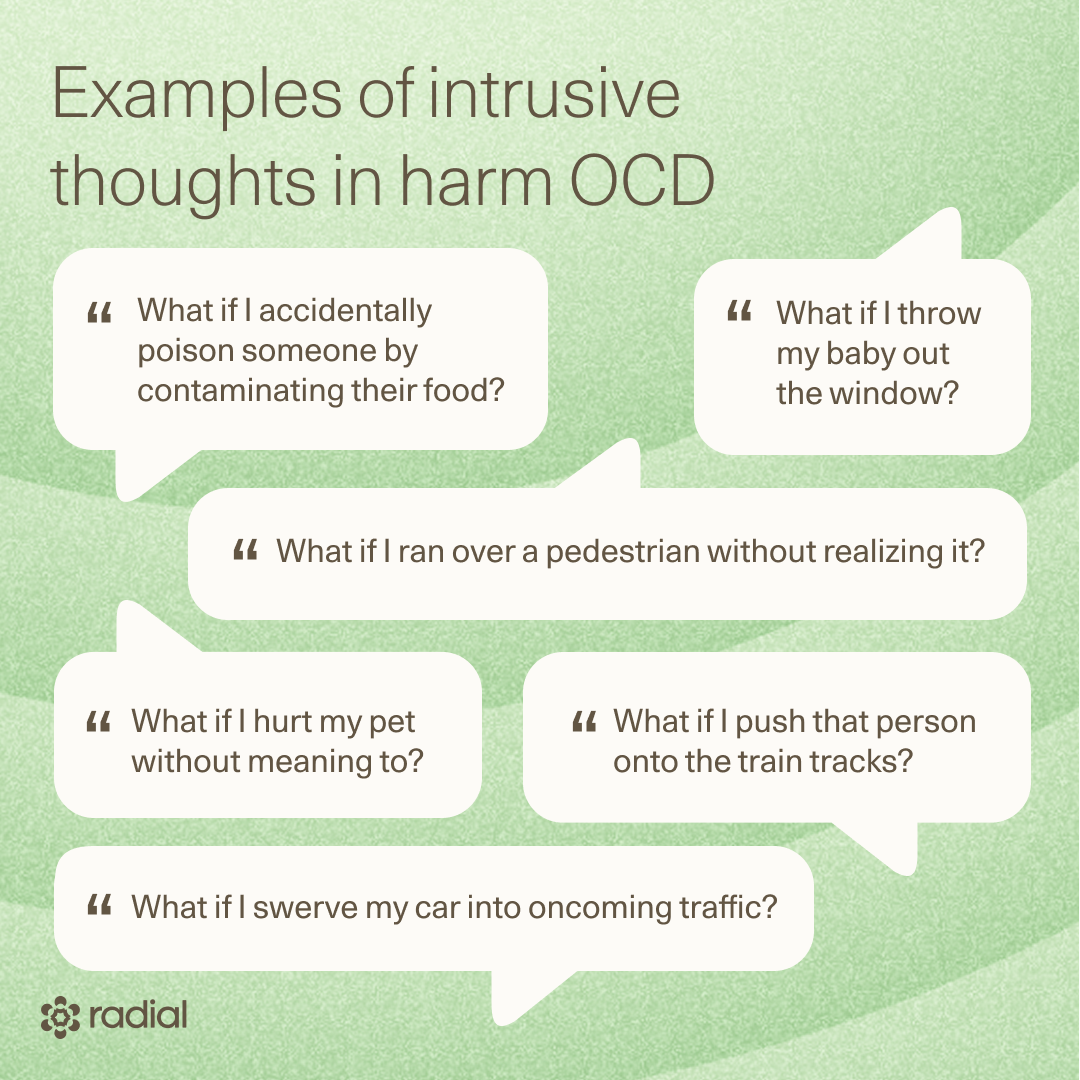
Examples of the types of intrusive thoughts that someone with harm OCD might experience include:
- What if I push that person onto the train tracks?
- What if I swerve my car into oncoming traffic?
- What if I accidentally poison someone by contaminating their food?
- What if I yell something hurtful or obscene at a stranger?
- What if I ran over a pedestrian without realizing it?
- What if I throw my baby out the window?
- What if I smother my baby while putting them to sleep?
- What if I hurt my pet without meaning to?
- What if I stab myself while making dinner?
- What if I steal something from the supermarket?
“They could be images of themselves engaging in any of those feared situations, which might be horrific or bloody scenes,” Schuler explains. “They could also be experienced as an unwanted ‘urge’ to do harm to themselves or others, even though they are terrified at the prospect and feel it is the opposite of what they want.”
It’s not just the content of these intrusive thoughts of violence that makes them so upsetting. It’s also how sudden, unexpected, vivid, and out-of-character they are.
The important thing to remember is that they aren’t a reflection of who you are or what you plan to do. Thoughts are mental events—not plans, impulses, or facts.
What are common triggers of OCD thoughts?
Some things that might play a role in triggering OCD thoughts include common general triggers of any mental illness, such as:
- Stress and fatigue
- Major life changes
- Hormonal changes, such as during the postpartum period
- Anxiety and depression
Beyond that, people with harm OCD are often triggered by specific situations, such as:
- Parenting or caregiving responsibilities
- Handling knives or sharp objects
- Driving or being in crowded spaces
- Waiting for public transportation
- Watching violent media or new stories
- High-stakes, stressful situations
- Being responsible for someone else’s safety
Such triggers don’t, on their own, cause intrusive thoughts. However, they do prime your mind to be more alert about potential dangers and misinterpret everyday worries or thoughts as dangerous.
Healing happens through strong relationships
Compassionate, experienced mental health professionals focused on evidence-based care



.jpg)
What are the symptoms of harm OCD?
The symptoms of harm OCD tend to show up in a cycle: intrusive thoughts create anxiety, which then leads to behaviors that are meant to help you feel less anxious and more in control. The problem is that these coping behaviors tend to worsen fear and keep the cycle going over time.
Obsessions
Harm obsessions are the intrusive thoughts, fears, and mental images about hurting themselves or others. “They are also ego-dystonic, which means counter to your values and how you view yourself,” explains Austin OCD therapist Jessica Fink, LCSW-S, at Jessica Fink Therapy.
Common obsessions in harm OCD include:
- Fear of losing control and hurting someone
- Worrying about accidentally harming a loved one
- Sudden mental images of violent scenarios
- Concern that even a minor action might accidentally lead to serious harm
- Replaying situations to make sure that no one is harmed
Schuler notes that having these kinds of intrusions alone does not mean that you have OCD. “The idea of an ‘obsession’ in OCD is that these intrusions become very ‘sticky’ and the person feels unable to dismiss them.” Because they are so afraid of these thoughts and can’t move past them, they then feel they must engage in a compulsion to counteract the thoughts or ensure that they don’t act on them.”
Compulsions
Compulsions are behaviors or mental actions that are meant to reduce the anxiety caused by obsessive thoughts and fears. The problem is that while these actions provide brief, temporary relief, they generally reinforce the fear cycle.
Common harm OCD compulsions include:
- Checking: Repeatedly checking mirrors when driving and reviewing interactions to ensure that no harm occurred
- Avoidance: Steering clear of potential dangers, such as knives, medications, or actions that feel unsafe
- Reassurance seeking: Asking others if they think you would harm anyone or if an event is safe
- Ritual behaviors: Repeating phrases, mantras, or prayers to neutralize the thoughts or ward off harm
Researchers have found that people with OCD often feel an exaggerated sense of responsibility for preventing harm from happening. This makes even low-risk situations feel urgent or dangerous, which fuels the strong urge to double-check or “fix” things in order to feel safe.
Harm OCD's emotional toll can be heavy. Many people feel guilt, shame, and fear that such thoughts say something terrible about them. They worry about being judged for sharing what they are experiencing, and may become even more isolated if they start to avoid anything that risks triggering these thoughts.
“People with OCD know their fears are irrational, but there is such a severe intolerance of uncertainty, and they don't want to take even the smallest risk. Especially when the feared outcome is somebody getting hurt," Fink says.
Harm OCD can also overlap with other OCD subtypes, particularly anger or moral scrupulosity OCD. It's easy for someone to worry that just a moment of irritation might lead to an outburst of violence or that a single moment of anger might mean they are a morally bad person.
What causes harm OCD?
Biological, genetic, and psychological factors all play a part in causing harm OCD.
- Brain differences: Like other OCD subtypes, it is associated with how the brain handles uncertainty. Some people are born with a threat response system that is more sensitive, which can make intrusive thoughts feel louder and more emotionally charged.
- Genetics and family history: Research also shows that having a family history of OCD or anxiety can increase the likelihood of developing similar symptoms.
- Problems filtering thoughts: Some researchers believe that harm OCD develops when the brain has issues filtering or redirecting unwanted thoughts. In other words, intrusive thoughts related to harm feel stronger because the mind cannot easily shift away from them.
None of this reflects anything about your character. Fink stresses people with harm OCD do not want to hurt themselves or others. In fact, they are repulsed and frightened by the idea, she says.
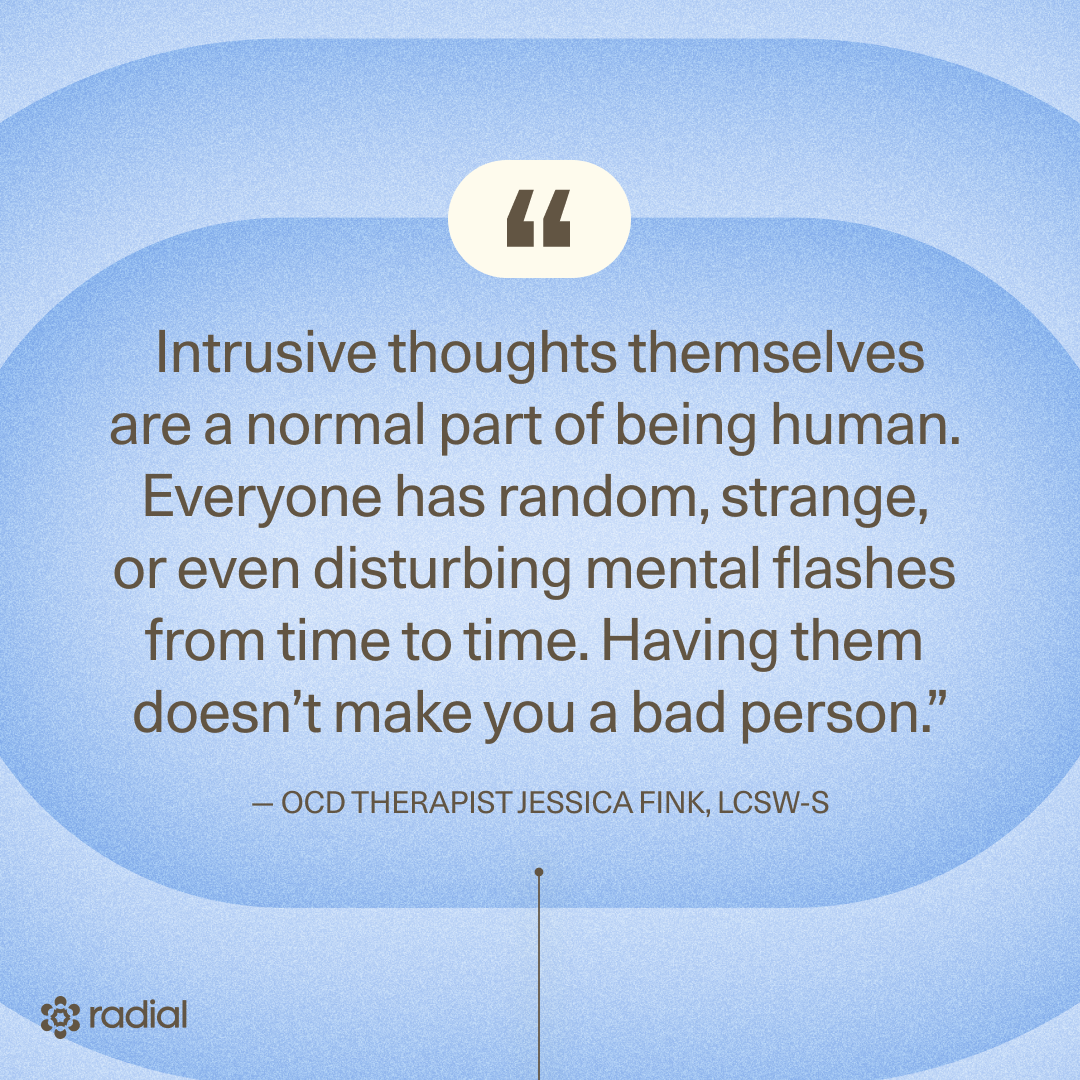
Instead, such thoughts reflect how your brain processes fear and doubt. Intrusive thoughts themselves are a normal part of being human. Everyone has random, strange, or even disturbing mental flashes from time to time. Having them doesn’t make you a bad person.
In harm OCD, the difference is all about how the thoughts are interpreted. Where most people just see them as mental noise, the brain of a person with harm OCD mistakenly treats them as more important or dangerous than they really are. When this happens, fear becomes more pronounced, and compulsions may emerge as a way to cope with it.
"We often see what we call 'thought-action fusion,' which is the belief that having a thought/image/urge is morally the same thing as having done the act in question," Schuler explains. "As you can imagine, this fuels further avoidance of any situation that might bring up obsessions."
Common myths and misunderstandings can make the experience even scarier. That’s why it’s so important to remember that:
- Intrusive thoughts do not reflect intent or predict behavior
- The idea that only bad people have violent thoughts isn’t true; nearly everyone has uncomfortable or violent mental flashes at times
- These thoughts don’t have the power to cause real-world events
- Feeling distressed by them is a sign of your values, not danger
How is harm OCD diagnosed?
Harm OCD is not recognized as a distinct condition in the DSM-5, the clinical tool that doctors and mental health professionals use to diagnose mental disorders. Instead, it is a cluster of specific symptoms related to obsessive-compulsive disorder.
To make a harm OCD diagnosis, a clinician will look at your pattern of obsessions and compulsions to better understand your experiences.
- The process starts with discussing your intrusive thoughts, when they occur, and how you respond to them.
- A clinician will ask questions about behaviors like avoidance, checking, or reassurance-seeking.
- Tools such as the Yale-Brown Obsessive Compulsive Scale (Y-BOCS) may be used to gauge symptom severity and get a better picture of how thoughts and compulsions affect your daily life.
Part of the diagnostic process involves distinguishing harm OCD from other conditions that may include similar thoughts. Due to the nature of your thoughts, it’s understandable that you might feel hesitant to share these thoughts. Clinicians trained in OCD recognize that these thoughts are unwanted and anxiety-provoking and are not signs of violent intent or suicidal ideation. They are there to help, not judge.
How is harm OCD treated?
Harm OCD treatment often focuses on a few evidence-based options. The goal is not to eliminate intrusive thoughts, but to change how you interpret and respond to them so they lose their power. Compulsions may be easier to manage with the right combination of therapy, medication, and support.
Exposure and response prevention (ERP) therapy
Exposure and Response Prevention (ERP) therapy is the leading treatment for OCD. In ERP, you slowly face the things that scare you while resisting your usual compulsions. With repeated practice, your brain learns that these thoughts are not dangerous.
Some harm OCD exposure ideas include writing down scary thoughts, holding a sharp knife while cooking, or visualizing distressing situations, all with a therapist who helps you move at a safe pace. Research suggests this type of therapy can lead to symptom remission in 42% to 52% of people with OCD.
Acceptance and commitment therapy (ACT)
Acceptance and commitment therapy teaches you how to allow intrusive thoughts to exist without fighting against them. Instead of worrying about what the thoughts mean or trying to stop or push them away, ACT focuses on self-compassion, openness, and acting in ways that align with your values.
This approach can help reduce the fear and sense of urgency that often accompany harm-related thoughts. Evidence suggests that ACT can help people feel more engaged in treatment, especially for those who don't fully respond to ERP.
Transcranial magnetic stimulation (TMS)
TMS is a type of non-invasive treatment that is FDA-cleared for OCD. It works by using magnetic pulses to target a specific brain region involved in obsessive thinking and compulsive behavior. Evidence suggests that TMS can reduce symptoms by around 58%, making it a viable option if first-line treatments, like therapy and medication, haven't provided sufficient improvement. In many cases, TMS is combined with psychotherapy for the best results.
Radial specializes in this treatment and can help you determine whether traditional TMS or advanced options like BrainsWay and AMPA are right for you. Schedule a consultation to explore how this approach can support your treatment and recovery.
Medication
Five medications have been FDA-approved to treat obsessive-compulsive disorder. Four of these are selective serotonin reuptake inhibitors (SSRIs), which have been shown to help reduce symptoms in up to 60% of people with OCD. Such medications can help reduce the intensity of obsessions and compulsions in harm OCD and are often used alongside therapy.
Other treatment options
In some cases, other treatments or care may be necessary if other first-line treatments are not successful. These may include:
- Intensive outpatient programs (IOPs) involve several hours of structured outpatient therapy each week, allowing you to continue living at home.
- Partial hospital programs (PHPs) offer daily treatment in a clinical setting for more intensive support.
- Residential treatment centers (RCTs) provide 24-hour-a-day care for people with severe or treatment-resistant OCD.
- Deep brain stimulation (DBS) is a promising surgical treatment for severe or treatment-resistant OCD, leading to symptom reduction in almost 50% of patients.
- Gamma knife radiosurgery (GKRS) is a highly specialized procedure reserved for the most severe, treatment-resistant cases. It involves using gamma rays to create lesions on pathways in the brain that are involved in OCD, potentially leading to a 50% reduction in symptoms or even full remission.
These treatments are generally reserved for situations in which a person is experiencing severe symptoms that significantly impact their ability to function, and they have not had adequate relief from other treatment options.
The good news is that with the right combination of treatment and support, you can find significant relief from harm OCD symptoms.
Relief within reach
Care covered by your insurance
Radial provides advanced mental health treatment, covered by the insurance you already use.








When to seek help
Intrusive thoughts are common, so how do you know when it’s time to seek help? It may be time to talk to a professional if your thoughts are taking up a lot of your time and energy, and are creating distress and disruption in your life. Consider talking to someone if:
- You find yourself avoiding situations or people because of your thoughts
- Harm OCD thoughts interfere with your daily life
- You have to constantly seek reassurance that you haven’t hurt anyone
- You feel overwhelmed by guilt, anxiety, or fear
- The thoughts interfere with your daily life, sleep, or relationships
- Your thoughts make it hard for you to feel safe around others
"Many with harm OCD worry that the existence of these obsessions means they are a bad person, when in reality, they are meaningless mental occurrences that their brain has latched onto," Schuler says.
Unfortunately, the shame that stems from harm-related thoughts often acts as a barrier to getting help. Keep in mind that mental health professionals are trained to help you understand what’s happening, guide you through treatments, and help you explore new coping skills.
The first step is to find a professional qualified to treat harm OCD. Look for someone who specializes in OCD and has experience with exposure and response prevention therapy or related, evidence-based treatments. Consider asking:
- Do you have any experience treating the harm OCD subtype or violent intrusive thoughts?
- What therapy approaches do you use to treat OCD?
- How do you incorporate ERP or ACT into treatment?
- How do you differentiate harm OCD from suicidal ideation or psychosis?
- What can I expect during the first few sessions?
A qualified therapist will understand that intrusive thoughts are symptoms, not a reflection of who you are. You will not be judged for sharing them. Instead, you’ll be guided toward treatments and OCD coping skills that will make the thoughts less frightening and easier to manage.
Asking for help isn’t a sign of weakness. It's a show of strength. Getting help early can make treatment more effective and ease the emotional weight, stress, and fear you’ve been carrying. Showing yourself compassion and kindness during this process is just as important as the treatment itself.
The bottom line
While harm OCD can seem overwhelming, it is a common and highly treatable form of OCD. Intrusive thoughts don’t define who you are, no matter how distressing they might be. They aren’t a sign that you’re a bad person or that you pose a danger to others. The fact that you find them so upsetting indicates the exact opposite.
Be gentle and compassionate with yourself as you reach out for the right type of support. With time, these thoughts will begin to lose their power and feel less frightening.
If you are struggling and ready to take the next step, Radial offers effective, cost-efficient treatments for OCD. You can connect with a clinician online or in person to learn more about your options and develop an individualized treatment plan. You deserve to feel better, and Radial’s treatments can make sure you are safe and understood at every point in your recovery.
Key takeaways
- Harm OCD is a presentation of obsessive-compulsive disorder that involves unwanted, intrusive thoughts about harm that are inconsistent with a person’s character and values.
- Intrusive thoughts are common, and their presence doesn’t indicate danger, intent, or a moral failing.
- Effective treatments include TMS, ERP, ACT, medication, and higher levels of care, which can significantly reduce distress and improve quality of life.
- Qualified mental health professionals understand these symptoms and can differentiate them from other conditions while offering supportive, evidence-based care.
Frequently asked questions (FAQs)
Is harm OCD common?
OCD has a prevalence rate of around 2% to 3%, making it fairly common among the general population. And among those with OCD, a fairly large portion suffer from harm OCD. It's also notable that nearly all people experience some form of intrusive thoughts at some point during their lives. But for most, those thoughts never escalate to the level of harm OCD.
What’s the difference between harm OCD and self-harm thoughts?
There are key distinctions between the two. Intrusive thoughts are unwanted and go against your values. You try to push them away when they happen. Genuine desires for self-harm are characterized by wanting the action to happen and not feeling anxiety when having such thoughts. Instead of pushing them away, you focus on actually planning the actions.
Can harm OCD make me dangerous?
No, harm OCD does not make you dangerous. While you might wonder why your intrusive thoughts are so violent, remind yourself that they are unwanted, anxiety-driven symptoms and not a sign of your intentions or character.
Fink notes that people with harm OCD are often some of the safest people you'll ever meet; they are the last people who would intentionally cause harm. These violent thoughts are so distressing precisely because they go against the values of the person having them. But if you ever feel unsure about your safety or fear that you may act on a thought, reach out to a mental health professional or call the 988 Suicide and Crisis Lifeline for immediate support.
Deep dive recommendations
- Jon Hershfield. Overcoming Harm OCD: Mindfulness and CBT Tools for Coping with Unwanted Violent Thoughts.
- Fred Penzel, PhD, International OCD Foundation. How I Treat OCD Killer Thoughts: Treating Violent Obsessions.
- Think Act Be Podcast. Ep. 38: Jon Hershfield — How to Find Relief from Unwanted Violent Thoughts in Harm OCD.
- Sally Winston & Martin Seif. Overcoming Unwanted Intrusive Thoughts: A CBT‑Based Guide to Getting Over Frightening, Obsessive, or Disturbing Thoughts.
- Therapy in a Nutshell. Harm OCD - Intrusive Thoughts That I Might Hurt Someone.
- New Frontiers in TMS Treatment of OCD: Can Brain Stimulation Get Better as a Treatment for OCD?
Editorial Standards
At Radial, we believe better health starts with trusted information. Our mission is to empower readers with accurate, accessible, and compassionate content rooted in evidence-based research and reviewed by qualified medical professionals. We’re committed to ensuring the quality and trustworthiness of our content and editorial process–and providing information that is up-to-date, accurate, and relies on evidence-based research and peer-reviewed journals. Learn more about our editorial process.
Let's connect
Get started with finding the right treatment for you or someone you care about
Get startedExplore more posts