Understanding Cluster B Personality Disorders: Emotional Intensity and Relationships

Cluster B personality disorders (aka narcissistic personality disorder, histrionic personality disorder, borderline personality disorder, and antisocial personality disorder) are often stigmatized and misunderstood. This guide separates fact from fiction so that we can all better understand these conditions and what effective treatment looks like.
You may have encountered the term "cluster B" (or one of the four conditions it represents) on social media, in a Reddit thread, or during a conversation about relationship dynamics. These conditions are often mentioned in everyday life, but they are misunderstood by many people. So, what actually are cluster B personality disorders?
In short, these disorders present with patterns of behavior that are overly dramatic, emotional, or unpredictable. “Cluster B personality disorders are patterns in the way someone experiences themselves, relates to other people, and responds under stress,” says Greg Malzberg, MD, a psychiatrist at Radial. “They are not just ‘bad behavior,’ and they are not a person’s whole identity. They are long-standing ways of coping, usually shaped by both temperament and development, that can become rigid and create repeated problems in relationships, work, self-esteem, and emotional regulation.”
Continue reading to learn more about the four cluster B personality disorders, including what they have in common and what makes each unique. We’ll also dive into the most common misconceptions about each, treatment options, and what to do if you or a loved one display cluster B traits.
What are the cluster B personality disorders?
From a mental health perspective, personality refers to the most consistent pattern of how someone interacts with others, behaves, feels, and thinks. When someone notices that these patterns become disruptive to their life, they may be diagnosed with a personality disorder.
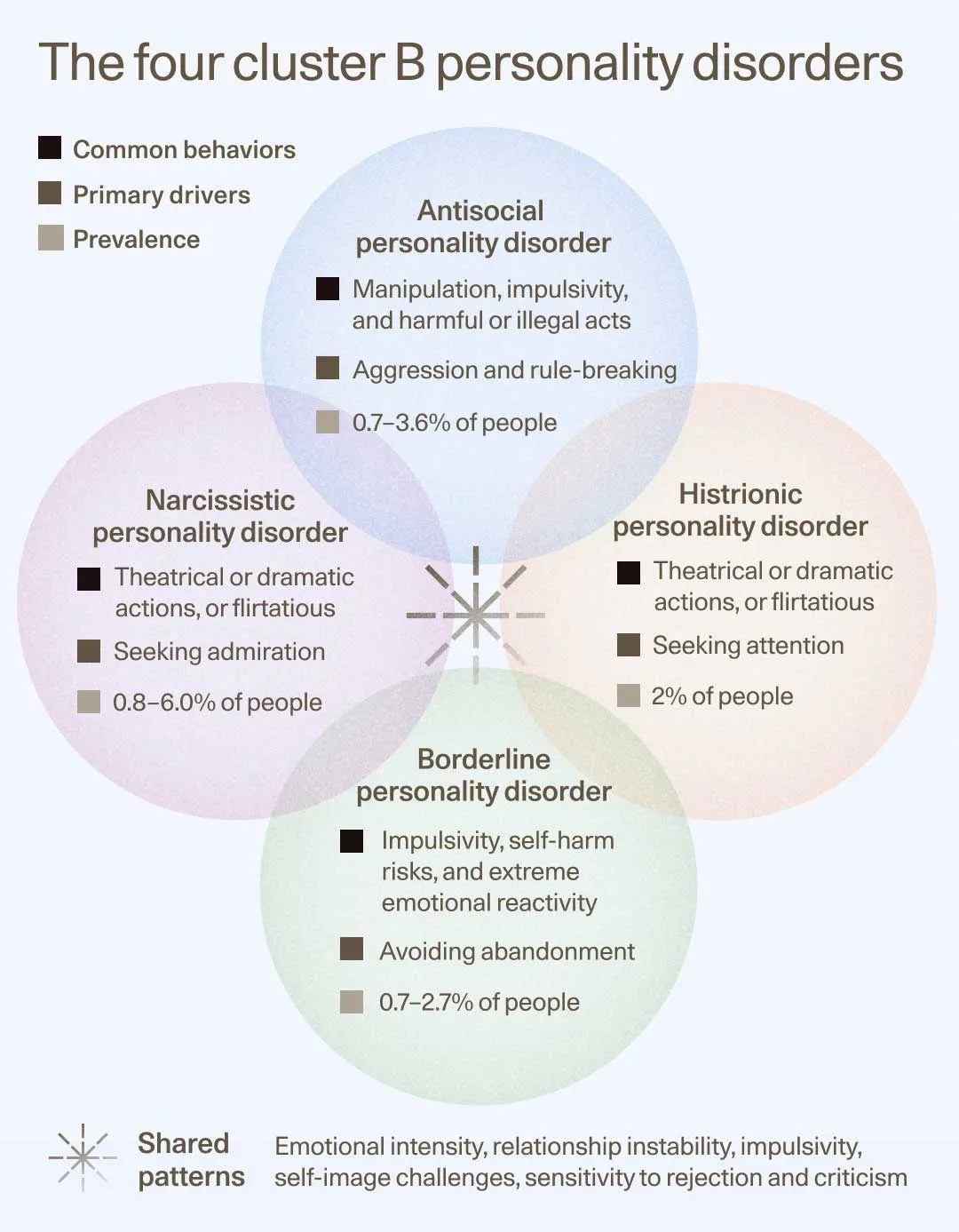
Cluster B personality disorders are characterized by heightened emotional states, impulsivity, difficulty maintaining healthy relationships with others, and identity disturbances. The list of cluster B personality disorders includes:
- Antisocial personality disorder (ASPD)
- Borderline personality disorder (BPD)
- Histronic personality disorder (HPD)
- Narcissistic personality disorder (NPD)
If you’re wondering what the “B” is all about, turn to the Diagnostic and Statistical Manual of Mental Disorders, which is the guide for psychiatrists and other mental health workers. This manual outlines three main clusters of personality disorders:
- Cluster A: These conditions may be characterized as odd or eccentric. Schizotypal personality disorder, paranoid personality disorder, and schizoid personality disorder are all in this cluster.
- Cluster B: The conditions covered here, these four types are marked by intense feelings, unstable image of self and others, and impulsivity.
- Cluster C: These conditions are characterized as anxious or fearful. This cluster includes obsessive compulsive personality disorder (OCPD , dependent personality disorder, and avoidant personality disorder.
Healing happens through strong relationships
Compassionate, experienced mental health professionals focused on evidence-based care

.jpg)

What are the similarities and differences between cluster B personality disorders?
Cluster B personality disorders are grouped together because they share some specific characteristics. Shared cluster B symptoms include:
- Emotional intensity: A hallmark feature of all these disorders is that people living with one of these conditions may tend to feel things very intensely and have trouble regulating their emotional state.
- Relationship instability: People with cluster B personality disorders often approach relationships in a way that’s unhealthy for themselves and loved ones. This often leads those with cluster B personality disorders to encounter conflict within their relationships, leading to major upheaval in many areas of their life.
- Impulsivity: All four cluster B personality disorders may display varying degrees of impulsivity that may cause major life disruptions. People may place themselves at risk for harm or others.
- Self-image challenges: Another cluster B trait is an impaired sense of self and self-direction. People with these disorders often struggle with developing or maintaining a sense of self.
- Sensitivity to rejection and criticism: People with cluster B personality disorders may be overly sensitive to rejection or criticism. They often ruminate to an unhealthy degree on times when someone rejected or ignored them.
If you read over these traits and thought of a time when rejection stung or when you acted impulsively, that doesn’t mean you have one of these conditions. “Everyone can be impulsive, defensive, self-focused, or emotionally reactive at times,” explains Dr. Malzberg. What makes something a disorder—and a personality disorder, in particular—is a consistent pattern across situations that causes suffering or dysfunction.
Still, the four cluster B disorders are also distinct. Their main differences include:
- Variations in relationship approaches: The way people with these four disorders tend to approach relationships varies widely. Someone with BPD, for example, may have intense but unstable relationships, while ASPD may manifest as more detached relationships that can be exploitive.
- Differences in emotional patterns: While all individuals with cluster B personality disorders may tend to feel emotions intensively, they may all have different emotional patterns, whether it’s feeling more fragile or reactive than normal or having limited remorse for actions that harm others.
- Distinct perceptions of self: All four types struggle with a sense of self, but in different ways. People with NPD, for example, often have an inflated but tenuous self-image while someone with HPD may have an externalized sense of self that constantly shifts based on what those around them think.
A closer look at the four cluster B personality disorders
Now that we have a basic understanding of these conditions, let’s take a deeper dive into each one.
Antisocial personality disorder (ASPD)
ASPD at a glance
- Estimated prevalence: 0.7-3.6% of the population
- Motivator for behavior, thoughts, and feelings: Aggression and rule-breaking
- Common thought patterns: A disregard for others, societal norms, or rules, difficulty planning ahead or considering the safety of themselves or others, a lack of remorse for their actions, and low empathy for others
- Common behaviors: Manipulating others, acting impulsively, repeating behaviors that are harmful to self or others or that could be grounds for arrest
Antisocial personality disorder is when someone consistently acts with a lack of regard for others or actively violates others’ boundaries. ASPD encompasses a wide range of behaviors that may be harmful to the individual and those around them, but ASPD is not synonymous with evil or criminality.
“Plenty of people do harmful or illegal things without having this disorder, and some people with antisocial traits are not overtly criminal,” explains Dr. Malzberg, “The deeper issue is a chronic pattern of violating the rights of others, exploiting people, failing to feel or use guilt in a normal way, and having limited concern for the impact of one’s behavior.” He adds that these behaviors usually stem from impairment regarding behavioral regulation or empathy.
Borderline personality disorder (BPD)
BPD at a glance
- Estimated prevalence: 0.7-2.7% of people
- Motivator for behavior, thoughts, and feelings: Avoiding abandonment
- Common thought patterns: Unstable sense of self, feeling empty a lot of the time, and difficulty controlling anger
- Common behaviors: Impulsive behaviors that often harm self or others, high risk of self-harming or suicidal behaviors, and extremely reactive to the emotions they are feeling in the moment
Borderline personality disorder (BPD)is when someone acts in extreme ways that harm themselves or others, often due to an extreme fear of abandonment or rejection by others. This condition often creates a lot of relational strains, including in an individual’s relationship with themself.
What people often miss is that BPD and an unstable sense of self is that, in most cases, it partially stems from trauma or emotional pain. “Loved ones may focus on the outward behavior and miss the inner experience of terror, emptiness, shame, and abandonment sensitivity,” says Dr. Malzberg.
Histrionic personality disorder (HPD)
HPD at a glance:
- Estimated prevalence: 2% of people
- Motivator for behavior, thoughts, and feelings: Receiving attention from others
- Common thought patterns: Thoughts and emotions shift rapidly and are easily influenced by others, often perceives relationships as more intimate than they are, and feels uncomfortable in situations where they are not the center of attention
- Common behaviors: May act in a way that’s perceived as promiscuous, or flirtatious, often behaves in a theatrical or exaggerated manner, and may use their appearance to draw attention to themselves
Histrionic personality disorder (HPD) is often perceived as attention-seeking. While it’s true that those with HPD may go to dramatic extremes to get others to notice them, focusing too much on this behavior only addresses how someone with HPD might present externally, not what’s going on internally.
“What is often missed is that the person may genuinely experience relationships and emotions in a heightened, impressionistic, approval-dependent way,” explains Dr. Malzberg, “The surface style can look flirtatious, theatrical, or rapidly shifting, but underneath there is often a fragile sense of self that relies heavily on being noticed, reassured, or desired.”
Narcissistic personality disorder (NPD)
NPD at a glance:
- Estimated prevalence: 0.8-6.0% of people
- Motivator for behavior, thoughts, and feelings: Getting admiration from others
- Common thought patterns: Grandiose sense of self, obsessive fantasies about success, a belief that they are “special,” and a desire for adoration, especially from those they also deem as “high status” or “important”
- Common behaviors: Constantly seeking praise from others, acting with a sense of entitlement, often envious of others, and may act in a way others perceive as arrogant
Narcissistic personality disorder (NPD) is a condition marked by a grandiose self-belief and a need for admiration from others. While narcissistic personality disorder isn’t the rarest personality disorder out there, we probably discuss it (and informally diagnose others with it) more than we should.
While some stereotypical characteristics of the disorder, such as an over-inflated sense of self and feeling overly entitled, are usually present, people often miss the vulnerability underneath the arrogant exterior. According to Dr. Malzberg, people with NPD often require admiration in order to hold themselves together.
NPD is also not always loud and self-promoting, which Dr. Malzberg says is a common misconception. This condition can also be marked by hypersensitivity, feeling more shame than the average person, and ruminating over rejection or exclusion.
Why are cluster B personality disorders often confused?
There are many, many reasons these conditions are misunderstood and misidentified. For one, we misuse words like “antisocial” and "narcissistic" in pop culture and society at large, which adds a layer of stigmatization and confusion. Additionally, social media can often spread misinformation about these diagnoses, which may lead people to inaccurately diagnose themselves or others. This can be harmful to everyone involved.
The conditions are also tricky for the average person (and some mental health providers) to differentiate. “Many people do not fall cleanly into one categorical disorder,” explains Dr. Malzberg, “And clinicians often overcall borderline based on self-harm or overcall antisocial based on arrests and countertransference.” This is why it’s important to work with a mental healthcare provider, such as the team at Radial, who has ample experience in helping people with these disorders.
Plus, someone can have more than one of these conditions or they can coexist with other mental health conditions that cause similar symptoms. Take BPD, for example. Individuals with BPD may exhibit traits that overlap with other personality disorders, particularly within Cluster B, and at times across other clusters. This reflects shared underlying dimensions of personality rather than the presence of multiple distinct disorders.
The confusion, stigmatization, and overlap is why Dr. Malzberg recommends working with a psychiatrist who takes the time to understand what is happening, rather than forcing a stereotypical image onto yourself or someone else. When searching for a mental healthcare provider to work with, he says, “the goal isn’t to find someone who minimizes the diagnosis, but someone who can be both boundaried and humane.”
What causes cluster B personality disorders?
The exact cause of personality disorders is unknown, though there seems to be a mix of factors at play, including genetics, differences in cognition and emotional regulation, and environmental factors like trauma or abandonment. Usually these conditions develop in early childhood, often resulting from traumatic experiences, abandonment, or unhealthy attachment styles with parental figures.
Can you diagnose cluster B personality disorders yourself?
Personality disorders cannot be self-diagnosed. In fact, assessment and diagnosis can take some time and evolve over the course of ongoing work with a mental health clinician. Once someone has a diagnosis, they and their psychiatrist should view it as a helpful framework for treatment, not a pattern that cannot be stopped or a reason to feel shame.
“A diagnosis is not meant to shame someone,” explains Dr. Malzberg, “It is meant to explain why certain patterns keep repeating, so treatment can be more targeted and more hopeful.”
How are cluster B personality disorders treated?
Cluster B personality disorders are not fixed forever. They are long-standing patterns that can improve with time and the right treatment.
“The most effective treatments are psychotherapies that improve emotional regulation, identity stability, reflective capacity, and relationship functioning over time,” says Dr. Malzberg. Psychotherapy is an umbrella term for the many different styles of talk therapy. The exact style a psychiatrist uses depends on the individual’s diagnosis and preferences.
That said, there are a few types of psychotherapy that work well for these disorders:
- Mentalization-Based Treatment (MBT): This type of psychotherapy helps people better understand their thoughts and emotions, as well as other people’s. A 2026 study found MBT to be one of the most effective therapeutic approaches for patients with a cluster B personality disorder. Fewer clinics offer this therapy type, but that smaller list includes Radial.
- Dialectical Behavior Therapy (DBT): DBT combines traditional one-on-one talk therapy with skill-building group sessions. It may be particularly useful for BPD.
- Schema-focused therapy: This therapy style helps patients identify how unhealthy personality patterns develop, what underlying emotional needs are unmet, and healthy ways to satisfy those needs. While first developed for BPD, it has since been successfully used for other personality disorders. In a 2026 clinical trial, participants with NPD who underwent this therapy type experienced significantly fewer symptoms of narcissistic grandiosity.
- Transference-Focused Psychotherapy (TFP): A therapeutic style that helps a patient work toward personality integration and examine verbal and nonverbal communication patterns. It's often used for borderline personality disorder, though therapists may utilize it for other personality disorders with some modifications.
A note on medication for cluster b personality disorders
Cluster b personality disorder treatment may sometimes include prescription medications to help stabilize symptoms. “Medication can be useful for specific symptoms or co-occurring conditions,” adds Dr. Malzberg. Co-existing conditions might include PTSD, impulsive aggression, depression, substance abuse disorders, and anxiety.
That said, it's important to remember that medication alone is not an appropriate treatment strategy for cluster B personality disorders. It should be used as an adjunctive treatment, with a focus on psychotherapy to address the root of harmful thought and behavior patterns.
Living with cluster B traits
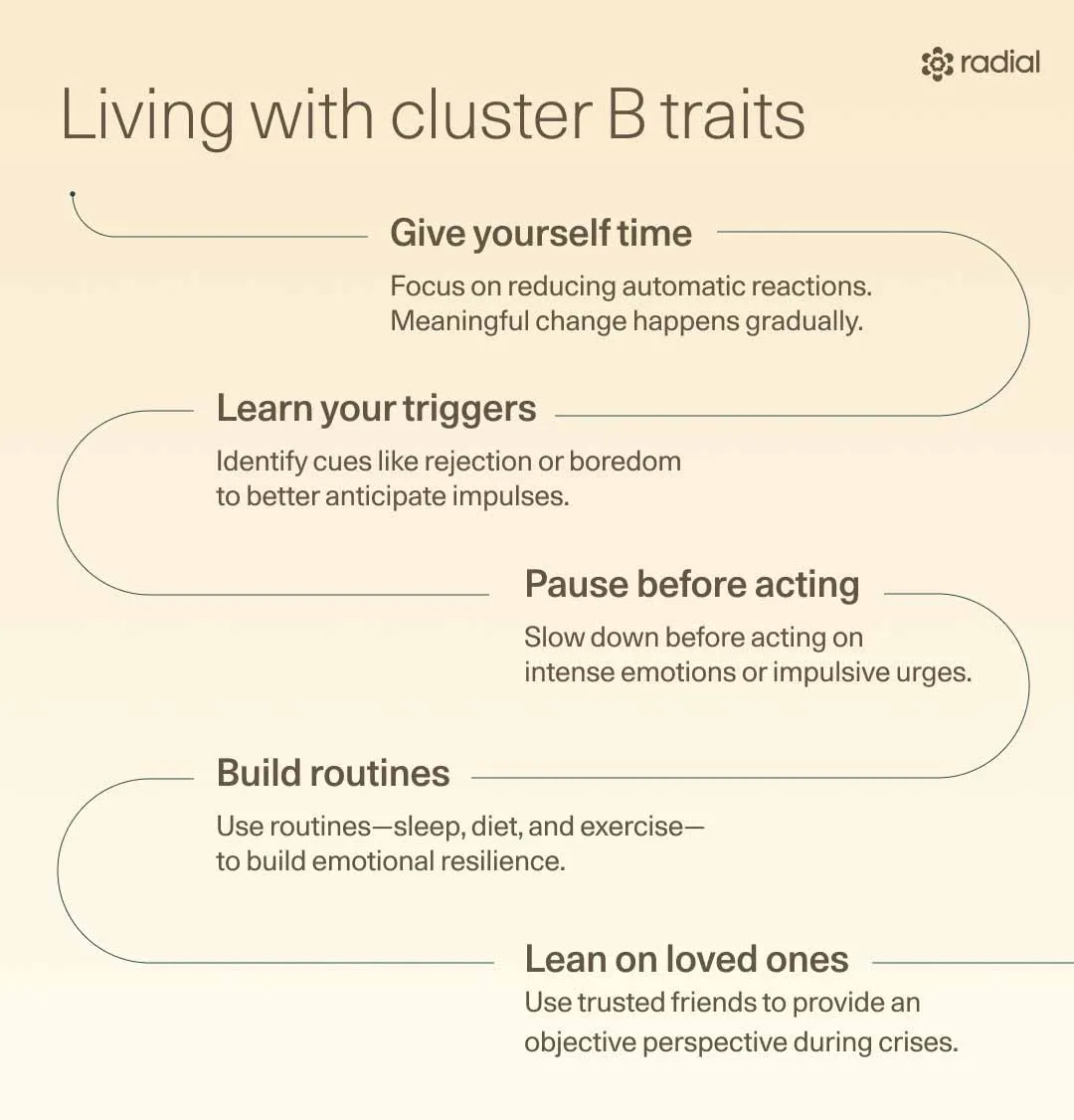
Along with receiving care from a qualified mental health professional, someone with cluster B traits can take small steps to improve their quality of life:
- Give yourself time: “The goal is not to become a different person overnight,” says Dr. Malzberg, “The goal is to become less trapped by automatic reactions.” He adds that it can take significant time to implement and maintain these pattern changes.
- Learn your triggers: Behavior often has an external or internal trigger, such as rejection, boredom, envy, or fear of abandonment. Learning individual triggers can help you more quickly identify and address future triggers.
- Pause before acting: Dr. Malzberg recommends slowing down when making decisions, especially during arguments, when sending a text or online message, or when you’re about to spend money, self-harm, have sex, drink, or use a substance.
- Build routines: Having a routine that lets you get adequate sleep, eat healthy meals, exercise regularly, and creates stability can help you develop a healthier environment for when triggers do arise.
Lean on loved ones: Dr. Malzberg advises having one or two people who can reality-check you when emotions or thoughts become intense and invasive.
Relief within reach
Care covered by your insurance
Radial provides advanced mental health treatment, covered by the insurance you already use.








When to seek help
While you cannot self-diagnose a cluster B personality disorder, you can make an appointment with a psychiatrist if you suspect you have one of these disorders.
Signs it’s time to speak to a mental healthcare provider, such as the team at Radial, include:
- Relationships in your life are repeatedly unstable
- Your emotions or behaviors are difficult to control
- You often feel intense anger or aggression
- Your thoughts or actions exhibit self-harm
- You experience an inability to develop healthy relationships with those around you and yourself

The bottom line
A cluster B diagnosis isn't a life sentence. While personality can feel fixed, working with the right psychiatrist and accessing the right treatments can help someone understand where these patterns come from and build new patterns that better serve them. If you notice traits that might stem from these disorders, the team at Radial can help you find a healthier way of relating to yourself and the world around you.
Key takeaways
- Cluster B personality disorders are marked by intense emotions, impulsive actions, and reactions or behaviors that may be considered extreme or dramatic by others.
- There are four types of personality disorders in this cluster: antisocial, borderline, histrionic, and narcissistic.
- You cannot self-diagnose these disorders. Personality questionnaires or quizzes, often found online or in popular media, are not diagnostic of personality disorders. Instead, a qualified mental health provider must assess symptoms and decide on a diagnosis based on set diagnostic criteria.
- A cluster B personality disorder isn’t a prophecy. It’s a pattern of behavior that can be changed with treatment over time. The team at Radial works with individuals to understand these disorders and access the right treatments.
Frequently asked questions (FAQs)
What are the different types of cluster B personality disorders?
There are four cluster B personality disorders. They are antisocial personality disorder (ASPD), borderline personality disorder (BPD), histrionic personality disorder (HPD), and narcissistic personality disorder (NPD). Each is a distinct condition, though they do share some traits, such as feeling emotions more intensely and acting in a way that may be perceived as dramatic or intense by others.
Can someone have more than one cluster B personality disorder?
Someone can have more than one cluster B personality disorder. Additionally, they may also have other mental health disorders too. Borderline personality disorder (BPD), for example, commonly overlaps with other cluster B personality disorders, mood disorders like bipolar disorder or major depressive disorder, and substance abuse disorders.
Are cluster B disorders dangerous?
Cluster B personality disorders are not inherently dangerous. However, when symptoms are severe and untreated, individuals may be at increased risk for self-harm, impulsivity, and difficulty regulating emotions, which can sometimes impact relationships or safety. With appropriate treatment, many people experience meaningful improvement in emotional regulation, relationships, and overall quality of life.
Editorial Standards
At Radial, we believe better health starts with trusted information. Our mission is to empower readers with accurate, accessible, and compassionate content rooted in evidence-based research and reviewed by qualified medical professionals. We’re committed to ensuring the quality and trustworthiness of our content and editorial process–and providing information that is up-to-date, accurate, and relies on evidence-based research and peer-reviewed journals. Learn more about our editorial process.
Let's connect
Get started with finding the right treatment for you or someone you care about
Get startedExplore more posts