Why Do I Feel Anxious for No Reason?

If you find yourself asking, “why do I feel anxious for no reason?,” you’re not alone. There are many biological and psychological reasons behind unexplained anxiety, as well as effective techniques to reduce it.
If anxiety was an airline, I’d be a frequent flier. Usually my anxious episodes have an obvious trigger (a stressful email, scrolling the news, etc.), but recently, I found myself experiencing symptoms out-of-the-blue. Racing thoughts and neck tension hit everyday around 3pm even when everything was going great. This led me to ask, “why do I feel anxious for no reason?”
For me, it turned out that those random afternoon anxiety dips came from sitting at my desk all day without a break. I replaced my afternoon coffee with a quick walk break and the anxiety for “no reason” subsided.
While the fix seems easy in hindsight, it took a lot of trial and error to find a stress relief technique that worked. To make that experimentation period quicker for you, this article outlines the most common reasons people feel anxious without a clear reason and, more importantly, ways to improve your mental health.
Healing happens through strong relationships
Compassionate, experienced mental health professionals focused on evidence-based care


.webp)

Can anxiety really happen for no reason?
It sometimes feels like anxiety happens for no reason. After all, the stereotypical perception of anxiety is that it occurs due to an immediate stressor, such as your boiler breaking or getting stuck in traffic, and it is possible to experience anxiety without an easy-to-identify trigger. However, the trigger is still there.
To understand why you may be feeling anxious for no reason, we have to do a refresher on the nervous system—I promise it’ll be quick. The nervous system is a series of nerve cells in the body with a lot of different jobs. One of them is to detect and respond to changes, either within the body or in the world around us.
You can think of the nervous system as a giant company with many smaller teams. Two “teams” that play a direct role in detecting and regulating responses to changes are:
- Sympathetic nervous system: Activates when the body enters fight-or-flight mode
- Parasympathetic nervous system: Takes the wheel when the body is in “rest-and-digest”
When a stressor occurs, the sympathetic nervous system takes the wheel. This is actually a good thing in some situations, says MaryEllen Eller, MD, a board-certified psychiatrist and the Southeast Regional Medical Director at Radial, since a healthy amount of anxiety can motivate us to act.
The problem is when the sympathetic nervous system takes on longer hours because anxiety pops up constantly and/or refuses to go away. In these instances, someone may experience random anxiety spikes that don’t have an easy-to-identify cause. Even in these cases, there is probably still a cause. Something is cueing the sympathetic nervous system to work overtime — though the underlying reason may be something you're not yet aware of.
What anxiety can feel like
Anxiety feels different for everyone. For me personally, I experience it differently day-to-day depending on how much I slept, my headspace when I wake up, and other factors.
Anxiety might look like:
- Feeling uneasy
- Racing thoughts
- Tension in the neck
- An upset stomach
- Racing heart
- Mind working in overdrive
- Restlessness
- Feeling empty or fatigued
- Nausea
- All or none of the above (anxiety is a highly personal experience!)
All these feelings are part of the body’s natural threat-detection system (aka the sympathetic nervous system). “When your ancestors encountered a grizzly bear, their threat-detection system fired instantly, preparing them to fight, run, or play dead,” explains Dr. Eller, “That same system is running today, except now it's responding to emails, social media, and a never-ending news cycle. The problem isn't that your alarm system is broken. It's that it can't tell the difference between a grizzly bear and a text message from your boss.”
If that alarm runs 24/7, you may experience ongoing physical and mental symptoms. Chronic anxiety is even linked to a higher risk of heart disease, gut health problems, and possibly even dementia.
Common causes of anxiety that seems to come from nowhere
We’ve established that anxiety out of nowhere will have an underlying cause. Here are some common reasons for unexplained anxiety.
Burnout and accumulated stress
Burnout occurs when we experience ongoing stress to the point of emotional exhaustion and cognitive fatigue. It often starts off with subtle signs, such as feeling more anxious without a direct stressor. Burnout is often linked to stress at work, but it may also stem from certain life circumstances, such as caregiving for an aging parent, or even pouring too much time into a passion project, such as a home renovation or training for a marathon.
Some anxiety disorders
Anxiety disorders are a common form of mental illness. All anxiety disorders lead to persistent anxiety that often gets in the way of everyday life, but the triggers of each can be different. Some even appear without an obvious cause.
Panic disorders, for example, may bring panic attacks without an obvious trigger. Even if triggers are identified in hindsight, panic attacks can still be unexpected in the moment. People with generalized anxiety disorders may also experience anxiety for what may seem like no reason when symptoms flare.
Lifestyle factors
A long slew of lifestyle factors may influence our tolerance of stress and lead to symptoms associated with anxiety.
Habits associated with anxiety include:
- Sleep problems, especially sleep deprivation
- Skipping meals
- Eating sugary foods that cause blood sugar spikes
- Consuming a lot of caffeine
- Regularly consuming more than the recommended amount of alcohol (one drink or less a day for women; two drinks or less a day for men)
- A big lifestyle change, such as having a baby or moving
Medical conditions
“Anxiety isn't always purely psychological,” says Dr. Eller, “Thyroid issues, blood sugar, anemia, heart conditions, and even too much caffeine can produce symptoms that feel like anxiety.”
And that’s before we throw in the fact that people with chronic physical health conditions, such as fibromyalgia and multiple sclerosis, experience anxiety disorders at a higher rate than the general population.
“An anxious mind can create an anxious body, and an anxious body can create an anxious mind,” says Dr. Eller. Both directions are impactful, and both deserve attention.
Sensory overload
At its core, anxiety is a reaction to an internal or external stimuli. When we feel overstimulated, it may trigger the body’s sympathetic nervous system—and thus symptoms associated with anxiety. Someone, for example, could feel overstimulated from being in a crowded place or having an overflowing email inbox.
Some evidence suggests neurodivergent individuals, such as people with autism or ADHD, may experience sensory overload more often than neurotypical people, meaning this might be an especially prevalent cause if you’re neurodivergent.
Trauma
Post-traumatic stress disorder is a mental condition where past trauma leads to feeling anxious in situations the brain perceives as similar. These could be obvious, though sometimes they are less so.
For example, someone with PTSD from witnessing a school shooting in childhood may be excited to go to a concert, but when they arrive, anxiety tags along too. On the surface, a concert and school shooting appear unrelated, but the large crowds and loud noises at the concert may subconsciously trigger their PTSD.
Medications
Some medications may increase the risk of anxiety or cause similar symptoms, such as heart palpitations. These include, but are not limited to, some heart medications, some Parkinson’s medications, and the long-term use of steroids.
How to identify your personal anxiety triggers
It would be nice if there was only one trigger for our anxiety. But if you’re anything like me, your life is riddled with many potential anxiety instigators. If you experience random waves of anxiety, it may be helpful to document patterns around when anxiety occurs.
Even just being able to identify when you’re in an anxious state is a great first step. Awareness of the anxiety is often crucial to managing it.
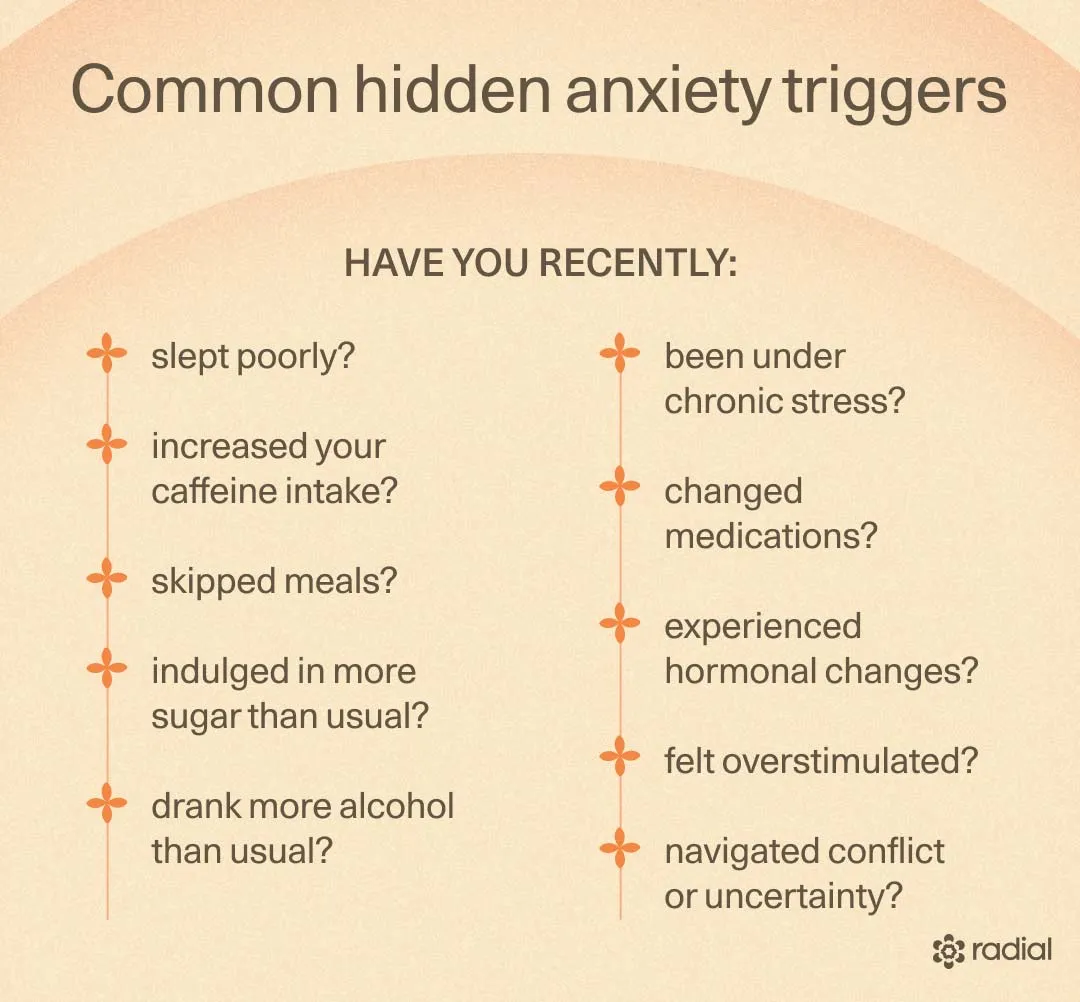
To start, track elements that may contribute to stress or anxiety:
- How long you sleep each night and quality of rest
- Stress levels throughout the day
- Caffeine intake
- Skipped meals or meals high in sugar
- Alcohol intake
- Situations where you feel overstimulated
- Times when your thoughts focus on conflict or uncertainty
- Any physical symptoms or emotional patterns that accompany anxiety bursts
When logging anything related to your anxiety, approach it from a place of curiosity, not self-judgement (easier said than done, I know). “The goal of treatment isn't to eliminate anxiety,” explains Dr. Eller, “It's to turn a system that's working against you back into one that works for you.”
What to do when anxiety hits without warning
It can be easy to doomscroll or turn to a favorite comfort food when anxiety strikes. While these tactics sometimes make us feel better in the moment, they almost always increase anxiety in the long-term. Instead, consider turning to evidence-based techniques, such as the five below.
Breathwork
- What it is: Breathwork is the act of intentionally focusing on your breath. In some studies, it has reduced symptoms of anxiety disorders in as little as five minutes. “Sometimes slowing your exhale is enough to convince your nervous system that the bear is gone,” explains Dr. Eller.
- Best used when: You feel on edge or disconnected from your body
- Time required: Five to ten minutes; this is the ten minute Youtube video I personally use
Exercise
- What it is: Exercise is another go-to that Dr. Eller recommends. This could be an intense run or workout, though even a short walk helps—and it’s sometimes easier to walk for ten minutes during an anxiety spiral.
- Best used when: Your thoughts are racing or you feel jittery
- Time required: Twenty minutes or more
Self-reflection
- What it is: A 2024 study found that participants who self-reflected on their emotions and anxiety triggers had a deeper understanding of their mental health and what strategies helped. This can be done in a physical journal, the notes app on your phone, or even as an audio recording to yourself.
- Best used when: Anxiety lingers in the background, not when it’s completely overwhelming
- Time required: As little as five minutes
Create something by hand
- What it is: Art therapy is a highly effective practice, and you can get some of the same benefits by creating something by hand, such as a bracelet or a favorite meal. In fact, a 2024 study suggests creating by hand makes us more resilient to stress and better able to regulate emotions.
- Best used when: When you’re obsessively ruminating or struggling to regulate emotions
- Time required: Probably over 30 minutes, though this can vary depending on what you’re creating
Hum
- What it is: Perhaps one of the easiest strategies is to hum along to a favorite song. A 2020 study found humming to be as effective as exercise at reducing certain stress and anxiety indicators.
- Best used when: When you need a quick, low-effort technique
- Time required: Less than one minute
When anxiety may need professional help
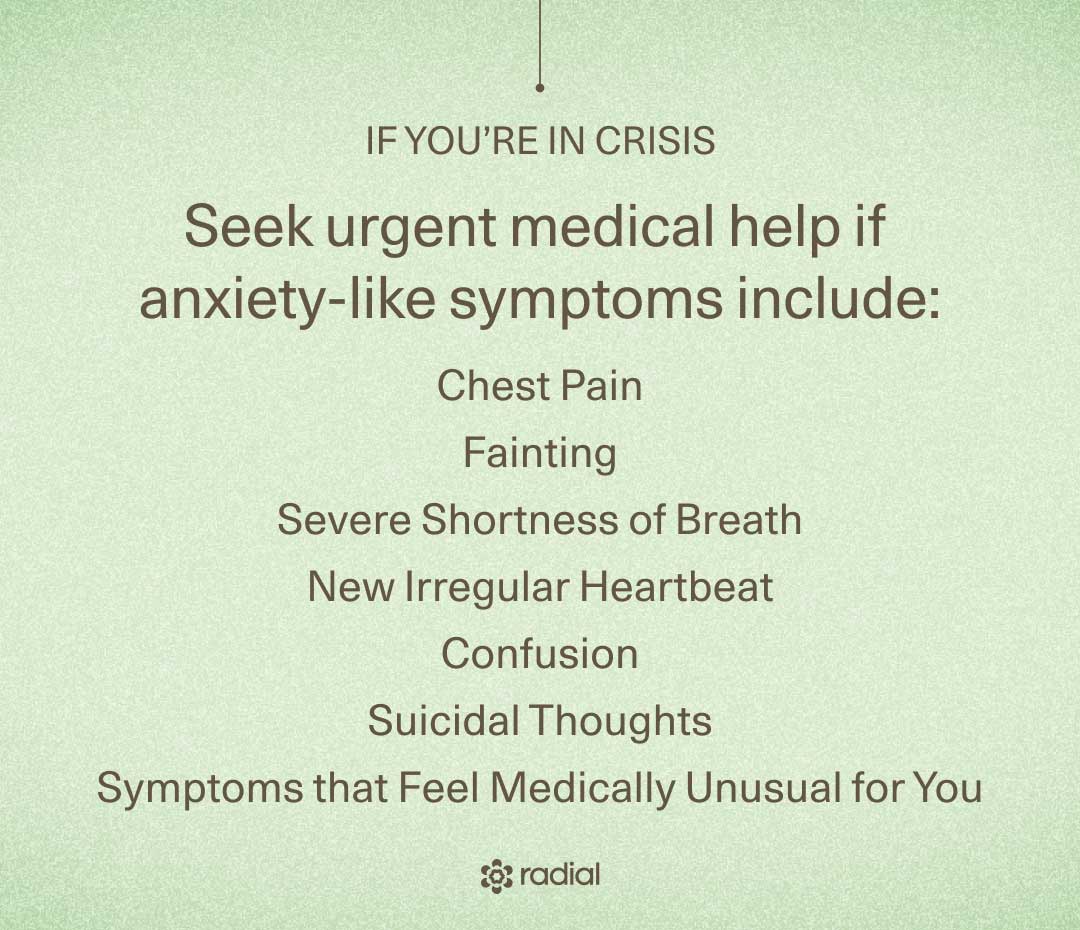
Occasional anxiety is part of the human experience. If anxiety pops up routinely, interferes with everyday life, or is hard to shake, it may be time to see a mental health provider, such as the team at Radial. They can help you find the right lifestyle changes and treatment options to relieve anxiety.
Treatment options for persistent anxiety
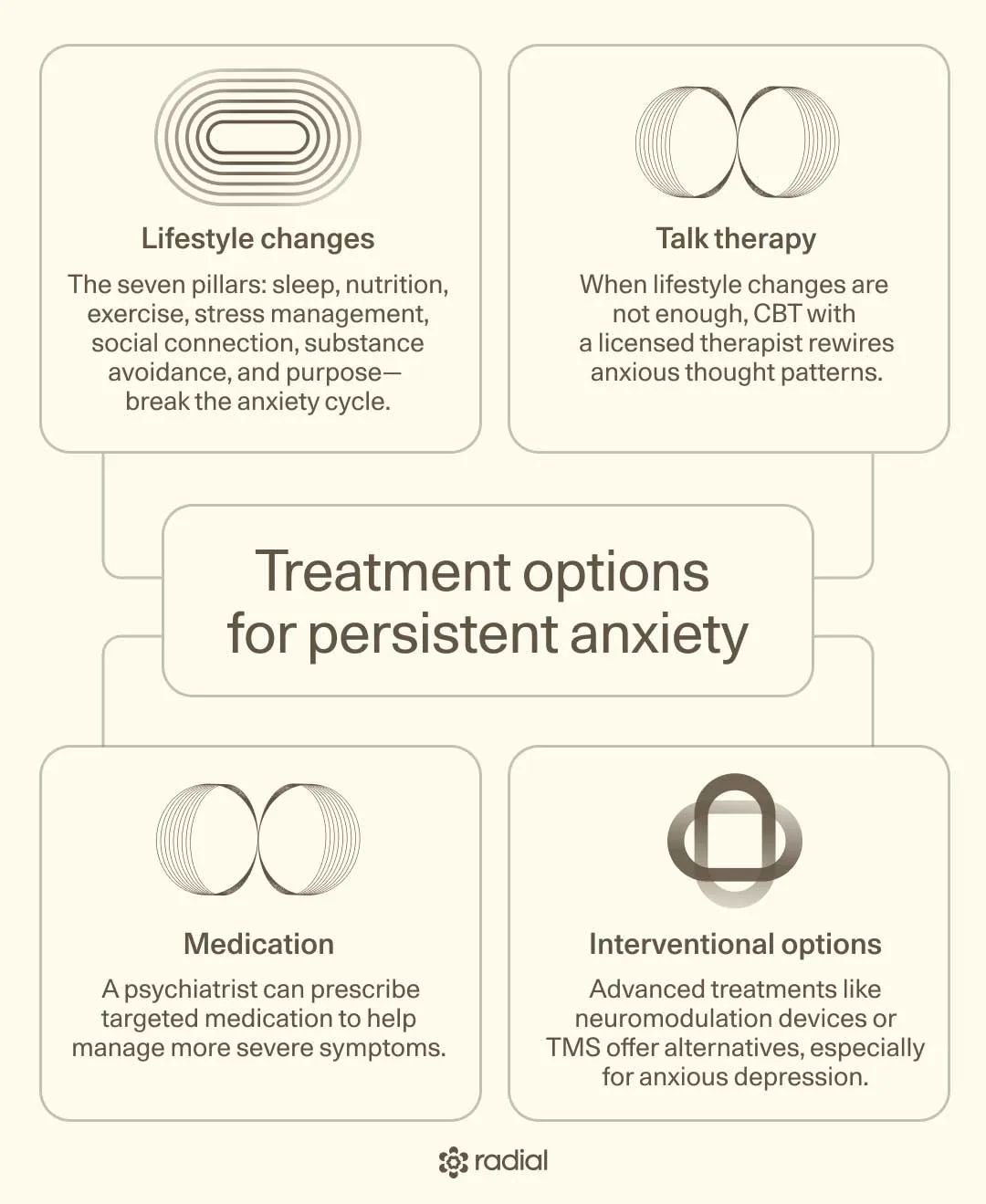
When working with a mental health provider, they’ll most likely ask questions about your anxiety to determine the underlying causes and triggers before making a customized treatment plan.
That plan might include:
- Lifestyle changes: Dr. Eller states the foundation of breaking the anxiety cycle are what she calls the seven lifestyle pillars—sleep, nutrition, exercise, stress management, social connection, substance avoidance, and sense of purpose. She regularly helps her patients experience these pillars more fully.
- Talk therapy: “When lifestyle foundations aren't enough, CBT with a licensed therapist is one of the most effective tools we have,” says Dr. Eller, “It helps rewire the thought patterns that keep pulling the fire alarm.”
- Medication: In some cases, medication may also help. A psychiatrist can help prescribe an appropriate medication.
- Interventional options: Medication and talk therapy are the most common tools for anxiety, but they aren’t the only ones. Options like a wearable neuromodulation device, a vagus nerve stimulator, or transcranial magnetic stimulation (TMS) can help, especially in cases of anxious depression. Working with a mental health clinic that’s at the forefront of interventional treatments, such as Radial, helps you gain access to a broader spectrum of ways to manage anxiety.
The bottom line
Anxiety can sometimes appear random, but there’s usually an underlying reason. Common reasons for unexplained anxiety include lifestyle factors, certain anxiety disorders, medical conditions, and even some medications. Working with a mental health provider, such as the team at Radial, can help you determine the cause and build a treatment plan.
Relief within reach
Care covered by your insurance
Radial provides advanced mental health treatment, covered by the insurance you already use.








Key takeaways
- Anxiety can randomly occur, though there’s usually an underlying reason. Sometimes, it’s ongoing stress at work, an underlying mental health condition, such as a panic disorder, or even a physical health condition, such as an autoimmune disease.
- To determine what’s causing unexplained anxiety, work with a qualified mental health provider who has experience treating anxiety disorders, such as the team at Radial.
- Radial can also recommend techniques that help in the moment and treatment options that help relieve anxiety symptoms in the long-term.
Frequently asked questions (FAQs)
Why do I feel anxious when I wake up?
There are many reasons you may feel anxious as soon as you wake up. Morning anxiety may be a carryover from yesterday’s mental load or the result of tossing and turning all night. Blood sugar spikes from skipping dinner then indulging in a sugary late night snack, an underlying physical or mental health condition, or even checking your phone first thing in the morning could be the culprit too.
Why does my anxiety feel worse at night?
Anxiety may feel worse at night because all the distractions during the day that occupy your brain disappear. This provides ample time and headspace to ruminate or worry. Additionally, some physical health conditions, like sleep apnea or perimenopause, may make it difficult to fall or stay asleep, which can also contribute to anxiety.
Can anxiety be mostly physical?
For some people, anxiety may be mostly physical. Physical symptoms of anxiety include heart palpitations or a faster heart rate, trouble breathing, chest pressure or pain, an upset stomach or changes in digestion, and tense muscles, among others.
Editorial Standards
At Radial, we believe better health starts with trusted information. Our mission is to empower readers with accurate, accessible, and compassionate content rooted in evidence-based research and reviewed by qualified medical professionals. We’re committed to ensuring the quality and trustworthiness of our content and editorial process–and providing information that is up-to-date, accurate, and relies on evidence-based research and peer-reviewed journals. Learn more about our editorial process.
Let's connect
Get started with finding the right treatment for you or someone you care about
Get startedExplore more posts