Spravato Reviews: What Patients are Saying About Esketamine Treatment

Spravato can be a fast-acting, effective treatment option for depression, but online reviews on this treatment are mixed. Here’s how to make sense of online Spravato reviews, and what to know if you’re considering esketamine treatment.
Spravato (the brand name for esketamine in nasal spray form) is a FDA-approved medication for treatment resistant depression and major depressive disorder (MDD) with acute suicidal thoughts or actions. It acts faster than many commonly used medications for depression, providing much needed relief in a shorter timeframe, but it doesn’t work for everyone. The treatment’s pros and cons are very apparent in online reviews.
If you read positive Spravato reviews online, the drug sounds like a fast-acting miracle—and for some people, it truly does help their depression. Hannah Jose, a beauty content creator, is one of the many Spravato success stories.
“I have so many moments where I think to myself ‘wow I’m not depressed,’” she recounts, “It’s still such a shock to me because depression was my default mode. I have such a brighter outlook about the future with Spravato.” Yet she also admits that the treatment days aren’t easy, since a trip to the clinic lasts hours each time the medication is administered.
For Hannah, the drawbacks are worth the investment, though some online reviewers share a different story. They claim Spravato doesn’t work or they’re unable to tolerate Spravato's side effects and time-consuming logistics. With such polarizing reviews, any hesitancy to try this treatment is totally understandable. This guide covers why public reviews are so mixed and how to read esketamine reviews in a way that actually helps you decide if Spravato is for you.
Connect with our Clinicians



What public online Spravato reviews consistently report
For many of us, any search for honest reviews starts on Reddit. To better understand what people consistently say online about the Spravato experience, I read popular Spravato Reddit threads as well as other online review boards. Here’s the TL;DR without getting sucked into hours of scrolling Reddit.
Common positive themes
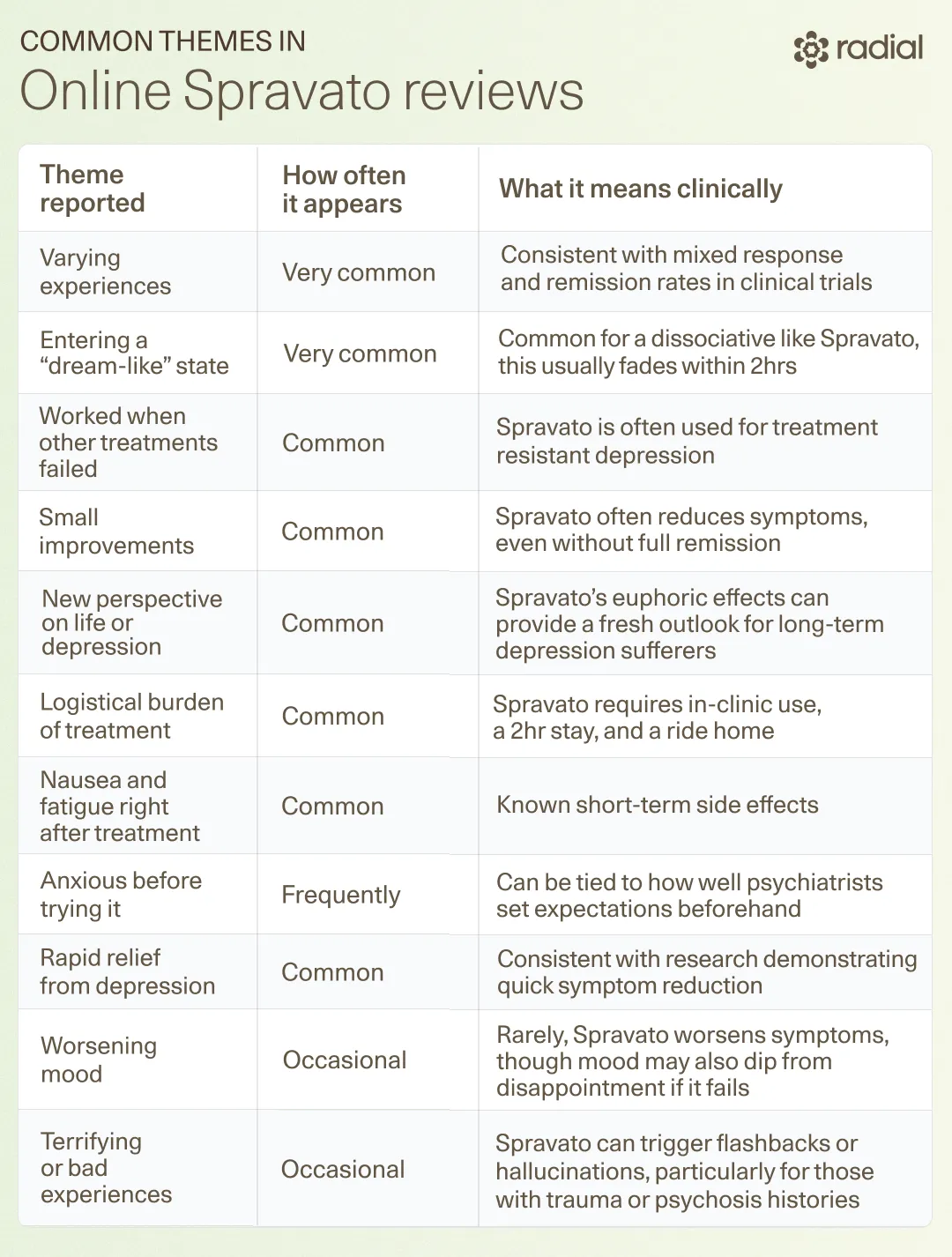
Themes across positive experiences of Spravato include:
- New perspective: “Ever since my first Spravato session (I am coming up on number 12 now) I have been experiencing these incredible journeys,” writes one Reddit user. They describe how these journeys have allowed them to reevaluate their relationship with their parents and others, leading to a deep sense of peace and better mental health overall.
- Rapid relief from symptoms: For some, changes come rapidly. Others take the medication for longer before experiencing results. One reviewer writes on Drug.com, “Every month I see a gradual improvement. The biggest improvement my first six months was the cessation of suicidal ideation. The last six months, not only has my general sadness gone away, but I can now bounce back when things are rough.”
- Positive experiences: “I feel good, most of the time now,” one Reddit user reflects, “The constant dread and sorrow and mind-numbing melancholy that had its claws in me for most of my life just wasn’t inside anymore.”
- Worked when other treatments failed: Spravato is especially useful for treatment resistant depression. “My depression score went from severe depression to mild mood disturbance,” writes one reviewer on Drug.com, “I haven’t felt normal in six years. Tried dozens of meds, and nothing. I know everyone responds differently, but for me it’s been life-changing."
- Small improvements: Spravato isn’t a cure but part of a treatment plan. One Reddit user celebrates their small improvements on the drug. “I wouldn't say my success with Spravato has been overnight,” they write, “But everyday, I am able to see small wins that make me feel like the depression is getting lighter.”
Commonly reported side effects
For some online reviewers, Spravato was disorienting or ineffective. Commonly reported side effects and bad experiences include:
- Anxiety before trying Spravato: “As a person who worries constantly, I'm worried to try,” writes one Reddit user considering Spravato. Since Spravato is a dissociative agent, many people report anxiety about the treatment before their first dose.
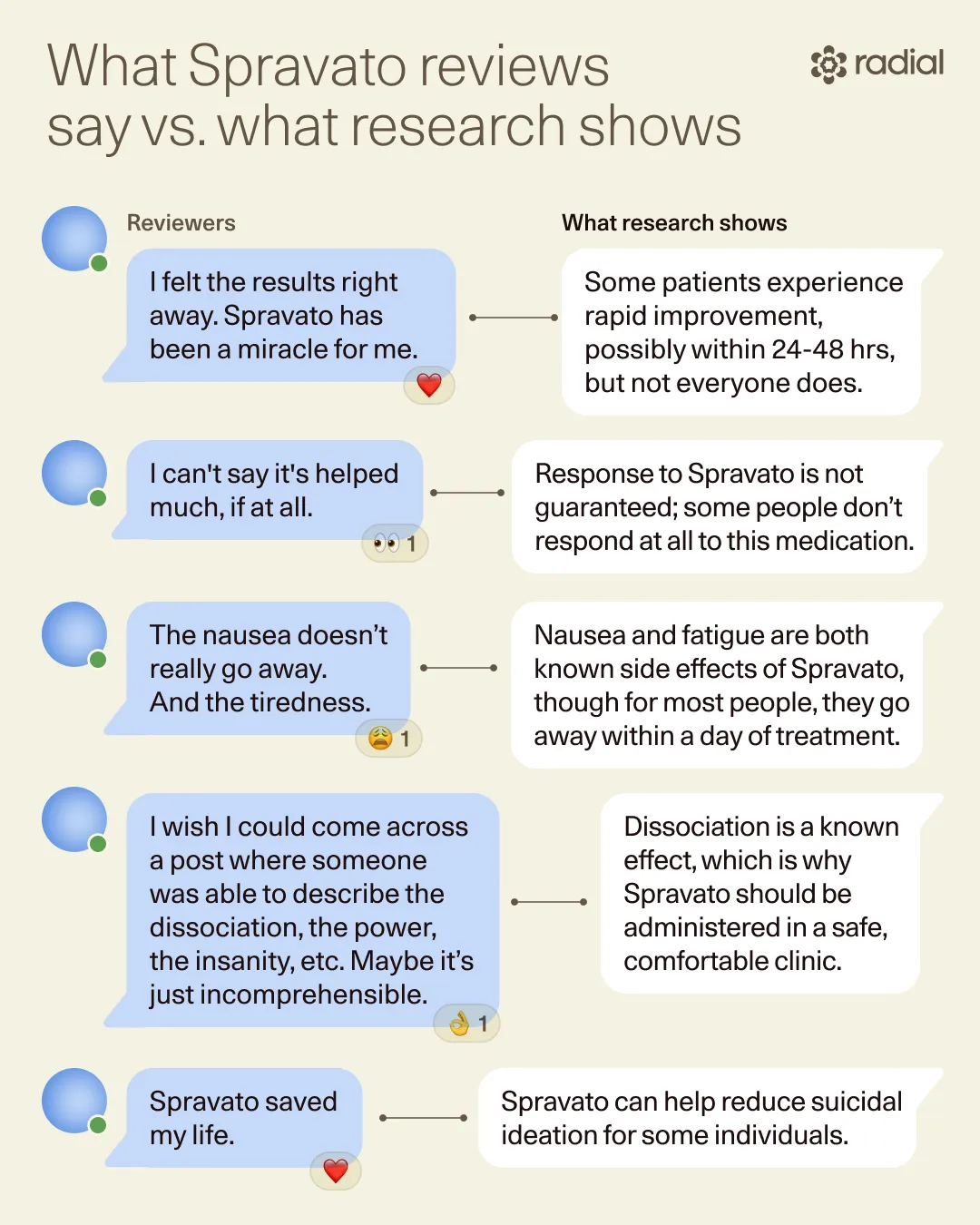
- Nausea: “The side effects were just awful,” writes one Drug.com user, “Felt extremely drunk—dissociation, severe nausea and sweating, dizziness, tiredness.” Still, other users comment that they were warned about the nausea but did not experience it or were able to take medications like Zofran to manage it.
- Fatigue: Some people feel extremely tired after treatment. “I have to take the day after and just crash,” says one Reddit user, “Usually, the next day, I'm better.”
- Worsening mood: “I had a treatment two days ago. The day of and the next day, I couldn’t stop crying,” writes one Reddit user, “I felt like I couldn’t handle the pain anymore and I was scared of my thoughts.” It’s worth noting this is a possible but rare outcome. Another Reddit user responded to this post, saying they sometimes feel sad the day after treatment but are better overall as the week progresses.
- Bad overall experience: While some people have amazing experiences on Spravato, some find the opposite to be true. “It feels like I am just a collection of random scary thoughts and this is what existence really is,” says one Reddit user, “There is a feeling of despair and hopelessness.”
It’s also worth pointing out that Spravato can be logistically tricky. It requires someone to spend two hours at the clinic for each treatment, to coordinate transportation since you can’t drive after taking Spravato, and to budget for the medication, especially if you’re not using insurance to pay.
One Reddit user even reported switching jobs because they couldn’t get the time off work for treatments. “I’m currently getting a new job where I work four days a week instead of five,” they write, “My current job was okay for the first two months but now that I’m continuing with my maintenance phase they can’t accommodate (which I get). It’s frustrating to have to balance a much-needed treatment with a job.”
When Spravato doesn’t work
There are a few medical conditions that could cause a psychiatrist to hesitate before prescribing Spravato:
- A history of PTSD: People with posttraumatic stress disorder (PTSD) can have frightening flashbacks when on Spravato. This isn’t necessarily a reason to not try this treatment, since Spravato has helped with PTSD in some clinical trials. It is a reason clinicians may pause and make sure a patient has the right support systems in place, such as access to talk therapy, before prescribing esketamine.
- High blood pressure: Spravato can lead to a temporary elevation in blood pressure. For many people, these aren’t a cause for concern, though they can affect those who already have high blood pressure. “Your blood pressure has to be well controlled before you are a good medical candidate for Spravato,” says MaryEllen Eller, MD, southeast regional medical director at Radial.
- A history of hallucinations: People who experience auditory or visual hallucinations are more likely to have a negative experience on Spravato because the medication might trigger hallucinations. “If somebody comes to us wanting Spravato, and they have a history of hallucinations, we're going to be very cautious,” explains Dr. Eller, “because Spravato may not be the right choice for them.”
Even when someone doesn’t have these conditions, the medication might just not work. “I stopped the medication after the fifth session as the medication didn't work at all (ZERO benefit),” wrote one reviewer on Drugs.com.
Why are Spravato reviews so polarized?
“Spravato is awesome because it works quickly,” says Dr. Eller, “The downside is it doesn't work for everybody, and it's got about a 50/50 chance of working incredibly well or not doing much of anything.”
This is part of the reason reviews are so polarized. If a medication helps treat a condition that has robbed you of enjoying life for months or years, you will probably sing it praises. Meanwhile, if you have high expectations and it does nothing, it’s understandable to feel disappointed and frustrated.
Spravato reviews are also varied because esketamine is a dissociative agent. Someone may temporarily feel disconnected from their body, thoughts, and/or emotions, a sensation we might describe as “feeling high.”
“Some people have a very unpleasant experience with that sensation of losing some control,” says Dr. Eller, “And that can be control over what they're thinking about. It can even be some control over what their body is feeling.” In clinical trials, about 25-31% of people experienced disassociation, though it resolved within two hours.
Dr. Eller mentions that if someone experiences dissociation, the setting matters a lot. A clinic that isn’t calm and safe can lead to a more negative experience. “At Radial, our goal is to make sure that you're as comfortable as possible,” says Dr. Eller, “You are in a safe environment where things are being monitored so whatever thoughts or experiences you may have, part of your brain will always know that you're safe.”
The third reason simply has to do with the internet. Most of us are probably aware that the online world amplifies extremes, meaning crazy good or nightmarishly horrible experiences gain more traction, and we’re more likely to see them in our feeds.
For a more comprehensive take on what to expect from Spravato treatment, check out our comprehensive guide.
How online reviews compare to clinical research
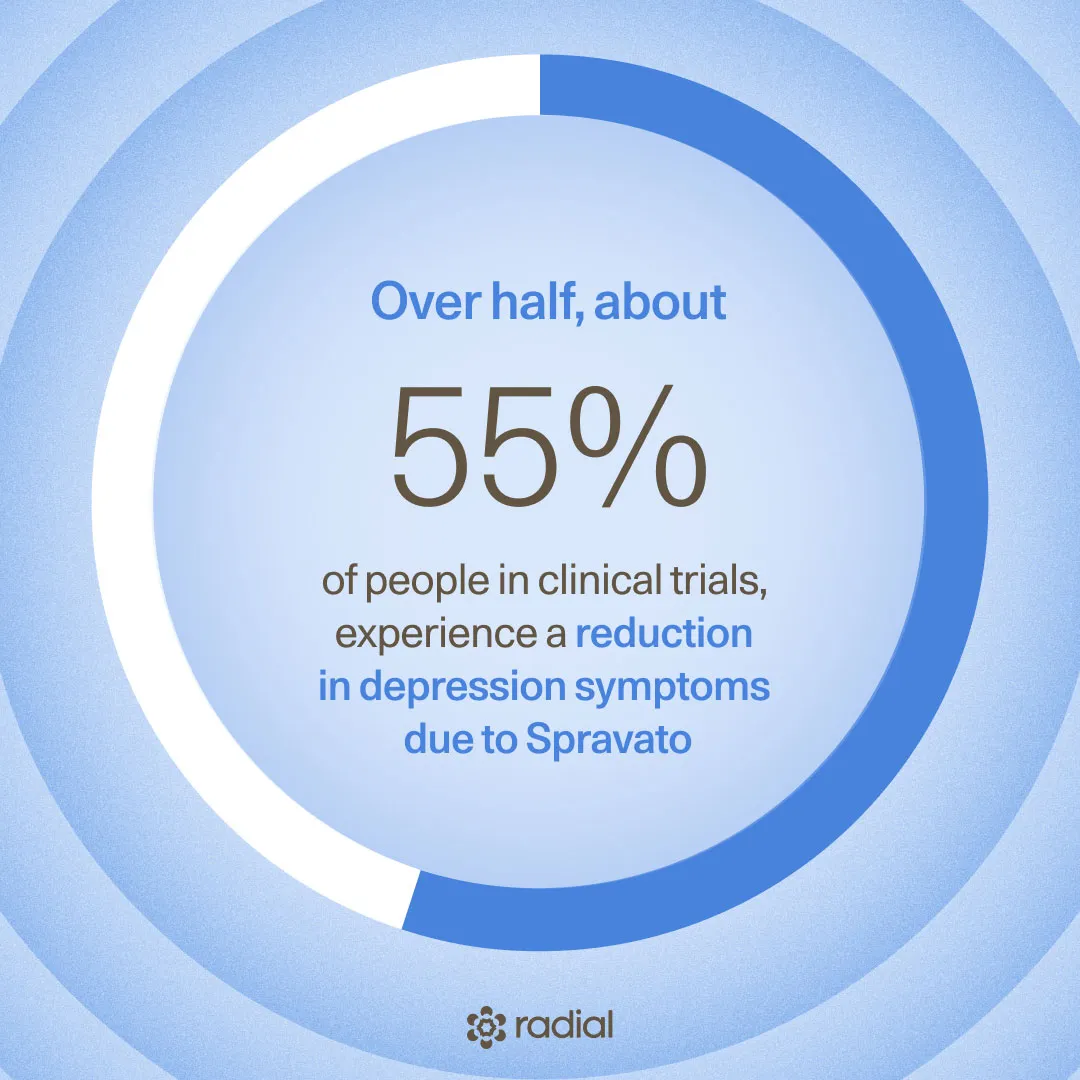
There’s a lot of value in online reviews, but it’s still important to see how Spravato treatment reviews stack up to findings from clinical trials. At a high level, about 27.1% of MDD cases go into remission with esketamine and 55.4% of people experience a reduction in symptoms. The second stat reflects the roughly 50/50 split of positive and negative reviews online.
For a better idea of the research behind esketamine, let’s get into the nitty gritty of what the research suggests about common claims from online reviews.
From hesitant to a new outlook on life
Dr. Eller has witnessed many amazing recovery journeys thanks to Spravato. One that comes to mind for her is Evelyn, a woman who had a history of trauma, depression, and anxiety. In her first Spravato session, Evelyn was nervous. “You could tell she was visibly scared and didn't really know what to anticipate,” says Dr. Eller, “And her very first treatment was fairly benign. Nothing impressive happened.” About an hour into the 120 minutes in the clinic, Evelyn wondered if Spravato would do anything at all.
In her second appointment, she experienced dissociation, describing how she felt as “woozy and loose.” Luckily, that effect wore off before the end of her 2-hour session. “All the things that we can control for can be exactly the same and still, someone's experience can be really different from one treatment to the next,” explains Dr. Eller, “That's part of where it's important to have a positive, trusting relationship with the team that you're going to get care from.”
Despite her sessions being two very different experiences, Evelyn felt lighter and less depressed after both. She continued to come back, and Spravato has since played a key role in her mental health journey.
Similarly, another Radial patient reflects, “I’ve been on Spravato almost a year. I’m a completely different person than I was when I started. I cope better, I decide easier, and I think differently.”
When Spravato works for one condition, but not another
Lucia was in her 50s with a MDD diagnosis, anxiety, and a history of trauma when she started working with Dr. Eller. After a few appointments, Lucia felt that her MDD was the biggest issue, and Dr. Eller prescribed Spravato to help.
“Her depression got better around treatments six to eight,” says Dr. Eller, “She was feeling quite a bit better, but what she noticed was that as the depression lifted, she started feeling more anxious, and it became apparent that the PTSD symptoms were actually a lot more severe than we had initially anticipated.”
The emergence of the PTSD symptoms made Lucia feel trapped. After the initial Spravato treatment, Dr. Eller recommended Prism neurofeedback therapy, which is where someone wears a cap that reads their brainwave activity and displays it on a screen. The individual can then use that information in real time to train their brain to respond differently. For Lucia, Prism neurofeedback therapy did an excellent job addressing both the depression and PTSD.
Pivoting from Spravato to another treatment
Todd, a man around 60 with a long history of depression and anxiety, had been on various medications for two years. None lead to meaningful change, so he decided to try Spravato. After his first eight treatment sessions, he didn’t feel like this medication provided enough benefits to be worth the disassociation he experienced.
“As his story evolved and Spravato wasn't as successful for him as we had hoped it could be, he ended up doing a course of TMS,” recounts Dr. Eller. Transcranial magnetic stimulation (TMS) is a depression treatment that uses magnetic impulses from a TMS machine to rewire and regulate brain activity.
Now, Todd is doing incredibly well. “For people who have tried Spravato and didn't get the desired response, the good news is that it's not the only option,” says Dr. Eller, “Oftentimes, there are other things that we can do. And for that guy, when Spravato wasn't the right answer, TMS ended up being right for him.”
Relief within reach
Care covered by your insurance
Radial provides advanced mental health treatment, covered by the insurance you already use.








How to read Spravato reviews more clearly
As you continue researching Spravato, here are some tips to better interpret online reviews:
- Take reviews with a grain of salt: On platforms like Reddit, the most provocative statements are often the top results. “The absolutely most dramatic and worst experience you could possibly imagine is going to be the one that gets the most traction on those kinds of sites,” says Dr. Eller, “So read these with a grain of salt.”
- Setting matters too: For Spravato, the environment you're in can have a huge impact on the experience. When reading reviews, remember that they all happened in different clinics, some of which may be warm and caring while others may not have the same safe, comfortable setting.
- Many elements set the stage: Along with the environment, elements like how thorough your psychiatric evaluation was before treatment, how well a clinic sets expectations before a session, and what type of talk therapy or other treatments you do alongside Spravato impact the experience.
The bottom line
Based on the online reviews and Radial patient stories, Spravato produces mixed results. For some, this medication changes their life. Others don’t experience the same. To better understand if this is the right treatment for you, consult a psychiatrist at Radial— we can help you figure out your next steps.
Key takeaways
- Spravato can be a fast-acting, transformational depression treatment. For some, Spravato is the treatment that finally lets them escape the depressive fog and achieve the quality of life they deserve.
- For others, Spravato does not lead to a reduction in symptoms. Some online reviewers even recount negative experiences, often due to dissociation or feeling like they’ve lost control during the session.
- Someone’s experience on Spravato is highly dictated by how comfortable they feel in the clinic where the medication is administered and the expectations set by the psychiatrist ahead of a session. That’s why it’s important to work with a clinic that regularly administers Spravato as part of treatment, such as Radial.
Frequently asked questions (FAQs)
What is the success rate of Spravato?
Over half of people (about 55.4% of people in clinical trials) experience a reduction in depression symptoms due to Spravato. That means there’s about a 50/50 chance that Spravato will help, and a psychiatrist familiar with this treatment, such as the team at Radial, can help determine if this is the right treatment for you.
Are Spravato reviews generally positive or negative?
Generally speaking, half of the reviews of Spravato are positive, the other half negative. When reading others’ experiences, keep in mind that provocative or dramatic reviews, whether positive or negative, are likely to come up first. For a better idea of how Spravato actually works, dig deeper into the reviews.
How will I feel on Spravato?
Everyone feels differently during their two hour treatment with Spravato. Some describe it as a calming experience while others feel frightened by the loss of control that might come with this dissociative medication. One person can even have different experiences from session to session. This variability is why it’s important to get Spravato from a clinic that you trust and one that actively builds a safe, comfortable treatment setting, such as Radial.
Editorial Standards
At Radial, we believe better health starts with trusted information. Our mission is to empower readers with accurate, accessible, and compassionate content rooted in evidence-based research and reviewed by qualified medical professionals. We’re committed to ensuring the quality and trustworthiness of our content and editorial process–and providing information that is up-to-date, accurate, and relies on evidence-based research and peer-reviewed journals. Learn more about our editorial process.
Let's connect
Get started with finding the right treatment for you or someone you care about
Get startedExplore more posts