
Relationship OCD (ROCD): How to Tell OCD Doubt From a Real Relationship Problem

Key takeaways
- Relationship OCD (ROCD) involves obsessions and compulsions that are focused on close relationships.
- Ordinary relationship doubts tend to ease or pass with time and reflection, but ROCD involves recurring doubts and reassurance-seeking that cause distress and interfere with daily life.
- OCD-focused treatment can help you respond differently to uncertainty, and partners can also show support without reinforcing the OCD cycle.
Do you ever wonder whether you love your partner, whether they really love you, or whether the relationship feels right? Doubts can creep into even the closest relationships, but relationship OCD can turn them into a distressing cycle that seems to never end.
“When these thoughts feel unwanted, intrusive, persistent, and distressing, and drive you to perform repetitive rituals, or begin to impact your daily or executive functioning, this may signal that relationship obsessive-compulsive disorder, or ROCD, is present,” says Ava Meyer, PMHNP-BC, MSN, APRN, a Psychiatric Nurse Practitioner at Radial.
In this article, we’ll explore what relationship OCD is, what it can look like, how it differs from ordinary relationship anxieties, and the kind of support and treatment that can help.
Connect with our Clinicians



What is relationship OCD?
Relationship OCD (ROCD) is a presentation of obsessive-compulsive disorder where obsessions and compulsions are focused on an intimate relationship, usually romantic in nature. It’s not a separate diagnosis, but a presentation of OCD that affects how symptoms and behaviors manifest
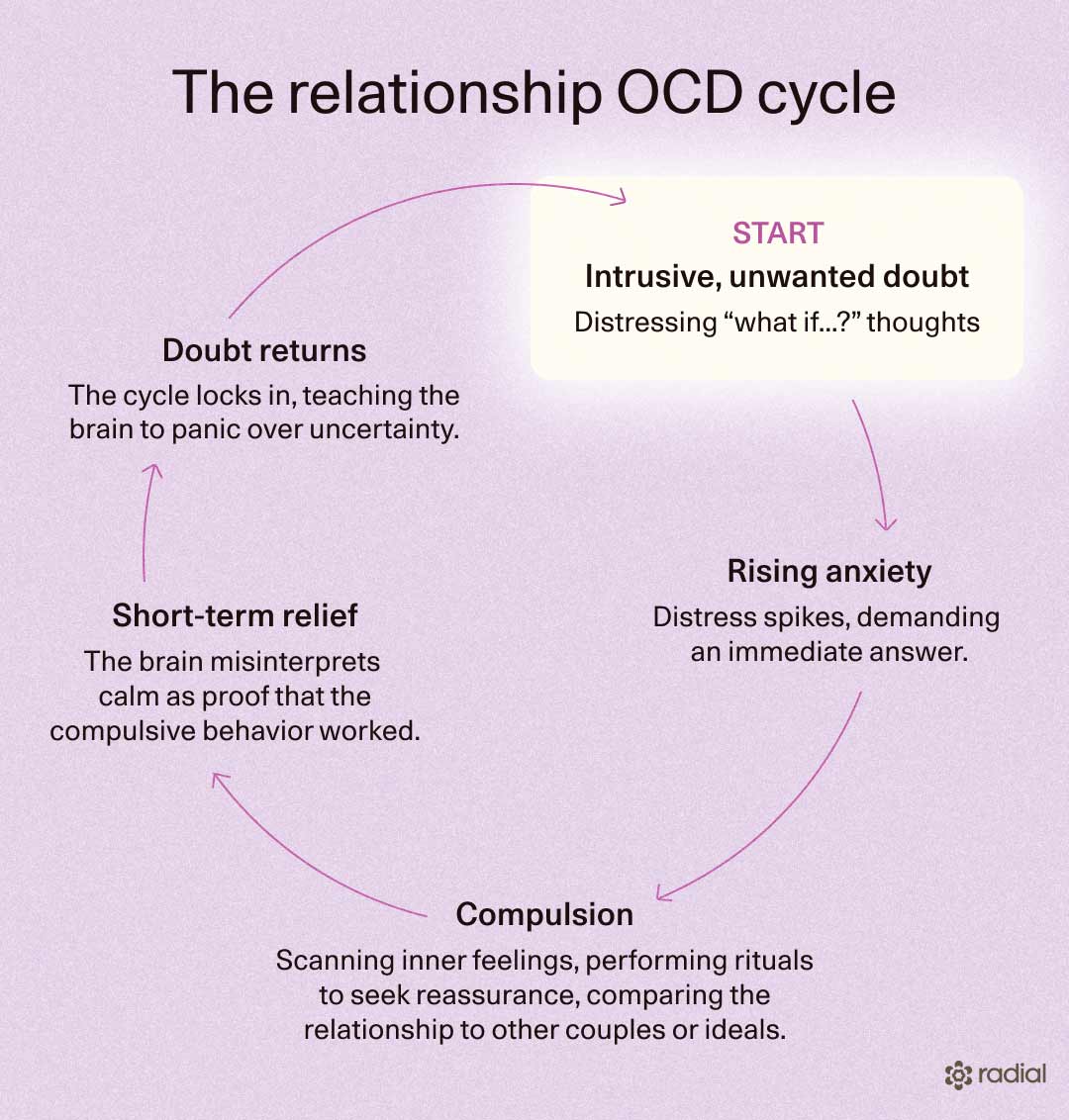
ROCD follows the same cycle as other types of OCD. Intrusive thoughts about your partner or relationship trigger anxiety, and a person may respond with a compulsion like asking their partner for reassurance. “Reassurance can function as a checking ritual that maintains or strengthens the ROCD,” says Ava Meyer.
The National Institute of Mental Health (NIMH) says compulsions can bring temporary relief, but the doubt returns and the cycle starts again.
ROCD can present in two common ways, according to research in Frontiers in Psychiatry. People can experience both, or sometimes shift back and forth between them.
- Relationship-centered: Doubts are centered on a person’s own feelings, their partner’s feelings, or whether the relationship feels “right.”
- Partner-focused: Concerns about a partner’s perceived flaws, including aspects of their appearance, personality, behaviors, or past relationships.
Relationship OCD symptoms often center on a current partner, but they can also focus on exes or friends. The Journal of Obsessive-Compulsive and Related Disorders notes that parents and children can also be the focus.
What does relationship OCD look like?
Relationship OCD causes recurring, distressing doubts about your own or your partner’s feelings, and you may look for reassurance so you can feel more certain. Doubt alone doesn’t mean you have ROCD, but knowing what it can look like can help you tell normal relationship concerns from ROCD-related worries.
Common obsessions
These doubts take many forms. Examples of relationship OCD obsessions include getting stuck on thoughts like “Do I really love them?” or “Is this the right relationship for me?” Or you might fixate on what you see as your partner’s flaws or whether the relationship meets your expectations. NIMH explains that this can show up as thoughts, images, urges, or questions that leave you distressed or guilty.
Anxiety can also make it harder to feel connected to your emotions. This emotional numbness can make love and attraction feel muted, creating another source of doubt.
Common compulsions
Compulsions, whether mental or behavioral, are ways to ease uncertainty and anxiety about the relationship. According to the Journal of Marital and Family Therapy, this might involve:
- Checking for signs of love or attraction to see how your partner actually feels
- Seeking reassurance from your partner, friends, or family members to confirm that the relationship is okay
- Comparing your partner or the relationship to a past relationship, another couple, or an idealized version of the perfect relationship
- Researching online, taking quizzes, or reviewing relationship advice
These behaviors may provide short-term relief, but research in Frontiers in Psychology explains that the doubts and questions eventually return. Over time, they create a cycle that teaches you every worry is urgent and needs to be solved immediately, which fuels the cycle further.
Relationship anxiety vs. relationship OCD
Relationship anxiety and relationship OCD (ROCD) can look similar because both may involve persistent worries, fear, insecurity, and uncertainty about a romantic relationship. However, the underlying patterns and the ways individuals respond to these thoughts are often different.
Relationship anxiety refers to worries, insecurities, and doubts that arise within romantic relationships. These concerns may center around commitment, emotional connection, compatibility, trust, fear of rejection, or uncertainty about a partner's feelings.
Anxiety can occur at any stage of a relationship, from early dating to long-term partnership. It may stem from life circumstances, communication patterns, past relationship experiences, unmet emotional needs, or individual insecurities.
People experiencing relationship anxiety may seek reassurance, avoid difficult conversations, or struggle with uncertainty about their relationship. However, these behaviors do not automatically indicate OCD.
Relationship OCD involves a more specific pattern of obsessions and compulsions centered on romantic relationships. Individuals may experience intrusive, unwanted doubts about whether they love their partner, whether their partner is right for them, whether they feel attracted enough, or whether the relationship is truly fulfilling.
These thoughts can trigger compulsions intended to reduce anxiety or achieve certainty. Compulsions may include repeatedly analyzing feelings, mentally reviewing interactions, comparing a partner to others, checking attraction, researching relationship compatibility, or seeking reassurance from friends and family.
For example, someone might notice another person they find attractive. While finding someone else attractive is a normal human experience, an individual with ROCD may interpret that moment as evidence that they do not truly love their partner or that they are in the wrong relationship.
This may trigger repetitive questions such as:
- Do I really love my partner if I find someone else attractive?
- Does this mean I'm not attracted to my partner?
- Would I be happier with someone else?
- What if I'm settling for this relationship?
- Does this mean my relationship isn't right for me?
They may then begin mentally comparing the other person to their partner, reviewing their feelings, checking their level of attraction, or asking friends for reassurance.
Although these behaviors may temporarily reduce anxiety, the doubt often returns, creating a repetitive obsession-compulsion cycle.
The key distinction between relationship anxiety and relationship OCD is not whether someone experiences relationship doubts or seeks reassurance. It is the pattern, frequency, intensity, and function of the thoughts and behaviors.
Can someone experience both relationship anxiety and relationship OCD?
Yes. Relationship anxiety and ROCD are not mutually exclusive. They can overlap, and someone can experience both at the same time.
For example, an individual may have concerns about their partner's communication or emotional availability. Those concerns may warrant an honest conversation and appropriate boundaries. However, the individual may also begin repeatedly reviewing conversations, questioning whether they interpreted something correctly, seeking reassurance from others, or mentally analyzing whether the relationship is right.
In these situations, treatment should address both the actual relationship concerns and the compulsive responses that maintain the OCD cycle. When someone with OCD engages in compulsive 'neutralizing' behaviors to calm obsessive thoughts, they're reinforcing the OCD cycle, believing that the feared outcome didn't come true because they engaged in the compulsive behavior. OCD treatment helps retrain your brain to show that distress can be tolerated without resorting to rituals, compulsions, or avoidance.
A thorough clinical assessment is needed to distinguish OCD from anxiety. Your provider will consider your experiences, compulsive responses, distress, and functional impairment before making a diagnosis. It's important not to self-diagnose, or dismiss legitimate relationship concerns as OCD. Having ROCD does not mean every concern is an obsession, just as experiencing relationship anxiety does not automatically mean someone has OCD.
A note on safety
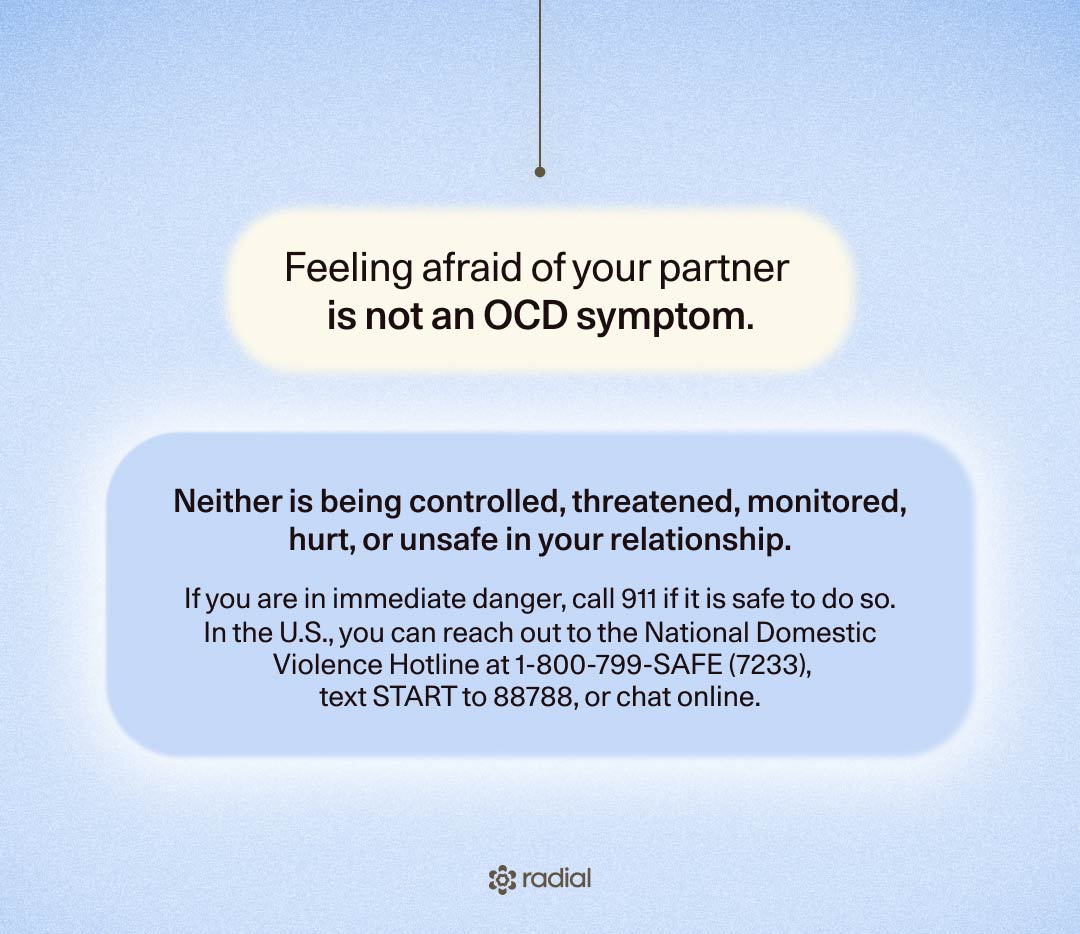
Feeling afraid of your partner is not an OCD symptom. Neither is being controlled, threatened, monitored, hurt, or unsafe in your relationship. If you are in immediate danger, call 911 if it is safe to do so. In the United States, you can reach out to the National Domestic Violence Hotline at 1-800-799-SAFE (7233), text START to 88788, or chat online.
What causes relationship OCD?
Relationship OCD doesn’t have a single known cause, but the Journal of Obsessive-Compulsive and Related Disorders suggests vulnerability to OCD and holding certain beliefs and concerns about relationships can play a role. NIMH suggests that the general risk factors for OCD include brain chemistry, genetics, life experiences, and temperament, but there isn’t a single thing that determines whether a person will develop it.
Another article in the same journal notes that perfectionism and strongly held beliefs about love and relationships can also contribute. For example, someone who believes that love should feel perfect and completely certain may think that any doubt means they are in the wrong relationship.
Major life changes, like moving in together, getting engaged, or deciding to have children, can also stir up doubt. OCD symptoms can also emerge or worsen during pregnancy and the postpartum period, according to Current Psychiatry Reports. However, perinatal or postpartum OCD usually focuses on worries about the baby’s safety, which isn’t necessarily related to ROCD.
How can partners help?
It’s hard to see someone you love in distress, and the urge to step in and offer reassurance is natural. “Our automatic response in the moment may be to provide reassurance, but this may only provide transient relief and could reinforce the compulsive loop, causing doubts to return quickly and often escalate,” Meyer says.
That’s why it’s important to respond with care without feeding the OCD cycle.
- Learn about OCD: Understanding the cycle of obsessions and compulsions can help you respond with more compassion and less frustration.
- Don’t take it personally: Intrusive thoughts can be upsetting and unwanted, so remember that they don’t automatically reflect on your relationship.
- Set limits on reassurance: Support matters, but constant reassurance can fuel more doubt. “Naming the behavior therapeutically when your partner asks for reassurance and responding with support is a great first step,” Meyer says.
- Encourage specialized OCD treatment: Offer to help them find a clinician who specializes in treating OCD.
- Take care of yourself: Protect time for your own needs and your own support system. Seek guidance if the OCD cycle is starting to affect your own well-being.
Could couples therapy help?
It can, with the right therapist. Working with someone who is knowledgeable about OCD is important: they can educate the partner and help them understand their partner's symptom presentation better. Most people think OCD is focused on cleanliness or perfectionism; they don't necessarily understand the different subtypes of OCD or how it can present in the context of a relationship.
“Couples counseling can help when one partner has ROCD, especially if it incorporates OCD-focused techniques like CBT and Exposure and Response Prevention (ERP),” Meyer explains. “It can help reduce reassurance-seeking, improve communication, and build healthier relationship patterns while managing ROCD symptoms.”
Remember that partners don’t cause ROCD, and they can’t solve it. They can offer support, but the person with OCD is the one who needs to seek treatment and manage their symptoms.
How is relationship OCD treated?
Relationship OCD is treated much like other forms of OCD, often using ERP-based psychotherapy and sometimes medication, while daily habits can also help support overall symptom management and well-being.
A clinician who has experience treating OCD can recommend strategies to help reduce compulsions and find ways to respond differently to feelings of doubt and uncertainty.
“An assessment from a clinician can provide helpful insight and guide next steps if this is something you experience,” Meyer says.
A clinician will look at your symptoms and how they affect your life. They may use tools like the Yale-Brown Obsessive Compulsive Scale (Y-BOCS) to measure severity and track changes over time, although the scale can’t diagnose OCD on its own.
The goal of relationship OCD treatment is to help you tolerate uncertainty about your relationship, not to make you feel 100% certain. Learning to sit with uncertainty makes it easier to make decisions based on your actual experience in the relationship without the false urgency OCD creates. It's also important to recognize that OCD treatment targets compulsive responses and intolerance of uncertainty, not legitimate relationship concerns that may trigger the OCD cycle.
Common treatments for OCD include:
- Exposure and response prevention (ERP): ERP is a well-established form of psychotherapy for OCD, according to the Journal of Clinical Psychology. This approach involves gradually tolerating uncertainty while resisting compulsions such as checking or seeking reassurance.
- Acceptance and commitment therapy (ACT): A type of therapy that helps people accept difficult thoughts and act in ways that are aligned with their values. According to the Journal of Obsessive-Compulsive and Related Disorders, ACT can help with OCD, but it’s not as well-established as ERP.
- Medication: Antidepressants may be prescribed to help people with OCD manage mood or anxiety symptoms, according to Current Neuropharmacology.
- When symptoms persist: If first-line treatments don’t help enough, a clinician may suggest other options, like transcranial magnetic stimulation (TMS). TMS can help some people with OCD who haven’t responded to other approaches. If you’re interested in TMS for OCD, you can connect with Radial's care team to understand whether it might be right for your needs.
Most of the evidence comes from studies of OCD in general, so more research is needed to better understand exactly how these treatments might help with ROCD specifically.
Relief within reach
Care covered by your insurance
Radial provides advanced mental health treatment, covered by the insurance you already use.


The bottom line
ROCD can make every doubt feel urgent, making it harder to decide what matters in your relationship. If the same doubts keep coming back, talking to an OCD-informed therapist can help you recognize these patterns and understand what deserves your attention.
If you’re supporting someone with ROCD, Meyer offers this advice: “Acknowledging their distress and encouraging them to utilize their skills to manage the uncertainty instead of providing an answer that directly gives the reassurance has been found to be the most helpful approach,” she says.
Frequently asked questions (FAQs)
Will ROCD ever go away?
ROCD symptoms can improve with OCD-focused treatment, such as ERP. Symptoms can also come and go over time, so treatment focuses on helping people learn to manage the obsession-compulsion cycle. That way, if doubts return, you have the skills to respond without turning to compulsions.
Can relationship OCD cause cheating behavior?
ROCD can involve fears about infidelity or compulsive attempts to test a partner’s feelings, but that doesn’t mean that it leads to cheating. A small study of 50 couples in the Journal of Obsessive-Compulsive and Related Disorders found that people who were told that their partner had high ROCD symptoms were more likely to rate themselves and their partner as susceptible to infidelity, especially if they had ROCD symptoms themselves. However, the study measured beliefs about infidelity and didn’t look at actual cheating.
Should I tell my partner I have relationship OCD?
You don’t need to share before you’re ready, but telling a trusted partner may help them better understand what you are feeling and how they can support you. You can start by describing some of the patterns you tend to experience and what tends to help, but you don’t need to share every intrusive thought that you experience.
Editorial Standards
At Radial, we believe better health starts with trusted information. Our mission is to empower readers with accurate, accessible, and compassionate content rooted in evidence-based research and reviewed by qualified medical professionals. We’re committed to ensuring the quality and trustworthiness of our content and editorial process–and providing information that is up-to-date, accurate, and relies on evidence-based research and peer-reviewed journals. Learn more about our editorial process.
Let's connect
Get started with finding the right treatment for you or someone you care about
Get startedExplore more posts


