
Do You Need TMS Maintenance? What to Know About Booster Sessions

Key takeaways
- TMS maintenance involves getting periodic treatment after your initial course. Maintenance sessions can help preserve TMS’ benefits and reduce the risk of relapse.
- Tapering, scheduled maintenance, boosters, and retreatment aren’t the same thing. Your clinician can help determine which approach makes sense and when.
- Not everyone needs TMS maintenance. Your treatment history, relapse risk, response to TMS, preferences, and practical circumstances all factor into the decision.
- If symptoms start coming back, a booster or retreatment may help. Changes in sleep, energy, mood, interest, or daily functioning can be early clues that it’s time to check in with your care team.
- Needing more treatment doesn’t mean TMS failed. Depression can be recurrent, and people who benefited from TMS may respond to retreatment if symptoms return.
If you’re considering TMS treatment, TMS maintenance is part of the long-term picture you'll want to consider. Or maybe you’ve finished treatment, feel better, and are wondering, How long will this last? The honest answer is: it depends.
Some people never need maintenance while others benefit from tapering, booster sessions, or retreatment. These approaches aren’t the same thing, and we’ll break down what each one means (and when it may be used).
Whatever your treatment path looks like, needing additional sessions doesn’t mean TMS failed — it reflects the reality that depression can be a recurring condition. This guide explains what maintenance involves, who may need it, how schedules are tailored, what early warning signs to watch for, and how to plan for cost, coverage, and ongoing care.
What is TMS maintenance?
TMS maintenance involves additional treatment sessions scheduled after your initial course to help preserve your progress and reduce the risk of relapse. The benefits of TMS may last, but other times depression can return. Some people need TMS maintenance treatment while others don’t.
There’s no standard maintenance strategy for TMS, and clinics may use terms like tapering, scheduled maintenance, and boosters differently. Before committing to a plan, ask your provider what approach they recommend, why it makes sense for you, and how often you’ll need maintenance sessions going forward.
Tapering
Tapering means gradually decreasing the number of sessions at the end of an acute course of TMS. For example, you might go from daily sessions to a few times a week, then weekly, per research in the Journal of Personalized Medicine.
At Radial, “many patients start with a gradual taper rather than a hard stop,” says Seth Resnick MD, DFAPA, FASAM, Radial’s New York Regional Medical Director. This gives the brain time to adjust. “The goal is to protect a new remission and give it the best chance of becoming a lasting recovery,” Dr. Resnick adds.
Scheduled maintenance
Scheduled maintenance means undergoing TMS at regular intervals after the initial course — often weekly to monthly — with the goal of preventing another depressive episode.
One option is cluster maintenance: “Cluster maintenance groups several sessions into a short, intensive block instead of spreading single sessions out over time,” says Dr. Resnick. A typical approach involves several sessions over one to three days, repeated about monthly.
“The rationale is that a concentrated dose may reinforce treatment effects more strongly than an occasional single session,” explains Dr. Resnick. “It can also be easier to fit into a busy life: a few days a month rather than a weekly appointment.”
Booster sessions
TMS booster sessions are given in short blocks when early symptoms return, ideally before a full relapse develops, says Dr. Resnicks. But the term TMS booster session can also describe regularly scheduled intensive blocks, similar to cluster maintenance, which adds to the terminology confusion, he says.
TMS retreatment
TMS retreatment means starting a full, new course of TMS when depressive symptoms return — whether that’s a relapse after TMS or a recurrence. A relapse is when the same symptoms return before full recovery. A recurrence is when a new episode develops after a longer period of sustained wellness — typically four to six months, says Dr. Resnick.
Does everyone need TMS maintenance?
Not everyone needs maintenance TMS – your clinician will weigh several factors, starting with your treatment history, to help decide if it’s right for you.
According to Dr. Resnick, history is the single most important factor: “Clinicians look at how many depressive episodes a patient has had, how severe they were, and how quickly they came back after earlier treatments worked. Someone with several prior episodes (or with a relapse soon after a previous TMS course) has a stronger case for planned maintenance than someone treated for a first episode.”
Per Dr. Resnick, clinicians also consider:
- How you responded to TMS and how long the benefits lasted
- Other treatments, such as medication and psychotherapy
- Your preferences and ability to recognize early warning signs
- Practical issues like travel, work, and availability for ongoing sessions
- Insurance, which often provides limited or no coverage for maintenance TMS
Considering these factors together can help you and your clinician decide whether maintenance makes sense — and, if it does, whether scheduled sessions or a more flexible, as-needed approach is the better fit. Both strategies have potential benefits and trade-offs:
Scheduled maintenance provides structure and regular check-ins. “Starting scheduled maintenance right away offers structure and peace of mind. Sessions happen whether or not symptoms appear, and frequent visits give clinicians more chances to catch subtle changes,” says Dr. Resnick. The downside is the ongoing time and cost of treatment.
As-needed boosters mean fewer appointments and lower costs while letting you see how durable your response is. “The trade-off is that it depends on catching early signs, and some patients find the uncertainty stressful,” says Dr. Resnick.
What does a TMS maintenance schedule look like?
The right TMS maintenance schedule depends on the individual. “Maintenance schedules vary and should be individualized based on the patient's clinical course, history of relapse, and overall treatment plan,” says Dr. Resnick.
A typical plan might include a taper followed by weekly or monthly sessions, or periodic cluster blocks. But TMS maintenance is still an active area of research, so there’s no set standard, says Dr. Resnick.
Your initial TMS protocol typically shapes the maintenance plan. So, your maintenance schedule may differ depending on whether you initially received standard TMS or an accelerated TMS protocol. “Maintenance often builds on whatever worked during that first course,” says Dr. Resnick.
Clinicians also consider when symptoms have returned in the past, monitor your response, and adjust the schedule over time, says Dr. Resnick. And practicalities like travel, work, and cost matter, too.
What is a TMS maintenance session like?
“A maintenance session is essentially the same as a session during the initial course,” says Dr. Resnick.
Here’s what to expect, according to Dr. Resnick:
- You’ll sit in a comfortable chair while the coil delivers magnetic pulses to the same treatment area.
- You’ll be awake — no anesthesia or sedation needed.
- Sessions can take anywhere from 3-40 minutes, depending on the protocol.
- Your clinician may recheck your motor threshold, especially if it’s been a while or your medications have changed.
- If you experienced scalp discomfort in your first course, it may be less bothersome.
- Visits may include a quick symptom check or rating scale to track your progress.
- You can typically drive home and get back to your usual activities right away.
To learn more about the TMS experience, see our guide about what a TMS session may feel like.

How do you know if you might need a booster session?
If depressive symptoms start returning, a booster may help. “Depression rarely returns overnight,” says Dr. Resnick. “It usually shows up first as small changes, and patients and families often notice them before the person feels depressed.”
Watch for:
- Sleep changes, low energy, or trouble concentrating
- Losing interest in things you usually enjoy
- More irritability or tearfulness
- Withdrawing from people
- Everyday tasks feeling harder
Tracking your mood and checking in with your provider can help spot patterns. “A gradual rise in scores on regular self-rating scales, such as the PHQ-9, can also flag a change before it feels obvious,” says Dr. Resnick.
“One bad day” isn’t necessarily a warning sign, says Dr. Resnick. “The key is a sustained pattern lasting more than a few days.” Contact your care team promptly if symptoms persist; seek immediate help for thoughts of self-harm.
“Acting early often means a short booster can restore stability, rather than a full retreatment course,” says Dr. Resnick.

If symptoms come back, will TMS work again?
Yes – if TMS helped the first time around, retreatment may provide relief if symptoms return. “Patients who responded once often respond again,” says Dr. Resnick.
In one study, 79% of people with treatment-resistant depression who relapsed after acute TMS were in remission after 20 weeks of maintenance treatment, per research in the Journal of Personalized Medicine.
“Needing maintenance doesn't mean TMS failed,” says Dr. Resnick. Depression is often chronic and recurrent – lifetime relapse risk is estimated at about 60% after a first episode and up to 90% after multiple episodes, according to research in the same journal.
In other words, a relapse or recurrence isn’t a personal failure or proof that TMS didn’t work.
How to plan for TMS maintenance
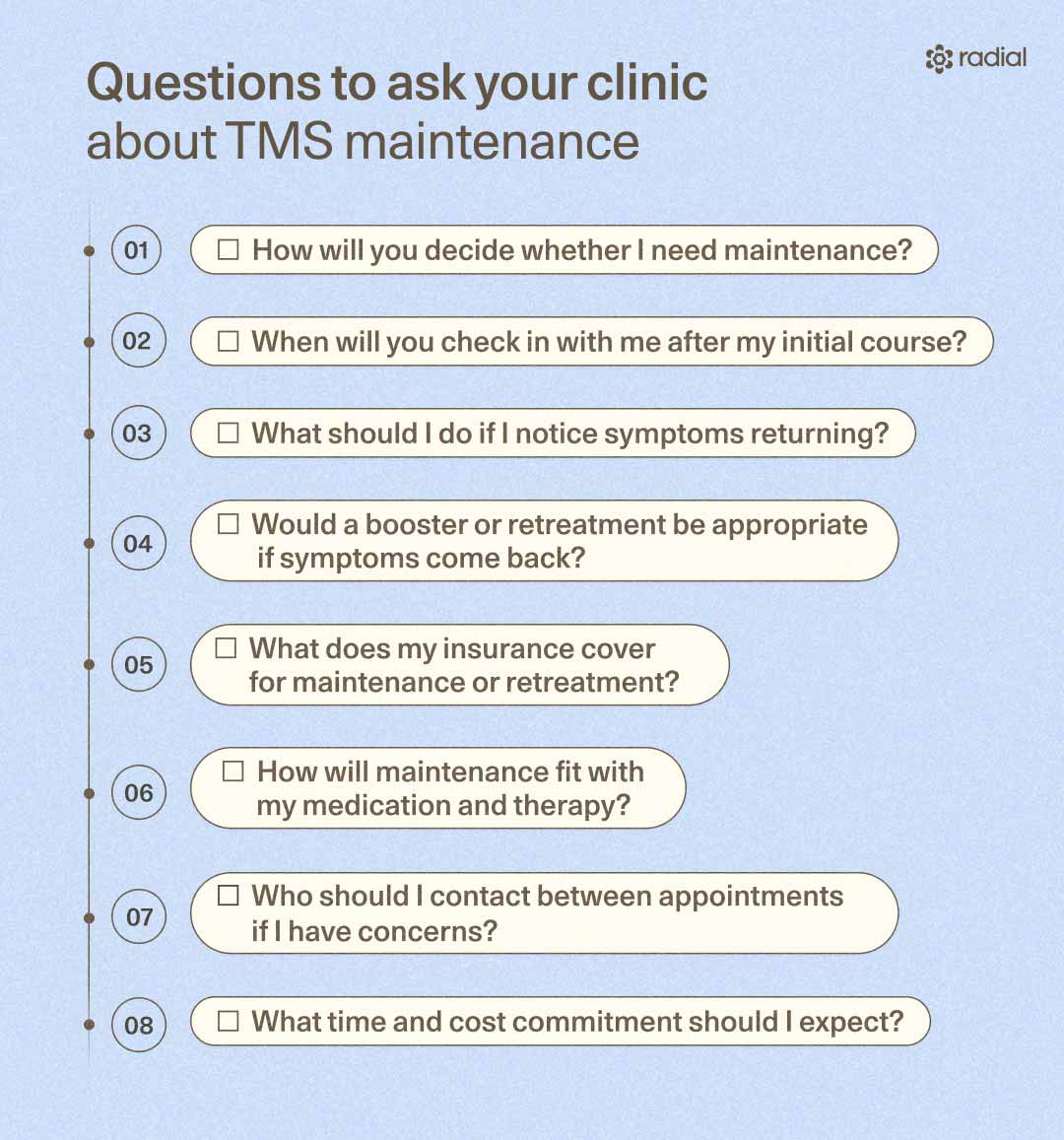
The best time to discuss TMS maintenance is before your initial course ends. “Depression often recurs, and planning for long-term wellness is part of treating it well,” says Dr. Resnick.
A few things to think about:
- Cost and coverage: TMS for depression is often covered by insurance, but maintenance often isn’t covered, says Dr. Resnick. Check your benefits early so you know what to expect.
- Medication and therapy: Maintenance works alongside ongoing care rather than replacing it. “Treat TMS as one part of a broader plan that also includes medication, therapy, sleep, and connection,” says Dr. Resnick.
- Practical logistics: Maintenance means an ongoing time commitment, including treatment sessions, travel, and check-ins.
At Radial, TMS maintenance is tailored to each patient. Dr. Resnick monitors symptoms with rating scales and regular check-ins, starting many patients with a gradual taper. If symptoms return, a booster or retreatment may be recommended, followed by a maintenance schedule based on the patient’s history.
Relief within reach
Care covered by your insurance
Radial provides advanced mental health treatment, covered by the insurance you already use.


The bottom line
Some people never need maintenance after TMS while others use it as a way to help preserve their gains and reduce the risk of symptoms returning. If you’re considering TMS maintenance, Radial makes it easy to connect virtually or in person with a licensed clinician who can help you explore whether it’s right for you.
Frequently asked questions (FAQs)
Do you have to do TMS forever?
After TMS, there’s no way to know for sure if or when you’ll need treatment again. Some people maintain benefits after one course while others need boosters or retreatment. If symptoms return, another TMS course may help — especially if TMS worked well the first time.
Is maintenance TMS covered by insurance?
Because maintenance protocols are still being studied, many insurers often don’t cover them, says Dr. Resnick. However, they may cover retreatment after relapse if you meet their criteria, which vary by plan (for example, see Aetna’s requirements).
If you have to pay out of pocket for maintenance, ask your provider for a personalized estimate of TMS cost.
Can I stop taking my antidepressant after TMS?
After a strong TMS response, some patients may consider tapering antidepressants once symptoms are stable. But never stop medication on your own — ask your treatment team whether tapering your medication is appropriate.
Editorial Standards
At Radial, we believe better health starts with trusted information. Our mission is to empower readers with accurate, accessible, and compassionate content rooted in evidence-based research and reviewed by qualified medical professionals. We’re committed to ensuring the quality and trustworthiness of our content and editorial process–and providing information that is up-to-date, accurate, and relies on evidence-based research and peer-reviewed journals. Learn more about our editorial process.
Let's connect
Get started with finding the right treatment for you or someone you care about
Get startedExplore more posts


